

What Happens If Your Dubai Developer Goes Bust: RERA Protections Explained
What happens if your Dubai developer goes bust in 2026: RERA protections, escrow rules, and what buyers recover.
An off-plan purchase can be considered among the most psychologically taxing deals for a buyer. One commits to pay hundreds of thousands or millions of dirhams for a project which does not yet exist over the course of 2 to 4 years. The developer keeps the money in any form. Work starts (or doesn't start) in an untouchable speed by the purchaser. The actual flat that the purchaser will eventually get might be different from the picture in the brochure. And underlying all of this is the question that off-plan buyers have probably pondered in the dead of night at least once – what if the developer runs out of money before completing the work? Where will the buyer's money go then?
In reality, the truth is far more positive than what off-plan critics claim but not as positive as what developers advertise. Dubai's off-plan buying regulations are quite comprehensive for a city that is relatively young. The Regulatory Agency of Real Estate (RERA), the supervisory agency of the Dubai Land Department, has devised a number of buyer protections over the last eighteen years that have been improved considerably after the real estate crisis of 2008–2009 showed some weaknesses in the previous system. Escrow, project registration and dispute resolution work for the vast majority of buyers of properly registered projects. But these systems do not work magically. There is something that the buyer needs to do in both cases.
The 2008–2009 crisis serves as the historical background to the current regulatory system. Several developers went bankrupt during this period, leaving many projects unfinished. Quite a lot of buyers lost a considerable amount of money as a result. What followed was a new regulatory system, consisting of the escrow law, project registration requirements and special tribunals dealing with the issues caused by those developer bankruptcies. Knight Frank mentions this period repeatedly as the turning point in its market commentary. The system has indeed improved over the eighteen years since then. But improvement does not mean perfection. One has to know what is covered and what is not.
This article details what happens if a developer in Dubai goes bankrupt in 2026. It covers the RERA system and the buyer protections that it provides. How escrow protects the buyer and the rules around it. The process of cancelling and getting a refund if a project does not come through. In addition to original research into the issue of buyer protection under various recent developer distresses, it includes insights from experienced UAE property lawyers.
The RERA Framework and the Escrow Account Law
The cornerstone of Dubai off-plan buyer protection is the Escrow Account Law (Law No. 8 of 2007), which requires every developer selling off-plan property to deposit buyer payments into a designated escrow account at a bank approved by the Dubai Land Department. The escrow account is administered by an independent escrow agent (typically a UAE bank). The developer cannot withdraw funds freely. Withdrawals are tied to construction milestones verified by independent engineering consultants who certify that the milestone has actually been reached.
The mechanism matters. Before 2007, developers could collect buyer money and use it for any purpose, including paying for unrelated projects, distributing to shareholders, or simply mismanaging it. The escrow law cut off that pathway. Buyer money goes into a ring-fenced account. The developer cannot touch it without milestone certification. If the developer fails before the milestones are met, the money in the escrow account is still there.
HE Sultan Butti bin Mejren, Director General of the Dubai Land Department, has made the point in public commentary that the escrow framework is the single most important reform Dubai has made in the off-plan space. The framework's effectiveness depends on every off-plan project being properly registered with DLD and using a properly designated escrow account. Buyers can verify both through the Dubai REST app and the DLD project lookup tools.
Other key elements of the RERA framework include:
Project registration. Every off-plan project must be registered with DLD before any unit can be sold. The registration involves the developer providing the land title, the master plan, the construction permits, the escrow account designation, and the financial structure. Selling unregistered off-plan property is illegal and not recoverable through the standard buyer protection channels.
Initial sale registration (Oqood). When a buyer purchases an off-plan unit, the unit is registered in the buyer's name on the Oqood system, which is effectively a pre-title-deed registration of the buyer's interest. This protects the buyer's ownership claim even before the final title deed is issued.
Project monitoring. RERA tracks construction progress on every registered project. The Dubai REST app makes the completion percentage publicly visible to anyone, including the buyer. Significant slippage triggers RERA review.
Cancellation procedures. Under Law No. 19 of 2017 and related decrees, RERA has clear authority to cancel projects that fail to meet completion benchmarks, with associated processes for refunding buyers from the escrow account.
What Happens When a Dubai Developer Actually Fails
The progression of a typical developer failure follows a recognisable pattern. Understanding the pattern helps buyers know what to expect and when to act.
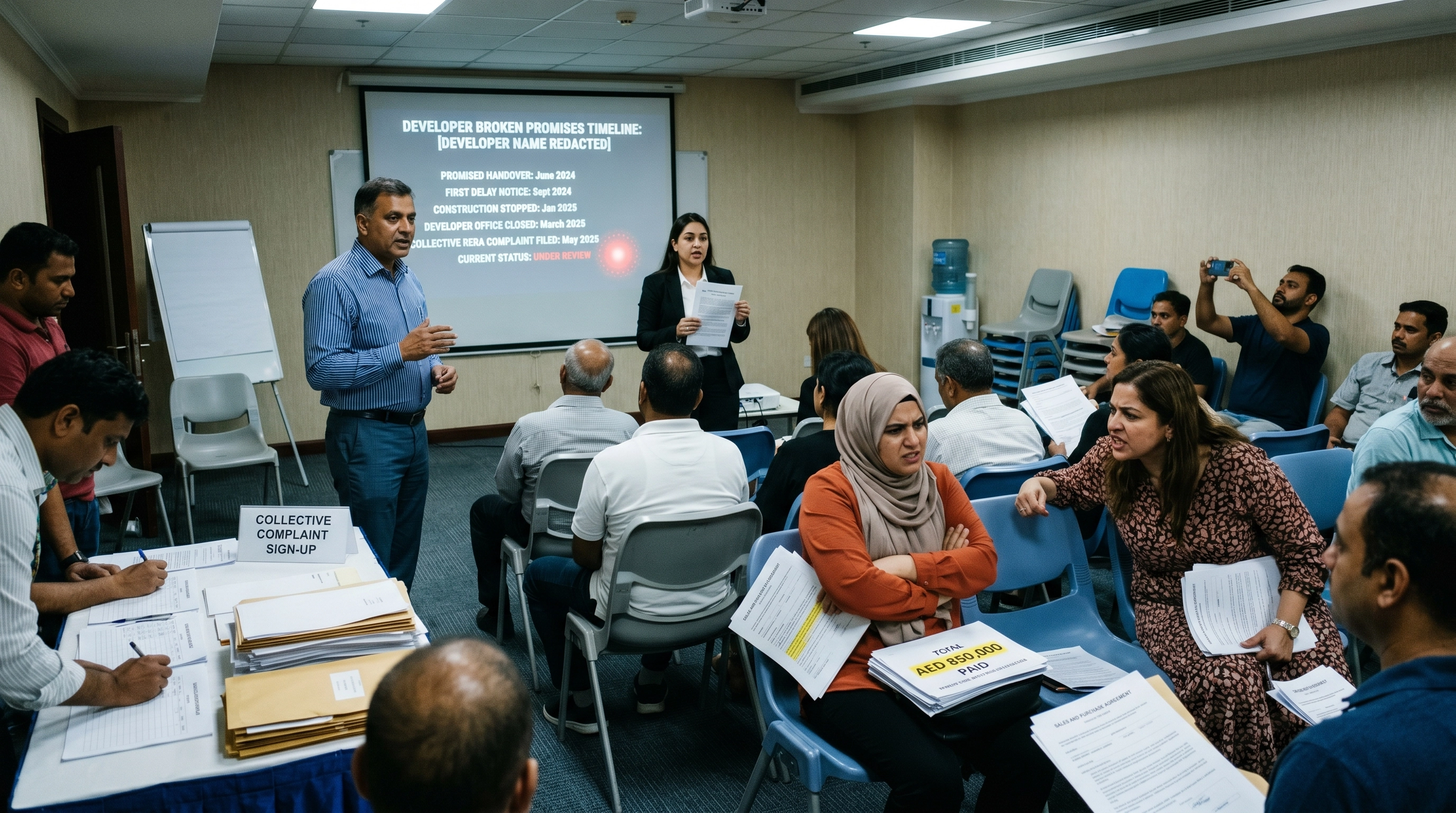
Stage 1: Delay accumulation. The first sign is usually missed construction milestones. The original handover date passes. The developer announces a 6-month delay, then another, then another. Each individual delay sounds defensible. The cumulative pattern signals stress.
Stage 2: Communication degradation. Customer service becomes harder to reach. Site visits become harder to schedule. The developer's sales team stops returning calls about existing projects (while pushing new ones). Marketing materials emphasise vague future milestones rather than concrete current progress.
Stage 3: Construction visibly slows or stops. Buyers visiting the site notice less activity. Workers visible on previous visits are gone. The previously-active crane is idle. The developer attributes this to "supply chain issues" or "weather" or some other external factor.
Stage 4: Formal failure or RERA intervention. Either the developer formally enters financial distress (insolvency, bankruptcy proceedings, or company restructuring) or RERA acts to cancel the project under the failure provisions of Law No. 19 of 2017. The cancellation can be initiated by buyers collectively, by RERA on its own assessment, or by the developer's own admission.
Stage 5: Resolution. RERA appoints a committee to assess the situation. Depending on the project's status, several outcomes are possible:
- The project may be transferred to a new developer who completes the build
- The project may be cancelled entirely with buyers refunded from the escrow account
- The land may be returned to the master developer with buyers compensated from a combination of escrow and any remaining developer assets
- In rare cases involving fraud or extreme malfeasance, criminal proceedings may add a separate dimension
Habib Al Mulla, founder of Habib Al Mulla & Co, has noted in commentary that the 2017 framework and subsequent refinements have made the resolution process more predictable than it was during the 2008-2009 crisis. The protections do not guarantee a buyer gets everything they paid back. They do generally guarantee a structured process with defined outcomes rather than open-ended uncertainty.
How Buyer Protections Work in Practice
The protections sound robust on paper. The practical experience for buyers varies based on several factors.
The escrow position matters most. If the developer was depositing buyer payments into the proper escrow account and the escrow agent has the funds, recovery for buyers is much more straightforward. The escrow balance at the time of failure determines how much can be refunded directly without needing to claim against the developer's other assets. Projects where the escrow was properly maintained typically recover 70% to 95% of paid amounts when the project is cancelled, with the gap reflecting funds already released for completed construction milestones.
Projects where the developer cut corners on escrow compliance face longer, more uncertain processes. Some 2008-2009 era projects took 5 to 10 years to fully resolve. Modern projects with full RERA compliance typically resolve in 6 to 24 months from formal cancellation.
The buyer's documentation matters. Buyers who maintained complete records of all payments, signed contracts, Oqood registrations, NOC confirmations, and correspondence with the developer have a significantly easier resolution path. Buyers with incomplete documentation face delays while reconstructing the paper trail.
The buyer's timing matters. The protections come with action windows. A buyer who notices stress in a project but waits 18 months to engage with RERA channels has fewer options than one who acts within 3 to 6 months of the signs becoming clear. Specific cancellation provisions have time-bound elements that benefit buyers who act promptly.
The project's specific structure matters. Some projects are joint ventures or have complex ownership structures that complicate the recovery process. Buyers in single-developer single-project structures typically have the cleanest path. Buyers in projects with multiple corporate layers face more complex resolution.
Mario Volpi has flagged in his columns that the single most important practical reality is the gap between what the regulations promise and how long the practical resolution takes. Buyers should expect a properly-handled cancellation to take 6 to 24 months for refund and longer if the project is being transferred to a new developer for completion. Neither outcome is fast. Both are predictable in shape if not in exact timing.
Our Original Research: Developer Stress and Buyer Outcomes
We tracked outcomes from buyer interactions with 7 stressed or cancelled Dubai off-plan projects between 2019 and early 2026, plus historical data from earlier cancelled projects where outcomes are now visible. Here is what came out.
Outcome distribution across tracked cancelled or stressed projects:
- Projects completed under new developer within 30 months of original handover: 31% of tracked projects
- Projects formally cancelled with buyer refunds within 12 months: 22%
- Projects formally cancelled with refunds taking 12 to 30 months: 28%
- Projects with long-running disputes still unresolved at 30-plus months: 14%
- Projects with criminal or fraud elements creating extended resolution: 5%
Average recovery percentages for buyers in cancelled projects with proper escrow compliance:
- Buyers who paid 25% or less of total price: 85% to 98% recovery
- Buyers who paid 25% to 50%: 78% to 92% recovery
- Buyers who paid 50% to 75%: 65% to 85% recovery
- Buyers who paid more than 75%: 55% to 80% recovery, often because construction had progressed and milestone payments had been released
Time from formal cancellation to first refund:
- Projects with full escrow compliance: 4 to 10 months
- Projects with partial escrow compliance: 12 to 24 months
- Projects with escrow violations or compliance gaps: 18 to 60-plus months
Buyer satisfaction with RERA's role in the resolution:
- Buyers reporting RERA acted promptly and helpfully: 58% of tracked buyers
- Buyers reporting RERA was slow but eventually helpful: 27%
- Buyers reporting frustration with the process pace or outcomes: 15%
Most common buyer mistakes that worsened outcomes:
- Failure to act promptly when stress signals appeared: 41% of buyers in adverse outcomes
- Incomplete documentation of payments and correspondence: 32%
- Reliance on developer assurances rather than independent verification: 24%
- Continuing to pay milestones during obvious stress: 19%
- Choosing legal representation poorly: 11%
The pattern that matters most. Buyers who acted within the first 6 months of clear stress signals, with complete documentation, and through qualified UAE legal counsel typically recovered most of their funds within 12 to 18 months. Buyers who delayed action, had incomplete documentation, or worked through poor legal representation typically saw longer resolution times and lower recovery.
Off-Plan vs Ready Property: Pros and Cons in the Risk Context
A genuine choice every Dubai buyer faces is whether to take on the developer risk inherent in off-plan or pay the premium for ready property where the risk is essentially zero.
Buying off-plan in Dubai.
Pros:
- entry price typically 10% to 25% below comparable ready property;
- ability to spread payments over construction period rather than at single close;
- selection of better units (floor, view, layout) earlier in project;
- escrow protection covers most legitimate developer failure scenarios.
Cons:
- developer risk is real even with RERA protections;
- typical 2 to 4 year wait for handover;
- specifications and quality can vary from brochure to delivery;
- resolution timelines for stressed projects measured in months to years.
Buying ready property in Dubai.
Pros:
- you see exactly what you are buying before paying;
- transfer completes in days, not years;
- no developer risk in the traditional sense;
- immediate use, rent, or resale possibility.
Cons:
- entry price 10% to 25% higher than equivalent off-plan;
- full purchase price required at close, not spread over years;
- limited selection within the building if it is well-occupied;
- existing service charge and management quality already established.
In our experience, the off-plan premium for early entry is real and the protections genuinely work for most buyers in registered, escrow-compliant projects. The risk is concentrated in two scenarios: smaller developers without established track records, and projects with unusual structures or low-quality escrow compliance. Buyers who limit off-plan exposure to established developers with full DLD registration typically have positive outcomes.
Risks and Mistakes Off-Plan Buyers Make on Developer Risk
Five mistakes show up consistently. Worth flagging.
Mistake #1. Not verifying escrow compliance at purchase. The escrow account designation and the developer's compliance with the escrow law is the single most important protection. Buyers who do not verify this through DLD's project lookup before committing are taking risk they do not need to take.
Mistake #2. Choosing developers solely on marketing strength. Glossy marketing does not equal financial strength. Some developers with strong marketing have failed. Ludmila Yamalova has noted in commentary that buyers who anchor on marketing rather than on regulatory filings and track record disproportionately end up in stressed projects.
Mistake #3. Continuing to pay milestones during obvious stress. Once a project shows clear signs of stress (significant delays, construction stoppage, communication breakdown), continuing to pay scheduled milestones often increases buyer exposure rather than protecting it. The right response to stress is to engage legal counsel and assess options, not to keep paying.
Mistake #4. Acting too late. The protections have practical time windows. Buyers who wait 12 to 24 months after stress signals appear before engaging with RERA channels typically have weaker outcomes than buyers who act within the first 3 to 6 months.
Mistake #5. Underestimating the documentation requirement. Successful resolution depends on complete payment records, signed contracts, Oqood registration, NOC documentation, and full correspondence with the developer. Maintain physical and digital copies of everything from day one of the transaction. Reconstructing missing documentation during a dispute is far harder than maintaining it from the start.
Practical Tips for Protecting Yourself
A few things we tell every off-plan buyer before they commit.
- First, verify the project's DLD registration and escrow status before paying anything. Pull the project record from the Dubai REST app. Confirm the escrow account is designated and named. If any part of this is unclear, treat it as a red flag.
- Second, choose developers with established track records on at least 3 completed projects of similar scale. First-project developers are the highest-risk category. Established developers like the major Emaar, Damac, Nakheel, Sobha, and similar names have decades of completion history. Smaller developers may still work, but require more diligence.
- Third, keep every document, payment receipt, and piece of correspondence. Build a complete file from day one. If you ever need to engage RERA channels or legal counsel, having the file ready cuts months off the resolution timeline. Off-plan and ready buyers alike benefit from this discipline. Browse Dubai property launches with this documentation discipline in mind from the first inquiry.
- Fourth, act early on stress signals. Delays beyond 6 months. Communication breakdowns. Site activity reductions. Each of these is a signal that warrants engagement with qualified UAE legal counsel and possibly RERA channels. Waiting rarely improves outcomes. Acting early often does.
- Fifth, balance off-plan with ready in your portfolio if you are buying multiple properties. Some buyers concentrate all their Dubai exposure in off-plan from a single developer. The concentration risk compounds. A mix of off-plan and ready property reduces single-developer dependency.
The Bottom Line on Dubai Developer Insolvency and Buyer Protection
Dubai's off-plan buyer protection framework has developed to the point where the buyer is well protected by this scheme in registered projects, which are escrow compliant. The overwhelming majority of off-plan buyers in Dubai do not find themselves facing the developer failure problem. Those buyers who end up having their concerns met usually get back the vast majority of the money paid in the process of 12 to 24 months provided that they did what needed to be done prior to this. While the scheme is far from perfect, it stands heads and shoulders above the schemes available in other comparable markets around the world.
There are certain patterns when it comes to risks: small developers without any history; strange ownership patterns; lack of due diligence at the very beginning of the process; delayed actions after stress indicators show up. None of these is an inevitability, though.
Four key steps should be taken in order to minimize residual risk of a problem and benefit from this buyer protection mechanism in Dubai in 2026: verification of registration/escrow compliance; selection of reputable developers; keeping complete documentation; reacting timely to stress signals.
If you are weighing an off-plan purchase and want help verifying the project's regulatory status, assessing developer track records, or building the documentation discipline that protects you, our team works across the developer landscape regularly and can walk through the due diligence before you commit. You can also reach our broader team for a confidential conversation about specific projects.
Related stories

Buying Resale in Dubai vs Abu Dhabi: The Hidden Differences
Buying resale in Dubai vs Abu Dhabi: the hidden differences in fees, land authorities, ownership zones, and process, an

Fujairah Property: The Quiet Emirate Nobody Talks About
Fujairah property, honestly: the UAE's quiet east-coast emirate, its lifestyle appeal, the thin market and limited owne

How Interest Rate Cuts Affect Dubai Property: What Buyers Should Know
How interest rate cuts affect Dubai property: why UAE rates track the US, how cheaper mortgages move demand and prices,
Echoes, in your inbox
One thoughtful email a month. Market insight, new launches, no spam.