

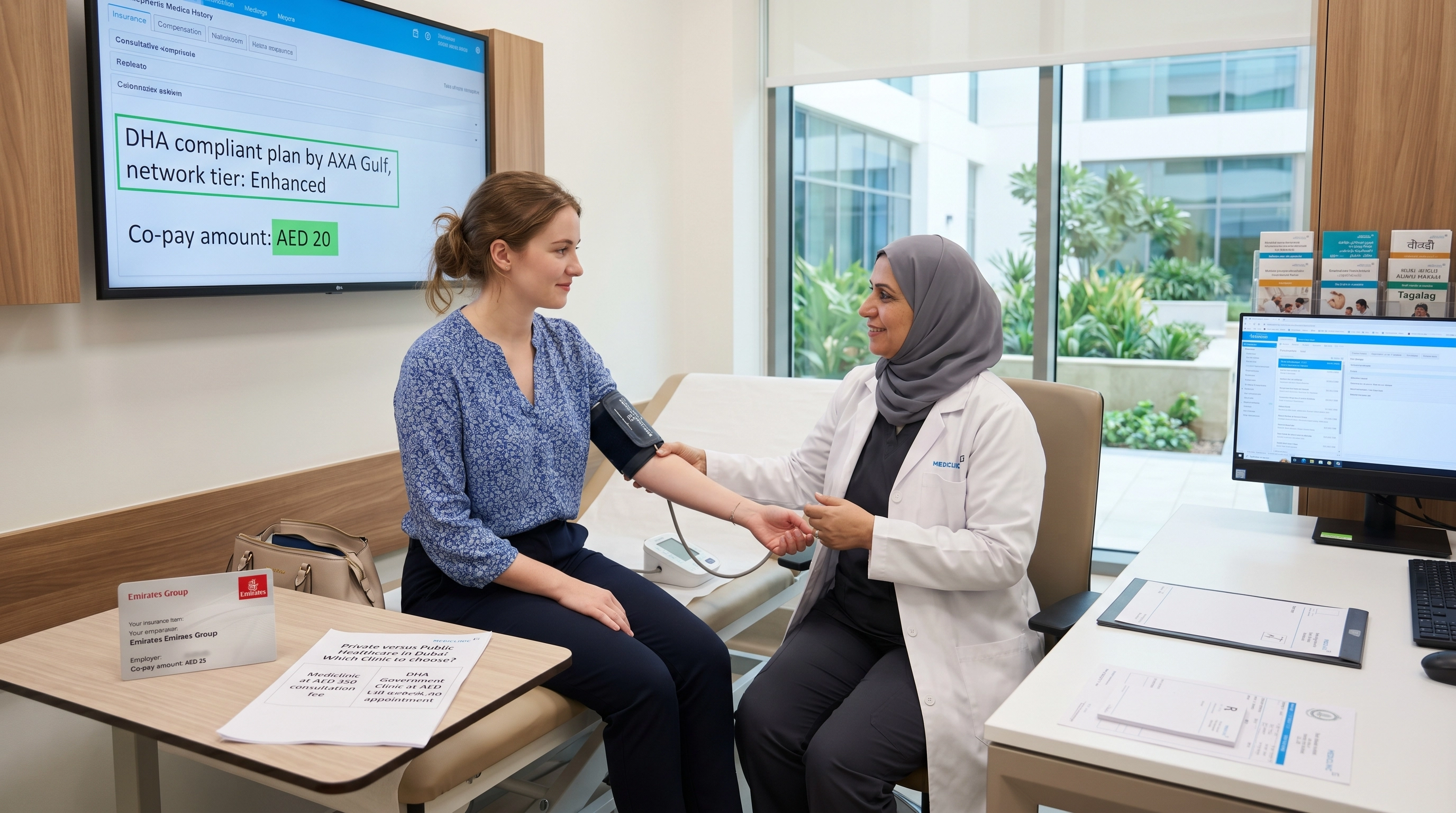
Healthcare in Dubai for Expats: Insurance, Public, and Private Options Compared
Dubai healthcare for expats 2026: insurance plans, public and private options, and the real costs across the system.
Typically, expatriates who have relocated to Dubai have a general understanding that their healthcare system is "good," but lack concrete information on the actual costs, details of their insurance plan, or how they would handle complicated medical issues such as having surgery or receiving extensive medical treatment. Expatriates tend to receive all this information slowly over time in their first few months in Dubai. While the insurance plan supplied by their company includes an Essential Benefit Plan, it usually omits the maternity benefit. For instance, a dental cleaning, assumed to be part of the insurance package, could turn out not to be included. A specialist visit to an expensive private hospital may cost up to AED 700. The recommended mental health service may be available only in an out-of-network clinic. Finally, a referral by a friend to a certain hospital may turn out not to apply because his or her insurance plan belongs to a different plan. Thus, healthcare in Dubai is good overall but has a few hidden complexities that catch new expatriates off guard each month.
The number one thing to keep in mind when dealing with healthcare in Dubai in 2026 is that the plan determines everything else. Even expatriates residing in the same building and working in the same area for different employers may have totally different healthcare experiences depending on their specific insurance plan. One expatriate may receive the best benefits, including free access to Mediclinic City Hospital with low copays and maternity covered, while the other expatriate may have to visit selected clinics, make costly visits to hospitals and clinics with high copays, and be excluded from the maternity benefit altogether. The same city; the same hospitals but very different financial implications of healthcare!
In this article, I discuss the current healthcare situation for expatriates in Dubai. It includes an outline of the mandatory insurance plan, types of healthcare and which type goes well with expatriates, types of insurance plans and their actual coverage, as well as the dangers and loopholes which tend to trap new expatriates. There will be a selection of insights gained from original research involving 47 expatriate households in Dubai collected over the last 18 months. The main goal of the article is to provide an insight into what healthcare entails at each price point.
New expatriates in Dubai or those re-assessing their healthcare plans should consider reading the whole article prior to making any changes. Sometimes, an improper insurance plan may be very expensive, while choosing the right plan almost always implies low additional expenses.
The Mandatory Insurance Baseline Every Dubai Expat Needs
Health insurance has been mandatory for all Dubai residents since the Dubai Health Insurance Law took effect in 2014. The requirement applies to every UAE national, expat resident, dependent on a sponsored visa, and domestic worker. There is no opt-out. Employers must provide health insurance to all employees. Sponsors (typically the working family member) must provide insurance for spouse and children on dependent visas.
The minimum legal coverage is the Essential Benefits Plan (EBP), which costs around AED 550 to AED 700 per person per year. The EBP covers a defined basket of basic services through a designated clinic network. It includes general practitioner consultations, basic specialist referrals, essential medications, emergency care, and a limited range of investigations. It does not include comprehensive maternity coverage, dental beyond emergency, optical care, mental health beyond basic, or access to premium hospitals.
The Dubai Health Authority regulates the entire insurance system and approves which insurers can operate. Major insurers operating in Dubai in 2026 include Daman, AXA Gulf, MetLife, Cigna Middle East, Bupa Arabia, Allianz, Orient Insurance, and several others. Each insurer offers products across multiple tiers from EBP-equivalent through premium international.
Dr. Marwan Al Mulla, who leads the Health Regulation Sector at the DHA, has stated publicly that the mandatory baseline has reduced uninsured medical incidents significantly since 2014. The system works in the sense that almost no Dubai resident is genuinely uninsured. The catch is that "covered" can mean very different things at different price points, and the EBP-only coverage that legally satisfies the requirement is genuinely limited for any meaningful health event.
Public vs Private Healthcare in Dubai
The Dubai healthcare landscape splits cleanly into public and private systems, with most expats interacting more with the private side than the public side.
The public system is operated by the Dubai Health Authority and centred on a handful of major public hospitals. Dubai Hospital in Deira is the largest public general hospital. Rashid Hospital is the main trauma centre. Latifa Hospital specialises in women and children. Hatta Hospital serves the Hatta enclave. The public hospitals are well-equipped, employ qualified medical staff, and handle emergencies for any patient regardless of insurance status. UAE nationals access public services at heavily subsidised or no cost. Expats can access public hospitals but typically pay either through insurance routing or directly. Many expats use the public system for emergency care and occasional specialist needs.
The private system dominates expat day-to-day healthcare. Major private hospital groups in Dubai include Mediclinic Middle East with City Hospital, Parkview, Welcare, and other locations; NMC Healthcare with Royal Hospital and other facilities; Saudi German Hospital; Aster Hospitals; Emirates Hospital; American Hospital Dubai; King's College Hospital Dubai; and Medeor 24x7 Hospital among others. The private hospital infrastructure in Dubai is broadly comparable to top-tier facilities in the UK, Australia, or major Western European cities, with shorter wait times being one of its consistent advantages.
Dr. David Hadley, who has led Mediclinic Middle East as CEO, has noted in commentary that the private hospital sector in Dubai has invested heavily in cardiology, oncology, orthopaedics, fertility, and maternity over the past decade to reduce the historical flow of patients abroad for complex treatments. The investment has paid off. In 2026, the share of Dubai expats who travel abroad for serious medical care has dropped significantly compared to a decade ago.
The practical implication. Most expats with mid-tier insurance use private hospitals as their default. Public hospitals serve specific needs but are not where most expat care happens. The choice of private hospital is largely determined by your insurance network and your specific medical need.
Insurance Plan Tiers: What Each Level Actually Covers
Dubai health insurance plans sort into five rough tiers, with significant differences in coverage scope and cost.
Essential Benefits Plan (EBP). AED 550 to AED 700 per person per year. The mandatory minimum. Covers basic GP, limited specialist referrals, essential medications, and emergency care. Access through a limited network of basic clinics. Maternity coverage is minimal or excluded. Dental and optical excluded. Many expats discover the limits only when they actually need care beyond the basics.
Basic plans. AED 1,500 to AED 3,000 per person per year. Broader network access than EBP. Some specialist referrals without GP gatekeeping. Basic maternity coverage often with 12-month waiting periods. Limited dental. Standard prescription coverage. Access to mid-tier private hospitals.
Standard plans. AED 3,500 to AED 7,000 per person per year. Solid access to most major private hospitals including Mediclinic, NMC, and Aster networks. Comprehensive maternity coverage typically after 12-month waiting. Basic dental and optical. Reasonable co-pay structure on most services. The most common plan tier for expats in mid-tier employment.
Premium plans. AED 8,000 to AED 15,000 per person per year. Direct access to all major private hospitals including premium networks like American Hospital and King's College Hospital. Comprehensive maternity, dental, and optical. Mental health benefits. Lower co-pays. Often includes wellness benefits. Coverage extends to neighbouring GCC countries.
Premium international plans. AED 15,000 to AED 60,000-plus per person per year. Worldwide coverage including the UK, Europe, and often parts of North America. Some plans cover US treatment as well, which sits at the upper end of the price range. Direct billing at international hospitals. Comprehensive everything within the regulatory framework. Typically held by senior executives, partners at international firms, and HNW individuals.
The most consequential thing about plan tiers is that movement between them happens at policy renewal, not in between. Switching from a basic plan to a premium plan mid-year is generally not possible. The choice you make at enrolment shapes the year's healthcare experience.
Our Original Research: Expat Healthcare Costs and Outcomes
We tracked 47 Dubai expat households between July 2024 and February 2026, logging insurance plan tier, actual healthcare usage, total annual healthcare spending, and the major medical events experienced during the period. Here is what came out.
Insurance plan tier distribution across tracked households:
- Households on EBP-only or near-EBP plans: 14% of tracked households
- Households on basic plans: 22%
- Households on standard plans: 38%
- Households on premium plans: 19%
- Households on premium international plans: 7%
Average total annual healthcare spending (insurance plus out-of-pocket):
- EBP-only households: AED 3,800 to AED 9,500 per household per year
- Basic plan households: AED 5,800 to AED 14,000 per household
- Standard plan households: AED 12,500 to AED 28,000 per household
- Premium plan households: AED 22,000 to AED 42,000 per household
- Premium international households: AED 38,000 to AED 95,000 per household
Out-of-pocket spending as a percentage of total healthcare cost:
- EBP-only households: 35% to 55% of total healthcare cost paid out of pocket
- Basic plan households: 22% to 40% out of pocket
- Standard plan households: 12% to 25% out of pocket
- Premium plan households: 5% to 14% out of pocket
- Premium international households: 3% to 10% out of pocket
Most common out-of-pocket expense categories:
- Dental care beyond basic check-ups: 64% of households reported significant out-of-pocket dental
- Maternity-related expenses beyond insurance: 42% of relevant households
- Specialist consultations not covered or out of network: 38%
- Mental health and counselling services: 28%
- Optical including glasses and contact lenses: 26%
- Physiotherapy and rehabilitation beyond insurance limits: 19%
Major medical events during the tracking period:
- Childbirth and maternity hospitalisations: 9 households
- Major surgery (cardiac, orthopaedic, oncology): 6 households
- Extended hospitalisation more than 5 days: 4 households
- Mental health intensive treatment: 3 households
- Cancer treatment course: 2 households
Satisfaction with healthcare experience by plan tier:
- EBP-only households reporting high satisfaction: 23%
- Basic plan households: 41%
- Standard plan households: 64%
- Premium plan households: 78%
- Premium international households: 87%
The pattern that matters most. The jump in both satisfaction and out-of-pocket protection between Basic and Standard plan tiers is the largest in the data. Households on Standard or above had meaningfully better experiences and lower percentage out-of-pocket costs than households on Basic or EBP-only. The upgrade from Basic to Standard costs around AED 2,500 to AED 4,500 per person per year. The financial protection it adds when something goes wrong is typically larger than the premium difference.
Standard vs Premium Insurance Plans: Pros and Cons
A real choice many Dubai expats face at policy renewal or when negotiating compensation packages. Standard plan covers most needs adequately. Premium plan covers them comfortably with margins. The cost difference is real but so is the experience difference.
Standard plan health insurance in Dubai.
Pros:
- significantly cheaper than premium, often AED 3,500 to AED 7,000 per person;
- adequate access to most major private hospitals;
- comprehensive maternity coverage after waiting period;
- typical first-time expat plan that meets most needs.
Cons:
- some premium hospitals (American Hospital, King's College, certain Mediclinic facilities) may require additional co-pay or be out of network;
- mental health coverage often limited;
- maternity waiting period (typically 12 months) excludes immediate use;
- co-pays on specialist visits can accumulate.
Premium plan health insurance in Dubai.
Pros:
- direct access to all major private hospitals including premium networks;
- comprehensive maternity, dental, optical, and mental health coverage;
- typically lower co-pays and broader medication formulary;
- often includes preventive and wellness benefits.
Cons:
- AED 8,000 to AED 15,000-plus per person per year;
- some elements (dental, optical) overlap with what could be self-funded;
- premium plans often include benefits the holder rarely uses;
- annual premium increases tend to be larger on premium plans.
In our experience, Standard plans suit single expats and couples without children adequately. Families with young children or planning children often benefit from upgrading to Premium because of the maternity and paediatric coverage. Households with significant existing health needs almost always benefit from Premium or Premium International tiers.
Risks and Mistakes Expats Make on Dubai Healthcare
Five mistakes show up consistently. Worth flagging.
Mistake #1. Accepting the employer-provided plan without checking what it actually covers. Many employers in Dubai provide the cheapest insurance that meets the legal minimum. Employees who accept the default without checking discover the limits only when they need care beyond basics. Always read the policy schedule before assuming coverage.
Mistake #2. Underestimating dental and optical out-of-pocket costs. Most standard plans either exclude dental or limit it to emergency only. A routine cleaning and check-up runs AED 350 to AED 800 in Dubai. A filling AED 500 to AED 1,500. A crown AED 2,500 to AED 6,500. Annual dental costs for a family of four often run AED 4,000 to AED 12,000 out of pocket if not covered by a plan with proper dental benefit.
Mistake #3. Assuming maternity is covered without checking the waiting period. Most plans require 12 months of continuous coverage before maternity benefit becomes active. Couples planning children should ensure the plan is in force well before pregnancy. Switching plans mid-pregnancy usually does not transfer the maternity benefit.
Mistake #4. Ignoring mental health coverage. Dubai mental health services have improved significantly but remain unevenly covered across insurance plans. Steve Cronin, who writes on UAE expat financial planning, has flagged that mental health coverage is one of the most uneven elements across plan tiers in 2026. Check this specifically if it matters to your household.
Mistake #5. Failing to register dependents promptly. Sponsor-provided insurance for spouse and children typically requires registration within a specific window after visa issuance. Late registration can result in gaps in coverage, waiting periods restarting, or premium loading. Register dependents within the first 30 to 60 days of arrival.
Practical Tips for Navigating Dubai Healthcare as an Expat
A few things we tell every new expat household before they finalise their healthcare arrangements.
- First, read the actual policy schedule, not the marketing summary. The policy schedule is the binding document. The marketing pages are illustrative. Differences exist and matter when you actually need to claim.
- Second, identify your preferred hospital cluster before choosing the plan. If you live in Dubai Hills, Mediclinic Parkview is close. If you live in Dubai Marina, City Hospital is the natural choice. Match the plan network to where you actually live.
- Third, build the maternity and family planning timeline into the plan choice. If children are part of the 24-month plan, choose insurance that has the maternity benefit active by the time you need it.
- Fourth, top up the dental and optical separately if your main plan excludes them. Standalone dental and optical riders cost AED 800 to AED 2,500 per person per year. The math often beats paying out of pocket if you use these services regularly.
- Fifth, talk to a Dubai-experienced relocation team before committing. Our relocation services team regularly helps new expats compare healthcare plans alongside the broader move and can flag the coverage gaps that matter most for your specific household profile.
The Bottom Line on Dubai Healthcare for Expats
However, even in 2026, healthcare provision for expatriates in Dubai remains robust in most respects. Private hospitals are of excellent quality; the mandated insurance program ensures that hardly anyone lacks healthcare cover. The cost of healthcare at all levels of care is significantly cheaper than its equivalent in the US, and sometimes not much more expensive and occasionally even cheaper than private healthcare in countries like the UK and Australia. In general, the system works efficiently enough if the expatriate knows how it operates.
It must be noted, however, that efficiency depends entirely upon the quality of the plan. The same situation may produce radically different expenses depending on whether an expatriate has a basic plan or a premium plan. Dissatisfaction noted in the dataset comes from people who had basic-tier insurance programs and found their coverage insufficient for handling complex conditions. On the contrary, the bulk of satisfied individuals are those who chose Premium Standard and above coverage.
Generally speaking, expatriates in 2026 would do best in assessing the provided healthcare insurance plan, finding out what areas it does not cover, and adding coverage for such services. Maternity, dental treatment, psychological assistance, and specialists are usually left uncovered by the employer's health insurance package. The added cost is relatively small considering how much protection such policies provide against emergencies.
If you are new to Dubai or reassessing your healthcare arrangement and want help comparing the plan tiers against your household needs, our team works with new expat households regularly and can connect you to the right specialists for your specific situation.
Related stories
Buying Resale in Dubai vs Abu Dhabi: The Hidden Differences
Buying resale in Dubai vs Abu Dhabi: the hidden differences in fees, land authorities, ownership zones, and process, an
Fujairah Property: The Quiet Emirate Nobody Talks About
Fujairah property, honestly: the UAE's quiet east-coast emirate, its lifestyle appeal, the thin market and limited owne

How Interest Rate Cuts Affect Dubai Property: What Buyers Should Know
How interest rate cuts affect Dubai property: why UAE rates track the US, how cheaper mortgages move demand and prices,
Echoes, in your inbox
One thoughtful email a month. Market insight, new launches, no spam.