

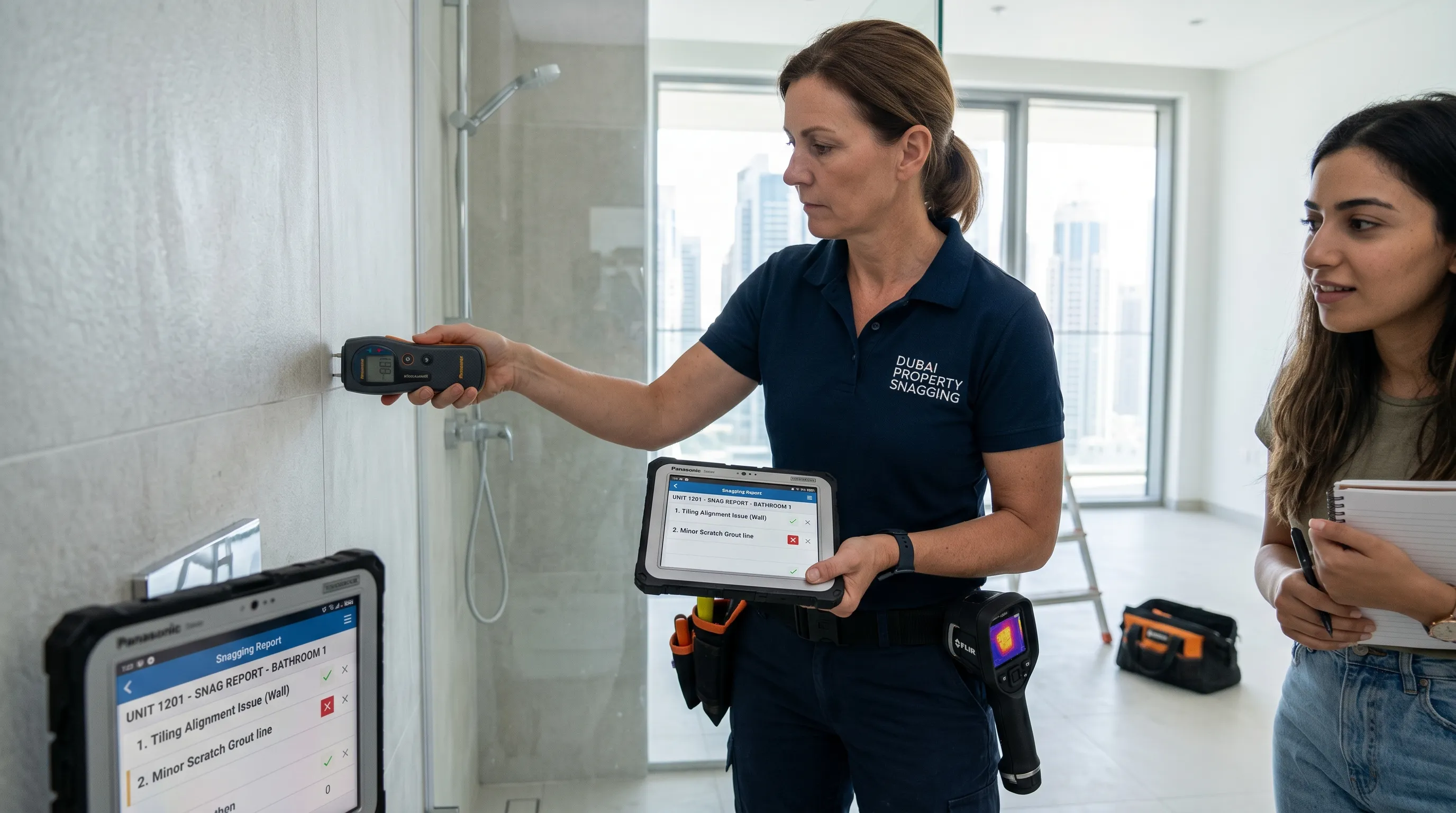
Property Handover in Dubai: The Snagging Checklist Every Buyer Needs
New build ready? Don't sign until you've snagged it. Here's the Dubai property handover process and the room-by-room sn
The handover day signifies the end of the build-up. For months, if not years, you have been watching an off-plan development come into being, paying installments, and relying on renderings. It is at that point that the developer becomes ready to hand over the keys to the completed house. Indeed, handover in Dubai can be described as an extremely exhilarating experience, but at the same time, it is the most important inspection you can ever perform since it is your last chance to spot defects for which the developer is responsible.
There exists a special term used when referring to this procedure, and the term is known as snagging. Snag refers to any problem or unfinished work in your new property, whereas snagging is the identification of these snags before accepting handover and signing papers, leaving them unaddressed makes it more difficult to sort them out later. Discovering them in good time and making a full list allows the developer to fix all of them in advance.
The current guide offers the entire handover procedure, starting from the definition and description of the handover itself through describing what snagging is and why it is important up to offering a detailed list of all items to be checked per each individual room and providing tips on how to do it and further steps to follow.
Please note: warranty period, fees, and deadlines are unique for each developer/project and subject to change. Consider the data provided as a reference only, consult your contract and relevant authorities. On the other hand, the snagging checklist can be applied to practically any newly-built property.
What Handover Actually Is
Handover is the moment the developer formally hands you a finished property and you take possession of it. In practice it is not a single event but a short process, a sequence of steps between the developer telling you the building is ready and you walking in with the keys as the legal owner.
For an off-plan purchase, which is where most handovers happen, the building reaches completion, the developer obtains its completion certificate, and you get a notice that your unit is ready. From there a fairly standard sequence runs. You are invited to inspect the unit, you snag it, the developer fixes what you find, you settle the final payment, you accept handover and sign, the property is registered to you, and you connect the utilities and move in. The order can vary a little by developer, but the shape is consistent.
Here is the handover process, step by step:
- Completion notice. The developer tells you the building is finished and your unit is ready to inspect.
- Inspection appointment. You are given a date to view and snag the unit before accepting it.
- Snagging. You inspect for defects and submit a written list of everything that needs fixing.
- Developer fixes. The developer puts right the items on your snag list, usually within an agreed window.
- Final payment. The last installment of the price typically falls due around handover, per your plan.
- Acceptance and keys. Once you are satisfied, you sign the handover documents and receive the keys.
- Registration and utilities. The property is registered in your name, and you connect water and power.
The key thing to understand is the order. The inspection comes before acceptance, and that is deliberate, because acceptance is the point where you confirm you are happy with the property. The buyer protections that sit around this process are real and are set out through the UAE government portal, but they work best when you use the inspection properly rather than rushing to sign.
If you are still in the off-plan stage and have not reached handover yet, it is worth knowing this process from the start, so you buy into a project that will hand over cleanly. Our property launches page lists registered off-plan projects, and knowing how handover works helps you judge them. Either way, the moment that matters most is the inspection, which is where snagging comes in.
Snagging, and Why It Matters
Snagging is the inspection where you hunt for every defect in your new property before you accept it. A snag is any fault or unfinished detail, a cracked tile, a door that sticks, a socket that does not work, paint that is patchy, an appliance that was promised but is missing. Snagging is simply the act of finding all of them and writing them down.
Why does it matter so much? Because of timing. Before you accept handover, fixing snags is squarely the developer's job, and they are motivated to sort them so you will sign. After you accept and sign, you can still rely on the warranty for genuine defects, but the easy pressure is gone, and small cosmetic issues in particular become much harder to get fixed. Snagging is the strongest hand you will ever hold in this deal, and it only comes once.
Here is why snagging is worth doing thoroughly:
- The upper hand. Before acceptance, fixing snags is the developer's clear responsibility, and they want your signature.
- It only comes once. The inspection is your single best chance to catch everything while it is easy to fix.
- Cosmetic issues fade. After handover, small finish defects are far harder to get a developer to return for.
- It protects the spec. Snagging is when you confirm the finishes match what the contract promised.
- It saves money. Every defect caught now is a repair you do not pay for later.
- It is normal. Developers expect a snag list, and a good one will not be offended by a thorough one.
There is also a warranty to understand. In the UAE, developers generally provide a defects liability period, commonly around one year for general defects and a longer period, often up to roughly ten years, for major structural problems. The exact terms vary by developer and are set out in your contract, so confirm them rather than assuming, but the principle is that you are not entirely on your own after handover. The warranty is a backstop, though, not a substitute for snagging.
The developer behind your project shapes how all of this goes. A builder with a strong record of clean handovers and honouring its warranty is a different experience from an unknown, which is one more reason the developer matters as much as the building. You can get a sense of who is who through our developers overview before you ever reach handover.
The Snagging Checklist, Room by Room
This is the heart of the guide, the actual checklist. Take it with you, go room by room, and test everything rather than just looking. A defect you spot now is the developer's problem. One you miss becomes yours.
Start with the surfaces and structure in every room, then work through the systems:
- Walls and ceilings. Check for cracks, dents, stains, patchy or uneven paint, and bumps under the finish.
- Floors. Look for cracked, chipped, or scratched tiles, hollow-sounding tiles, uneven edges where tiles meet, and gaps.
- Doors. Open and close every one, check it does not stick or scrape, and test that locks and handles work.
- Windows. Check they open, close, and seal properly, that the glass is unscratched, and that there are no gaps.
- Skirting and joinery. Look at the finish on skirting boards, wardrobes, and any built-in shelving for gaps or damage.
Then the wet areas and the systems, which is where the expensive problems hide:
- Kitchen. Test cabinet doors and hinges, check countertops for chips, run the taps, check water pressure, and look for leaks under the sink.
- Appliances. If any are included, switch on every one and confirm it works as it should.
- Bathrooms. Run every tap, flush the toilet, test the shower and drainage, and check the sealant, grout, and tiles.
- Electrical. Test every single socket, every light switch, and every light fitting, and check the distribution board and intercom.
- Air conditioning. Run the cooling in every room, check it actually gets cold, and listen for odd noises or look for leaks.
- Plumbing. Check hot water reaches every tap, water pressure is good, and there are no leaks anywhere.
- Balcony or terrace. Check the railings are secure, the drainage works, and there are no signs of pooling water.
Two extra checks matter beyond the room-by-room sweep. First, measure or at least sense-check the unit size against the area stated in your contract, because the floor area you are paying for should be the floor area you receive. Second, read the property against the specifications schedule, the document that lists the materials and finishes you were promised, and flag anything that has been substituted for something cheaper or is simply missing.
The golden rule of the whole checklist is to test, not glance. A socket that looks fine may be dead. A tap that looks fine may have no pressure. An air conditioner that looks fine may not cool. Switch on, turn on, open, close, and flush everything, in daylight, and write down every single thing that is not right. A thorough snag list is long, and that is exactly as it should be.
How to Snag Like a Pro
Having the checklist is half the job. Using it well is the other half. Here is how to run the inspection so nothing slips through, and so the snags you find actually get fixed.
The single best decision, especially for a larger or more valuable unit, is to bring in a professional snagging company. They inspect for a living, they have the tools, and they catch things an excited buyer walks straight past. Their fee varies with the size of the property, but is often somewhere from a few hundred up to around AED 1,000 or more, which is small against the price of the home and the cost of missed defects. If you do snag yourself, slow right down and treat it as a job, not a celebration.
Here is how to do the inspection properly:
- Go in daylight. Natural light shows up finish defects, cracks, and scratches that you will miss in the evening.
- Take your time. Block out a proper window, not a rushed twenty minutes, and work through every room.
- Test everything. Every socket, tap, switch, light, door, window, and appliance gets switched on and checked.
- Photograph every defect. Take clear, dated photos and video of each snag so there is no argument later.
- Write a room-by-room list. Be specific, the room, the item, and exactly what is wrong with it.
- Consider a professional. For a big or pricey unit, a snagging company usually pays for itself in caught defects.
- Do not sign until it is sorted. Withhold acceptance until snags are fixed, or the fixes are agreed in writing.
- Re-inspect after fixes. Go back and confirm every item is actually done before you accept handover.
The two points that protect you most are the written record and the re-inspection. A clear, dated, photographed snag list, submitted in writing, leaves no room for a defect to be forgotten or denied. And re-inspecting after the developer says it is fixed, sometimes called de-snagging, makes sure the fixes are real rather than taken on trust. Never accept handover on a promise that the work will be done later, get it done first, or agreed in writing with a deadline.
Once you are in, keeping the property in good shape becomes the ongoing job, and a good manager can pick up where the snag list left off, tracking any warranty issues that emerge in the first year. Our property management team handles exactly this kind of follow-up, which matters most in those early months when warranty defects tend to show themselves.
After the Snag: Accepting and Moving In
Once your snags are fixed and re-inspected, the rest of handover is mostly administration, but it is worth knowing the steps so nothing surprises you. This is the stretch where the property formally becomes yours and you get to move in.
We lined up the steps that follow a clean snag, each on one line:
- Snag list submitted: the developer fixes the items within an agreed window, ideally confirmed in writing.
- De-snag re-inspection: you confirm every fix in person before you accept, rather than taking their word.
- Final payment: the last installment of the price usually falls due at handover, in line with your plan.
- Accepting handover: you sign the handover documents only once you are genuinely satisfied with the unit.
- Title registration: the property is registered in your name, the off-plan record converting to a full title deed.
- Utilities and move-in: you connect water and power, set up cooling if separate, and the home is yours.
A couple of these deserve a word. Registration is the step that makes you the legal owner on the record, with the off-plan registration converting into a title deed, and it is handled through the Dubai Land Department, where you can also confirm fees and the status of your unit rather than relying on anyone's word. Budget for the registration and transfer costs as part of your handover, since they are separate from the purchase price.
Then there is moving in, which means getting the utilities live. Water and electricity in Dubai run through DEWA, and you will need to set up an account and connect supply to the unit, with district cooling, where a community uses it, set up separately. It is worth sorting this before move-in day so you are not arriving to a home with no power or water.
The honest summary of the after-snag stage is that it is the easy part, as long as the snag itself was done well. Fixes confirmed, final payment made, documents signed, title registered, utilities on. The work that protects you was all in the inspection. Do that part properly, and accepting, registering, and moving in is just a satisfying set of steps to the keys being truly yours.
What We Would Actually Do
Summary: Success of the process entirely depends on conducting thorough snagging check of the flat before you sign any papers. Handover procedure implies change of property ownership from the developer to the buyer; snagging is the last chance to detect all the defects and force the developer to fix them in compliance with the checklist; registration and moving in will go smoothly afterwards.
To help our friend with the preparations we would recommend to treat the inspection phase as an important procedure, and not a celebration. The inspection should be conducted during the daytime, taking the checklist, testing every switch, tap, light, door and air conditioner individually. Photograph all flaws, compile the list and provide it in due form. We would recommend using the services of professionals for inspecting expensive or large apartments; it is likely that the costs will outweigh the benefits.
Another thing we would tell him to keep in mind is a very simple, but crucial recommendation. Do not sign until the snags are fixed or a deadline and the terms of agreement on fixing are stated in writing. This step is irreversible, take your time and act only when you are completely sure. Inspect once again when you get a report from the developer about completion of the work.
The main mistake buyers often make in their haste to get the keys is rushing to sign and then discovering the defects afterwards. Be cautious – the apartment will wait for its new owner. Spending one or two hours on inspecting it thoroughly will save you many months trying to sort out the things afterwards.
If you want help through a handover, from knowing what to expect to having an experienced eye on the snag and the paperwork, that is part of what we do. Our property buying service supports buyers right through to the keys, not just to the sale. And if you have a handover coming up and want a straight conversation about how to get it right, we are glad to help. Get in touch and we will take it from there.
Related stories

Buying Resale in Dubai vs Abu Dhabi: The Hidden Differences
Buying resale in Dubai vs Abu Dhabi: the hidden differences in fees, land authorities, ownership zones, and process, an

Fujairah Property: The Quiet Emirate Nobody Talks About
Fujairah property, honestly: the UAE's quiet east-coast emirate, its lifestyle appeal, the thin market and limited owne

How Interest Rate Cuts Affect Dubai Property: What Buyers Should Know
How interest rate cuts affect Dubai property: why UAE rates track the US, how cheaper mortgages move demand and prices,
Echoes, in your inbox
One thoughtful email a month. Market insight, new launches, no spam.