

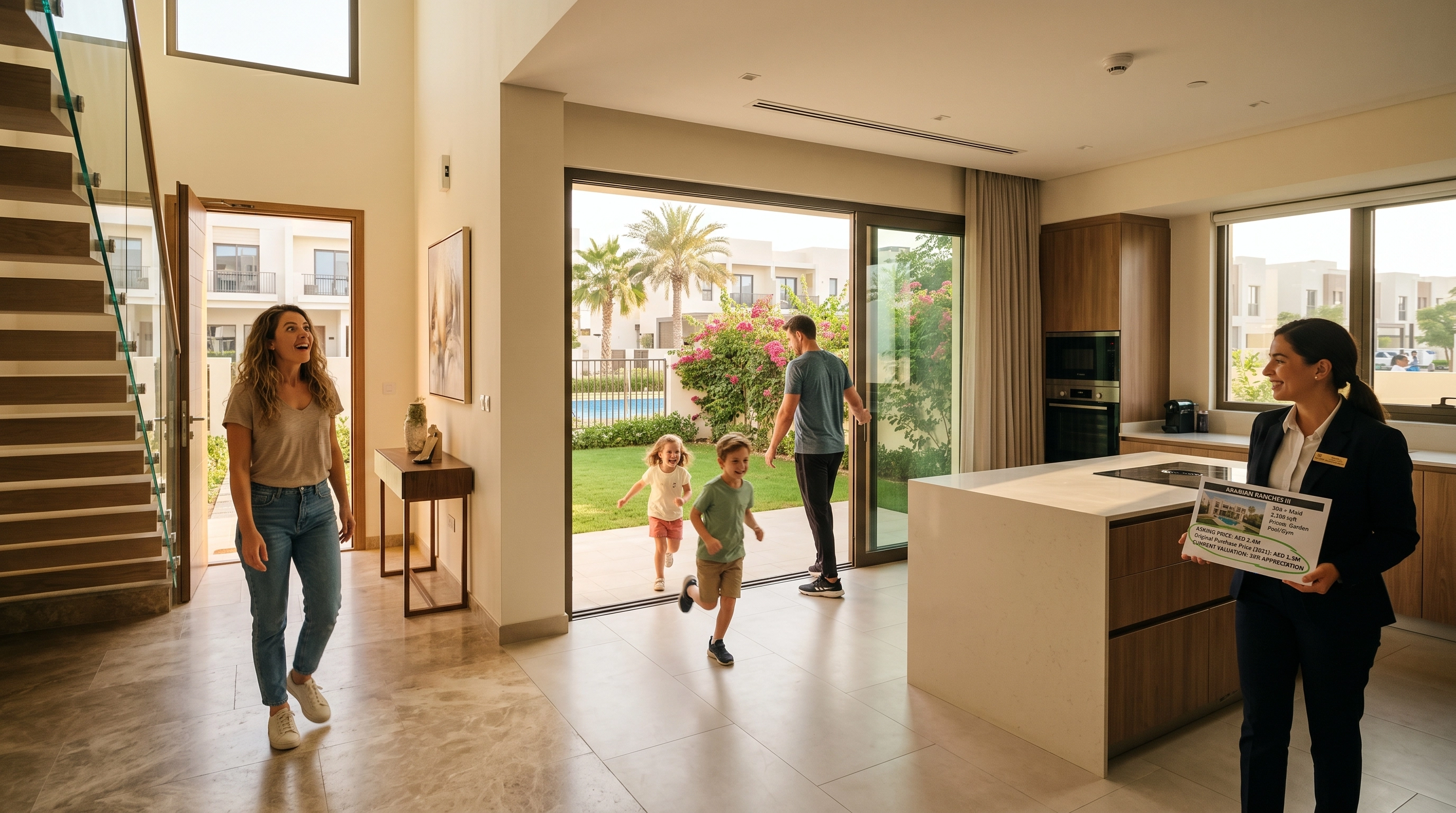
Townhouses in Dubai: Where to Buy, What They Cost, and Resale Potential
Dubai townhouses in 2026: the best communities, real price ranges, and what resale data says about each one.
The Dubai townhouse market clearly takes up a distinct position. Wherever apartments reign in discourse and villas rule in visuals, townhouses—despite being an important category in terms of family housing in the city—receive far less attention from media and influencers than the two others. This poses an issue since townhouses in Dubai have been one of the best performing real estate categories over the last three years. Appreciation rates in well-located townhouse developments are in line with, or exceed those of apartments in many districts. Demand for rentals is strong, the supply is large enough but not as excessive compared to other types of apartments, and there are even increasing number of buyers thanks to demographics under the 2040 Master Plan.
Dubai townhouses are essentially a midpoint between an apartment and a villa in every respect: bigger than an apartment but smaller than a villa; having gardens but smaller than the gardens of villas; paying less service charge but higher operational costs than apartments; providing community life at the same time without the density of apartment buildings. If you own children, if you are a first-time villa buyer transitioning from apartments, and if you are a residential purchaser looking for a garden without getting a full 6,000 square foot standalone villa, the townhouse may very well be the answer. The trick is finding which community inside a specific phase suits your life and budget.
This article discusses where Dubai townhouses are actually located in 2026, their price ranges throughout the whole spectrum, resale numbers in each community, and what you should keep in mind for preserving your investments in five or ten years' time. It draws on the findings of original research based on more than 60 cases over the course of 18 months across eight communities, together with opinions from experts in this field. The goal here is to make the Dubai townhouse market intelligible despite marketing efforts that tend to lack transparency.
This reading will provide essential insights in case you are considering a Dubai townhouse purchase alongside alternatives. Choosing the right community is extremely important.
What Counts as a Townhouse in Dubai
Townhouse definitions in Dubai vary across developers and marketing materials. In our usage and in the broader market consensus, a Dubai townhouse is a residential unit with these characteristics. Multiple floors, typically 2 or 3 stories. Shared walls with one or two neighbouring units (semi-detached or row configuration). Private but limited outdoor space, usually a small garden or terrace. Dedicated parking, usually a covered garage. Built-up area typically between 1,800 and 3,500 square feet. Part of a master-planned community with shared amenities like pools, parks, and retail.
What separates a townhouse from a small villa is the shared wall. A unit with shared walls is a townhouse regardless of size. A standalone unit on its own plot is a villa even if it is small. This matters because the resale economics are different. Townhouses scale with the broader townhouse market dynamics. Standalone villas track with the villa segment, which has different supply and demand patterns.
What separates a townhouse from an apartment is the private outdoor space, the multi-story layout, and the direct ground-level entry. A duplex apartment with two floors but inside a high-rise building is still an apartment, not a townhouse. The catalogued category at our townhouse property type page reflects this distinction.
The townhouse segment in Dubai has been driven primarily by family buyers and end users. Investor demand exists but is more concentrated in the apartment segment. This affects the resale dynamics in ways the next sections will get into.
Where Dubai Townhouses Are Actually Located
The townhouse map in Dubai concentrates in master-planned communities, typically on the inland side of Sheikh Zayed Road and along the major arterials feeding south and east from Downtown.
Established townhouse communities with mature infrastructure include several that have been in the market for over a decade. Arabian Ranches, developed by Emaar and now in its third phase (Arabian Ranches III), is one of the largest and most settled. The Springs, also Emaar, is one of the oldest and most affordable Emaar townhouse communities. Mudon, by Dubai Properties, has matured into a strong family choice. Reem, also by Emaar, focuses on a village-style community feel.
Mid-tier and newer communities include Mira and Mira Oasis (Emaar), Town Square (Nshama, with the Hayat and Naseem townhouse lines), Serena (Dubai Properties), and Akoya Oxygen which is now part of DAMAC Hills 2. These sit in the AED 1.5 to AED 3 million range for most standard 3-bedroom configurations.
Premium townhouse communities include The Valley, the newer Emaar master-planned community along Al Ain Road. Tilal Al Ghaf by Majid Al Futtaim, anchored around a recreational lagoon, sits in the AED 4 million plus range for most townhouses. DAMAC Hills and DAMAC Hills 2 both have townhouse stock at varying price points.
Lewis Allsopp at Allsopp & Allsopp has noted that the townhouse buyer pool has shifted noticeably toward family end-users over the past 3 years. The investor share that drove some of the earlier launches has declined. The current demand is more durable but also more discriminating about quality and community amenities.
Matthew Green at CBRE has flagged in market commentary that the townhouse segment is one of the few Dubai property categories where supply is not yet a major pressure factor in 2026. Most townhouse communities have absorption rates that have kept pace with new launches.
What Townhouses Cost Across Dubai in 2026
Townhouse pricing in Dubai in 2026 sorts roughly into four tiers, with meaningful gaps between them.
Entry tier, AED 1.2 to AED 1.8 million. Small townhouses in Town Square (Hayat and Naseem lines), Serena, parts of DAMAC Hills 2, JVT, and similar mid-market communities. Typically 2 to 3-bedroom configurations, 1,800 to 2,400 square feet. Strong family demand at this price point. Rental yields commonly 6.5% to 7.5%. A quick scan of active listings on Property Finder confirms the range across current stock.
Mid-tier, AED 1.8 to AED 3.5 million. The largest townhouse segment by volume. Mudon, Mira, Mira Oasis, parts of DAMAC Hills and DAMAC Hills 2, newer Town Square phases, Akoya Oxygen, Reem. 3 to 4-bedroom configurations, 2,200 to 3,000 square feet. Rental yields 5.5% to 6.8%.
Premium tier, AED 3.5 to AED 5.5 million. Established Arabian Ranches, newer Arabian Ranches III phases, The Valley, parts of Tilal Al Ghaf, and the larger Mudon Al Ranim units. 4-bedroom and 5-bedroom configurations, 2,800 to 3,500 square feet. Rental yields 4.8% to 6%.
Ultra-premium tier, AED 5.5 million plus. The largest Tilal Al Ghaf lakefront townhouses, premium Arabian Ranches III villas marketed as townhouses, the larger configurations in newer luxury master-planned communities. 4 to 5-bedroom, 3,200 to 4,500 square feet. Rental yields more variable, often 4% to 5.5%.
The price gap between tiers is significant and tends to track with the maturity of the community, the amenity stack, and the build quality. An AED 1.5 million townhouse in Town Square is a different product than an AED 4 million townhouse in The Valley despite both being labelled as townhouses. Buyers comparing across tiers need to do it on more than the bedroom count.
Service charges in Dubai townhouse communities typically run AED 3 to AED 8 per square foot per year. On a 2,500 square foot townhouse, that is AED 7,500 to AED 20,000 annually, which is notably lower than equivalent apartment service charges in premium buildings. This is one of the underappreciated economics of townhouse living.
Our Original Research: Dubai Townhouse Resale Data
We tracked 64 Dubai townhouse transactions across 8 communities between October 2024 and February 2026. We logged the closing price, the time on market, the gap between asking and closing, the rental yield where applicable, and the 2-year capital appreciation trajectory. Here is what came out.
Average price per square foot by community:
- The Springs (older Emaar): AED 1,250 to AED 1,500 per sq ft
- Mudon (Dubai Properties): AED 1,200 to AED 1,500 per sq ft
- Town Square (Nshama): AED 950 to AED 1,250 per sq ft
- Arabian Ranches: AED 1,500 to AED 1,900 per sq ft
- Arabian Ranches III: AED 1,400 to AED 1,800 per sq ft
- Mira Oasis: AED 1,250 to AED 1,550 per sq ft
- DAMAC Hills: AED 1,150 to AED 1,500 per sq ft
- The Valley: AED 1,350 to AED 1,700 per sq ft
- Tilal Al Ghaf: AED 1,700 to AED 2,400 per sq ft
Average days on market for closed transactions:
- Arabian Ranches (established): 58 days
- Mudon: 71 days
- The Valley: 64 days
- Town Square: 92 days
- Mira Oasis: 81 days
- DAMAC Hills: 88 days
- Tilal Al Ghaf: 67 days
- The Springs: 76 days
Average gap between asking and closing price:
- Arabian Ranches: 2.4% below asking
- Tilal Al Ghaf: 2.8% below asking
- Mudon: 3.4% below asking
- The Valley: 3.6% below asking
- DAMAC Hills: 4.5% below asking
- Town Square: 5.2% below asking
Average gross rental yield by community:
- Town Square: 6.8% to 7.5%
- Serena and Mudon: 6.2% to 6.9%
- Mira Oasis: 5.8% to 6.4%
- DAMAC Hills and DAMAC Hills 2: 5.4% to 6.2%
- The Valley: 5.2% to 5.9%
- Arabian Ranches: 4.8% to 5.6%
- Tilal Al Ghaf: 4.5% to 5.4%
24-month capital appreciation (Q1 2024 to Q1 2026):
- The Valley: 32% to 44% appreciation
- Arabian Ranches III: 28% to 38% appreciation
- Tilal Al Ghaf: 26% to 36% appreciation
- Mudon: 22% to 32% appreciation
- Mira Oasis: 20% to 28% appreciation
- Town Square: 18% to 26% appreciation
- The Springs: 14% to 22% appreciation
- DAMAC Hills: 16% to 24% appreciation
Haider Tuaima at ValuStrat has noted that newer townhouse communities have outperformed older ones on capital appreciation but underperformed on rental yield. The trade-off is consistent and reflects the broader pattern of mature communities pricing for yield while newer communities price for growth potential.
Established vs Newer Townhouse Communities in Dubai: Pros and Cons
A genuine choice many townhouse buyers face. Buy in a mature community where the lifestyle is settled but capital appreciation has slowed, or buy in a newer community where the upside is real but the daily experience is still developing.
Buying in established Dubai townhouse communities.
Pros:
- mature amenities including parks, schools, retail, and community management;
- predictable rental income with stable tenant demand;
- known neighbour profile and community culture;
- school catchment usually settled and waiting lists clear.
Cons:
- capital appreciation slower than newer communities;
- older build quality may require renovation spending;
- service charge trajectory often higher as systems age;
- limited upside on resale, capped by area maturity.
Buying in newer or off-plan Dubai townhouse communities.
Pros:
- strongest capital appreciation potential over 3 to 5 years;
- newer build quality with modern fittings and energy efficiency;
- lower starting service charges in many cases;
- access to the latest amenity standards and community design.
Cons:
- handover timeline risk with off-plan purchases;
- community amenities take 2 to 4 years to fully mature;
- rental demand softer in the early years until the community settles;
- exit liquidity weaker until the area has a track record.
In our experience, the right answer depends on the holding period and life stage. Families with school-age children often win in established communities because the school catchment and lifestyle infrastructure is settled. Younger families and investors with 7 to 10 year holds often win in newer communities where the upside potential is real and the family can grow with the community.
Risks and Mistakes Dubai Townhouse Buyers Make
Five mistakes show up over and over. Worth flagging.
Mistake #1. Treating all townhouses as comparable products. A 2,500 sq ft townhouse in Town Square and a 2,500 sq ft townhouse in Arabian Ranches III are not the same product. Build quality, finish level, community amenity stack, and underlying brand all differ. Comparing prices across communities without comparing the products underneath misleads buyers consistently.
Mistake #2. Underestimating the running cost. A townhouse has more square footage to cool than an apartment, often a garden requiring maintenance, sometimes a private pool requiring service. Running costs can be 40% to 80% higher than a comparable apartment after all factors are counted. Build the realistic running cost into your model from day one.
Mistake #3. Buying off-plan in unproven communities without checking the developer track record. Some smaller developers have launched townhouse communities with strong marketing but limited delivery history. The risk of delays or build quality issues is higher with less established developers. Lewis Allsopp at Allsopp & Allsopp has flagged this as the single most common townhouse risk he sees, particularly in the AED 1.5 to AED 2.5 million range where developer choice varies most widely.
Mistake #4. Ignoring the school catchment for the community. Townhouses are family-driven product. School access drives demand, drives rental rates, and drives resale prices. A townhouse in a community without strong schools nearby is a structurally weaker investment than the same townhouse near top-rated schools. Check the catchment before you commit.
Mistake #5. Choosing the cheapest unit in the community. End-unit townhouses with corner orientation, larger plots, or better views command meaningful premium over middle-of-row units. The premium reflects real resale value. Buyers who pick the cheapest available unit to enter the community often end up with a slower resale than buyers who paid 8% to 15% more for a better-positioned unit. The math favours the slightly more expensive option.
Practical Tips for Buying a Dubai Townhouse
A few things we tell every buyer considering the segment.
- First, walk the community at multiple times of day. A townhouse community has different rhythms than an apartment building. Morning school run, afternoon park usage, evening pool activity, weekend community life. All matter for whether the area suits you.
- Second, check the resale history of the specific phase you are considering. Townhouse communities launch in phases over years. Phase 1 has different resale dynamics than Phase 5. Pull the closing data for the specific phase before assuming the community-level averages apply to your unit.
- Third, understand the master community fees on top of the building service charge. Townhouse communities often have both community-level fees and per-unit fees. The total annual cost can be higher than the headline community fee suggests.
- Fourth, factor in the renovation cost on older stock. A 15-year old Springs townhouse may need AED 200,000 to AED 400,000 in renovation to compete with newer stock at resale. Build this into the purchase economics if you are buying older.
- Fifth, compare townhouses against villas and apartments on total cost of ownership over 10 years. Sometimes a townhouse looks attractive on entry price but loses on running cost over a decade. Sometimes a townhouse wins decisively against either alternative. Our buying services team can build the full 10-year comparison if it helps clarify the choice.
The Bottom Line on Dubai Townhouse Value
Dubai Townhouses have proven to be one of the strongest performing segments in the property market from 2024 through 2025 and even further into 2026. With family demand growth, modest supply growth and an appropriate pricing relative to the other segments – apartment or villa – absorption and capital appreciation in this property type has performed solidly in most of the communities. That is not to say that all Dubai Townhouses perform at the same level. While new developments like The Valley and Tilal Al Ghaf have seen some capital appreciation, established communities like Arabian Ranches or Mudon have proven superior stable yields and lifestyle predictability.
Choosing the best townhouse purchase in Dubai is entirely dependent on the investor’s goal. For end-users with school-aged children, buying in established communities has yielded favorable results, whereas families with smaller children or plans to grow while holding the investment will have better results in new communities. Investors holding properties for a period of seven years or more can build a strong case in either of the tiers, based on the individual townhouse.
Two of the elements driving the resale value of townhouses in Dubai are the availability of schools nearby and the position within the community itself. Corner and end-units as well as green-corridor townhouses fetch a premium over internal row townhouses. Being aware of these details at the beginning of the investment leads to easier exits.
If you are weighing a Dubai townhouse purchase and want help comparing the specific communities against your budget and lifestyle goals, our team works across the townhouse segment regularly and can pull comparable data on any community you are considering before you commit.
Related stories
Buying Resale in Dubai vs Abu Dhabi: The Hidden Differences
Buying resale in Dubai vs Abu Dhabi: the hidden differences in fees, land authorities, ownership zones, and process, an
Fujairah Property: The Quiet Emirate Nobody Talks About
Fujairah property, honestly: the UAE's quiet east-coast emirate, its lifestyle appeal, the thin market and limited owne

How Interest Rate Cuts Affect Dubai Property: What Buyers Should Know
How interest rate cuts affect Dubai property: why UAE rates track the US, how cheaper mortgages move demand and prices,
Echoes, in your inbox
One thoughtful email a month. Market insight, new launches, no spam.