

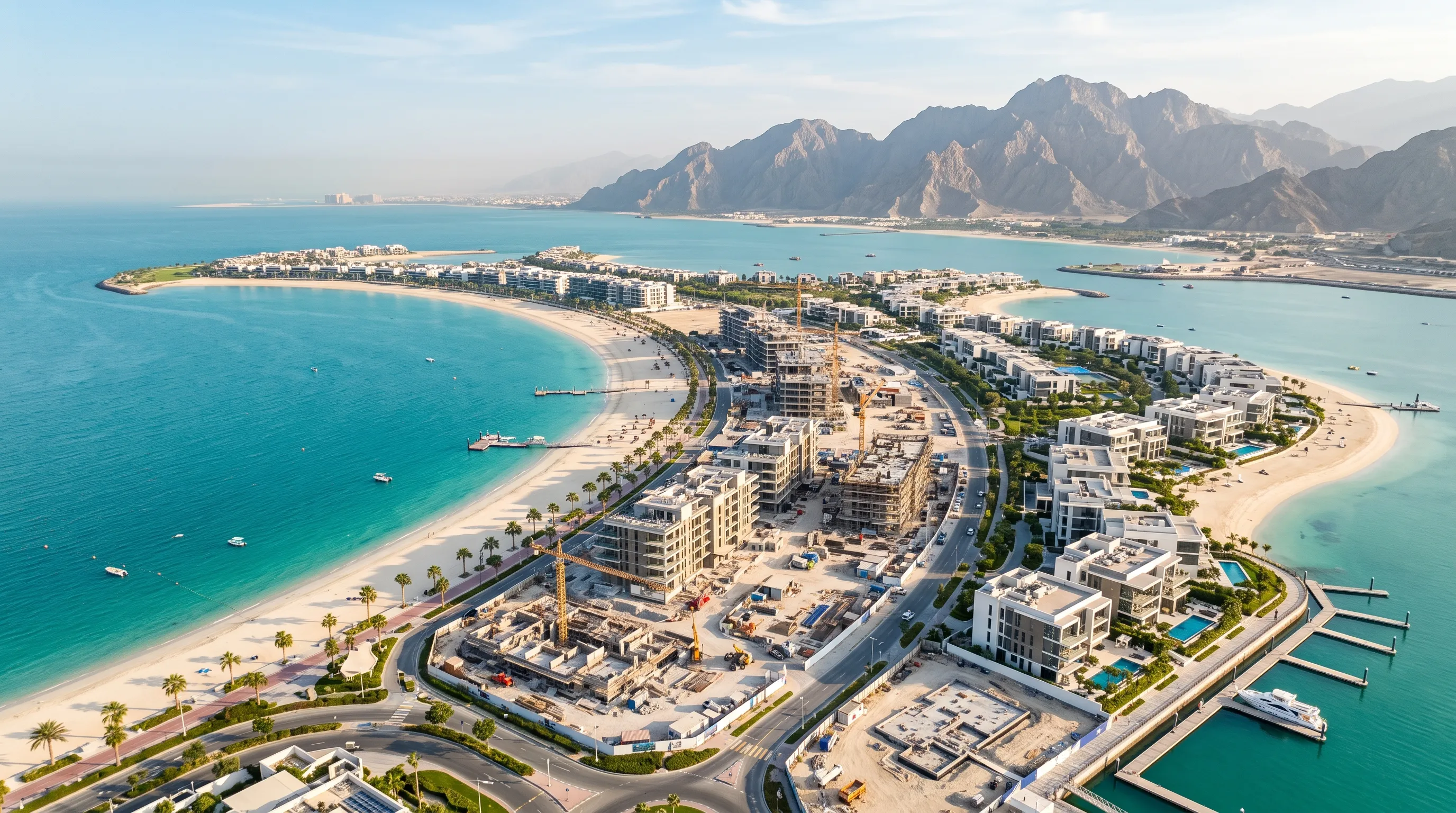
Dubai vs RAK Off-Plan Returns: Where the Smart Money Is Going
Dubai vs RAK off-plan returns, compared honestly. The proven Dubai market versus the RAK resort story, the real risks,
Just spend some time around the Dubai off-plan vs. Ras Al Khaimah (RAK) off-plan debate among investors in the UAE, and the following dilemma arises. Do you stick to the well-tested Dubai off-plan property, the known sector, or you follow the bigger figures often mentioned in the up-north Ras Al Khaimah? RAK has transformed from the silent emirate on the northern part of the UAE to the center of attraction of many investors thanks to a significant resort development in the region. In this case, the basic question to be asked is obvious: Where do smart investments go?
The straight answer to the off-plan property market choice between Dubai and RAK is simple: There is no doubt winner; who says something different tries to sell you something. It is two different kinds of bets here. Dubai provides a proven, liquid and low-risk market. RAK is an emerging market with higher risks but more possibilities because of a certain catalyst. The smart money does not choose randomly between those options; it matches the investment to its risk appetite, which is the right approach in this case in general.
The following guide presents the facts about each side: the case for the Dubai off-plan property market, the case for the RAK off-plan property market and the story behind it, the risks often ignored in both cases, and where the investment should be done. Here you have practical and solid information about the comparison.
There are two important notes to keep in mind first. As a property company, we cannot give financial advice; therefore, this information is general only. Please make your own calculations and consult others before making any decision. Second, the off-plan returns in either emirate are not assured and depend on various factors including the timing and the developer performance. Therefore, all figures presented below should be treated just as an illustration and not the current situation. Especially concerning RAK. Let us move on to the comparison then.
The Question Behind the Hype
Before picking sides, it helps to strip the question down. What you are really comparing is not Dubai against RAK as places, but two different risk-and-reward profiles wearing the off-plan label. Get that framing right and the rest gets a lot clearer.
Dubai off-plan is the established, proven option. It is a huge, mature market with a long track record, deep liquidity, broad freehold, and many developers, where returns have been strong but are increasingly well understood and priced in. RAK off-plan is the emerging, story-driven option. It is a much smaller market that has come alive on the back of a major resort and tourism push, where prices have been lower and the potential upside looks larger, but where far more rests on a single catalyst playing out. One is the steady core, the other the higher-risk bet, and that difference matters more than any headline yield. For a grounded read on how returns and prices are actually moving in both, market research from firms like Knight Frank tracks the data rather than the excitement.
Here is the real shape of the comparison:
- Dubai is proven. A mature, liquid market with a long track record.
- RAK is emerging. A smaller market riding a specific, recent catalyst.
- Dubai is lower-risk. Steadier, better understood, easier to exit.
- RAK is higher-risk. More potential upside, but more that can go wrong.
- Returns differ in kind. Dubai offers proven steadiness, RAK offers a bigger bet.
- Both are off-plan. Both carry the delays and uncertainty of buying before completion.
The trap to avoid is treating higher potential returns as if they were higher actual returns. RAK may offer a bigger upside on paper, but bigger upside always comes with bigger risk, that is how markets work, and a projection is not a payout. The investor who hears higher returns and rushes in has heard only half the sentence, because the other half is higher risk, and the two are inseparable.
So the useful way to read what follows is not as a search for the winner, but as a weighing of two trades. The proven, liquid, steadier Dubai trade, and the emerging, catalyst-driven, riskier RAK trade. Which is smarter depends entirely on you, your risk appetite, and your timeframe, and the next sections give you each case in full so you can judge for yourself.
The Dubai Off-Plan Case
Start with the incumbent, because it is the benchmark everything else is measured against. Dubai's off-plan market is the largest and most established in the region, and its main appeal is exactly that, it is proven. Decades of building, a deep pool of buyers and renters, and a long track record give it a steadiness that a newer market simply cannot match.
The strengths are about safety and liquidity as much as returns. Dubai has broad freehold ownership, a large number of established developers, and a regulatory framework built around off-plan, with registered projects and escrow accounts that release money against construction progress. That makes it relatively low-risk for an off-plan market, and just as importantly, it is liquid, you can usually resell or assign an off-plan unit before completion because there is a deep market of buyers, which is a real advantage if your plans change. Returns have been strong over time, and while prime areas are expensive and a lot of the growth is well understood, there is genuine choice across price points. You can see what is currently launching on our property launches page.
Whatever you are weighing, you can verify that any project is properly registered with escrow through the Dubai Land Department, which is the backbone of buying off-plan safely here.
Here is the Dubai off-plan case:
- Proven market. The largest and most established off-plan market in the region.
- High liquidity. You can usually resell or assign before completion.
- Broad freehold. Wide foreign ownership across many areas.
- Strong protections. Registered projects and escrow are well established.
- Many developers. A deep pool with track records you can check.
- Steadier returns. Strong over time, if increasingly well understood and priced in.
The trade-off is that proven and popular means a lot of the easy money is already known about. Prime Dubai is expensive, the market is competitive, supply is substantial, and the spectacular early-mover gains of a brand-new market are not really on the table in a mature one. You are buying steadiness and liquidity, not a secret. For many investors that is exactly right, a strong, liquid, lower-risk core holding, but it is a different proposition from chasing a catalyst.
The honest summary is that Dubai off-plan is the lower-risk, higher-liquidity, proven choice. It rewards investors who want steadiness, an easy exit, and a deep market over the chance of a dramatic catalyst-driven jump. If you value being able to sleep at night and sell when you want over swinging for the fences, Dubai is your market.
The RAK Off-Plan Case
Now the challenger, and the reason this comparison exists at all. Ras Al Khaimah has become an investor talking point almost entirely because of one thing, a major integrated resort development on Al Marjan Island, anchored by the Wynn Al Marjan Island resort, a large integrated resort with gaming that is set to be among the first of its kind in the region. That single catalyst has reshaped the RAK story and drawn a wave of attention and capital to the emirate.
The case is built on that catalyst and what it could mean. A landmark resort of that scale promises a surge in tourism, jobs, and demand, the kind of thing that can lift property values and rental demand across a previously quiet market, and early movers into an emerging market sometimes capture outsized gains if the story delivers. RAK has historically offered lower entry prices than prime Dubai, so the appeal is a cheaper way in with a larger potential upside, concentrated around Al Marjan Island and nearby. RAK also allows foreign freehold in designated areas such as Al Marjan Island, Al Hamra, and Mina Al Arab, which keeps the door open to overseas investors. You can get a feel for the area at the centre of it all through our Al Marjan Island guide.
Here is the RAK off-plan case:
- A major catalyst. A landmark integrated resort driving the whole story.
- Tourism upside. A potential surge in visitors, jobs, and demand.
- Lower entry prices. Historically cheaper to buy into than prime Dubai.
- Early-mover potential. Emerging markets can reward those in early, if the story delivers.
- Foreign freehold. Designated areas like Al Marjan Island are open to overseas buyers.
- A concentrated bet. Most of the upside rests on one catalyst landing as planned.
The words that matter most in all of that are could and if. The resort is a target with an opening timeline that can move, the boom is a projection rather than a fact, and much of RAK's investment case rests on this one development delivering on schedule and drawing the visitors expected. That is genuine potential, but it is also concentration, a lot riding on a single story, in a smaller and less liquid market than Dubai. As a rough illustration, a budget around AED 1 million that buys a modest off-plan unit in RAK might buy considerably less in prime Dubai, but the cheaper entry comes with the higher uncertainty, not instead of it.
The honest summary is that RAK off-plan is the higher-risk, higher-potential, story-driven bet. It rewards investors who believe in the catalyst, can take on more risk and less liquidity, and can hold while the story plays out. If you want a bigger swing and can stomach a bigger miss, RAK is the more exciting market, as long as you go in seeing the bet for what it is.
The Risks Both Sides Skip
Every investment pitch leads with the upside and mumbles the risks. So here is the part the brochures rush past, for both markets, because understanding the downside is what separates an investor from a gambler.
The first risk applies to both. Off-plan is off-plan everywhere, which means you are buying something not yet built, on a timeline that can slip, from a developer who has to deliver, so delays, design changes, and the occasional stalled project are real possibilities in either emirate. The protection against this is the same in both, a registered project with your money in escrow and a developer whose track record you have checked, and skipping that diligence is the single biggest avoidable risk regardless of which market you choose. The general framework for property and investment sits within the UAE government portal, but the specific checks are on you and your advisers.
Here are the risks to weigh on each side:
- Off-plan delay risk. Both markets can see timelines slip and projects stall.
- RAK concentration. A lot of the RAK case rests on one catalyst landing as planned.
- RAK liquidity. A smaller market can be slower and harder to sell in.
- RAK timing. The resort timeline is a target that can move, changing the story.
- Dubai supply. A large, competitive market with substantial new supply coming.
- Returns are not promised. Projected returns in either market are never guaranteed.
Then come the differences. RAK carries concentration risk, a great deal riding on a single resort story delivering on time and drawing the crowds, plus lower liquidity, meaning if you need to sell, a smaller market can be slower and less forgiving than Dubai's deep one. Dubai carries its own risks, chiefly that it is competitive with substantial supply, so not every project is a winner and the easy gains are harder to find. Neither set of risks is a reason to avoid the market, but pretending they do not exist is how investors get hurt.
The honest summary is that both markets can disappoint as well as reward, in different ways. RAK can disappoint if the catalyst slips or underwhelms, or if you need to exit a thin market. Dubai can disappoint if you overpay into a crowded segment. Go in with the risks in full view, do the diligence, and never invest more than you can afford to have tied up or to see fall, because that is true of off-plan in any emirate.
Where the Smart Money Actually Is
So, back to the question in the title. Where is the smart money going? The honest answer is the least glamorous one, smart money is not going all-in on either, it is matching the bet to its appetite and timeframe, and often spreading across both.
We lined up common investor priorities against the market that tends to fit, each on one line:
- You want steadier, proven returns: Dubai, with a mature and far more liquid off-plan market.
- You want higher potential upside and can take more risk: RAK, riding the resort and tourism story.
- You want to exit quickly if needed: Dubai, where reselling off-plan is much easier.
- You believe in the RAK catalyst and can hold: RAK, if the resort timeline and story play out.
- You want lower entry prices: RAK has historically offered cheaper entry than prime Dubai.
- You want a core, lower-risk holding: Dubai, with RAK better suited as a smaller, riskier satellite.
The pattern that genuinely sophisticated investors follow is not picking a winner but sizing the bet. Dubai tends to play the role of the core, the proven, liquid holding you can rely on and exit, while RAK plays the role of the satellite, a smaller, higher-risk position taken deliberately because you believe in the catalyst and can afford the risk. That is what smart money usually looks like, not a single bold call, but a core-and-satellite balance matched to how much risk you actually want. Investment-focused buyers exploring this often look at our hot properties across the proven market while weighing a smaller emerging-market position separately.
The other half of smart is not over-betting the catalyst. RAK's resort story is genuinely interesting, but putting everything into a single emerging market on a single catalyst is a concentration most experienced investors would not make, however exciting it sounds. If RAK fits your risk appetite, it fits as part of a balanced position, not as the whole of it, and that restraint is itself a mark of smart money.
The honest read is that where the smart money is going is wherever it is matched to the investor's own risk, timeframe, and need for liquidity, with diversification doing the quiet work. For most, that means a proven Dubai core, with RAK as an optional, sized, eyes-open satellite for those who want the swing. The smart move is not choosing the hot market, it is choosing the right balance for you.
What We Would Actually Do
Ultimately, this is not a fight to the finish between Dubai and RAK. This is a choice between two different risk profiles. Dubai is a solid, liquid, less risky core play with steady returns and a simple way out. RAK is an emerging, catalyst-based and high risk play, with high upsides in case the resort story is realized but many more things that can go wrong. Both plays are off-plan and hence are subject to all off-plan risks.
If a friend asks us about investment advice, we will not provide him with the latest hot stock tip. We will ask about his profile. What kind of risk he can afford to bear? What is his holding period? Does liquidity matter? Depending on the answers we will suggest proper allocation. Cautious investor who needs liquidity will mostly fit into Dubai scheme. But the patient investor with risk tolerance can allocate a part of his portfolio in RAK play on the catalyst.
We should also emphasize the important caveats. Returns are not guaranteed; off-plan schemes always slip; the RAK story is a projection and not a sure thing. Therefore, one needs to check the current status of the investment and do the calculations himself before allocating any money. In any case, regardless of allocation, do your homework – check for the registration of the project, escrow system, developer that can deliver – these safeguards work in both emirates.
The main mistake made by the investors we see quite often is investing in an exciting story without sizing properly the risk involved. Over-allocation of funds to a single emerging market catalyst just because of potentially huge return and ignoring the fact that high upside carries also high risks. Properly sized investment according to the risk tolerance, balanced with a solid core and a satellite on a catalyst, this is the principle prudent capital works on.
If you need assistance with off-plan investment opportunities in both emirates and sizing it accordingly to your objectives, this is our business. Our property buying service can lay the proven and the emerging side by side and be straight about the risks.
And if you want a frank, non-hype conversation about where your money actually fits, we are glad to help. Get in touch and we will take it from there.
Related stories
Buying Resale in Dubai vs Abu Dhabi: The Hidden Differences
Buying resale in Dubai vs Abu Dhabi: the hidden differences in fees, land authorities, ownership zones, and process, an
Fujairah Property: The Quiet Emirate Nobody Talks About
Fujairah property, honestly: the UAE's quiet east-coast emirate, its lifestyle appeal, the thin market and limited owne

How Interest Rate Cuts Affect Dubai Property: What Buyers Should Know
How interest rate cuts affect Dubai property: why UAE rates track the US, how cheaper mortgages move demand and prices,
Echoes, in your inbox
One thoughtful email a month. Market insight, new launches, no spam.