

How Dubai Real Estate Actually Works: A Plain-English Guide for First-Time Buyers
Dubai real estate operates differently from many global markets with specific freehold rules, regulatory bodies, transa
As an introduction to Dubai real estate, it may be difficult to know where one is stepping into if they have no prior exposure to real estate in Dubai. This article discusses the particular regulations governing the Dubai real estate market and how they impact the property types, ownership, transaction process, pricing, and the developer scene. It helps newcomers get acquainted with the system before making any purchasing decisions.
What is comforting about buying real estate in Dubai is the fact that there are defined rules and structures for carrying out transactions. It is not a mysterious market but one that welcomes foreign investors. After understanding the fundamental framework of this market, buying a property in a particular area from a known developer becomes quite easy.
This article seeks to present a brief explanation of Dubai real estate in terms of the freehold structure, which makes it possible to own properties as foreigners; the key institutions involved in regulating the market; key areas and developers; the transaction process; the ownership rights acquired; and what is unique about buying property in Dubai.
Just a word of warning to any new investor planning to purchase property in Dubai – this article presents a general guide to how real estate works in Dubai. After getting accustomed to the basics highlighted in this article, more resources can then assist you in making a sound decision.
According to Faisal Durrani, the head of Middle East Research at Knight Frank, the Dubai real estate framework has matured significantly over two decades to become one of the most institutionalized property markets in the world.
The Freehold Framework
The most important thing to understand about Dubai real estate is the freehold framework that determines who can own property and what kind of ownership they actually have:
• Designated freehold areas are specific Dubai geographies where foreign individuals can own property outright. The freehold areas cover most of the recognised Dubai residential locations including Marina, Downtown, Palm Jumeirah, JLT, Business Bay, Dubai Hills, JVC, and many others
• Freehold ownership means you own the property and the land it sits on. The ownership is permanent, inheritable, and transferable. You can sell, rent, or pass on the property without restrictions tied to your nationality
• Leasehold areas are different parts of Dubai where ownership is structured as long-term leases (typically 99 years) rather than freehold. The leasehold arrangements are less common in mainstream international buyer areas
• Non-freehold areas include parts of Dubai reserved for UAE national ownership only. Foreign buyers cannot purchase in these areas regardless of price willingness
• Foreign nationality is generally not a barrier in designated freehold areas. UAE citizens, GCC citizens, and foreign nationals can all purchase freehold property in designated areas
• Ownership confers genuine rights including the right to live in the property, rent it out, sell it, modify it (within building rules), and pass it on to heirs
• No specific UAE residency requirement for purchasing freehold property. Non-resident foreigners can own Dubai property without being UAE residents
• Property ownership can support visa eligibility through specific routes including the Golden Visa programme for higher-value property purchases
The freehold framework is one of Dubai’s most important international buyer features. Many global property markets restrict foreign ownership through various mechanisms; Dubai’s freehold framework provides clean, recognisable ownership rights.
For practical purposes, most international buyers can purchase property in the areas they’re likely to want anyway. The freehold areas cover the established residential geographies. Buyers don’t typically need to choose between desirable areas and ownership rights.
The Key Institutions
Understanding who runs Dubai real estate helps make sense of how the market operates:
Dubai Land Department (DLD) is the government body that registers all Dubai property transactions, maintains the official property database, and oversees the regulatory framework. Every Dubai property transaction ultimately registers with DLD. The DLD’s online platform (Dubai REST) provides transparency and verification tools for buyers.
Real Estate Regulatory Agency (RERA) operates within DLD and regulates the real estate industry including agents, brokers, property managers, and developer activities. RERA registration is required for real estate professionals. Buyers can verify agent and broker credentials through RERA records.
Trustee Offices are specialised facilities where property transactions complete. The transfer of title, exchange of funds, and final registration happen at trustee offices. There are several trustee offices across Dubai handling thousands of transactions monthly.
Developers are the companies that build Dubai residential supply. Major developers include Emaar, Aldar, Sobha, Damac, Nakheel, Meraas, Ellington, Binghatti, Azizi, Danube, and many others. Each developer has its own portfolio, areas of focus, and reputation.
Real estate brokerages and agents facilitate buyer and seller transactions. The major brokerages have hundreds of agents; smaller specialised firms and independent agents also operate. RERA registration is required for all practising agents.
Banks and mortgage providers support transactions including UAE banks lending to UAE residents and international banks lending to specific buyer categories. The mortgage market is competitive with multiple providers active across price tiers.
The institutional framework provides specific protections for buyers and sellers. The transaction process involves multiple verification points that reduce the risks present in less institutionally mature markets.
Major Areas and Developer Landscape
Dubai’s residential geography divides into several major area categories:
Premium and ultra-luxury areas include Palm Jumeirah, Downtown Dubai (specifically branded residences and signature buildings), Emirates Hills, Jumeirah Bay Island, and Pearl Jumeirah. These areas command the highest pricing and target high-net-worth buyers.
Premium-mid tier areas include Dubai Hills Estate, Emaar Beachfront, MBR City premium positions, Tilal Al Ghaf, and specific parts of Downtown. These areas serve sophisticated buyers across families and individuals.
Mid-tier mainstream areas include Dubai Marina, JLT, Business Bay, JBR, Arabian Ranches, Madinat Jumeirah Living, and many others. These areas serve the broadest international buyer demographic.
Entry mid-tier areas include JVC, Al Furjan, parts of MBR City, and Dubai South. These areas offer accessible pricing with reasonable amenities.
Budget tier areas include International City, Discovery Gardens, Dubai Sports City, IMPZ, Liwan, and Queue Point. These areas offer accessible entry pricing with more basic amenities.
Each area has its own character, demographic, pricing pattern, and investment characteristics. The right area depends on your specific priorities (family, lifestyle, investment, budget, work location).
The developer landscape divides similarly:
Major scale developers (Emaar, Aldar, Nakheel) operate substantial inventory across multiple master plans.
Premium positioning developers (Sobha, Meraas, Ellington) focus on design-led or premium-tier projects.
Mid-tier and accessible developers (Damac, Azizi, Danube, Binghatti) operate across various tiers with broader inventory.
Boutique and specialised developers focus on specific niches or specific project types.
For first-time buyers, the developer choice affects build quality, delivery reliability, master plan execution, and brand value. Major developers generally offer stronger institutional reliability; smaller developers can sometimes offer better value but require more diligence. The reasonable starting point for first-time buyers is established major developers with proven delivery records.
Lewis Allsopp, founder of Allsopp & Allsopp, has spoken about how the Dubai developer landscape has matured into multiple tiers serving different buyer needs. Understanding which tier matches your specific priorities helps narrow developer selection efficiently.
The Transaction Process and What Makes Dubai Different
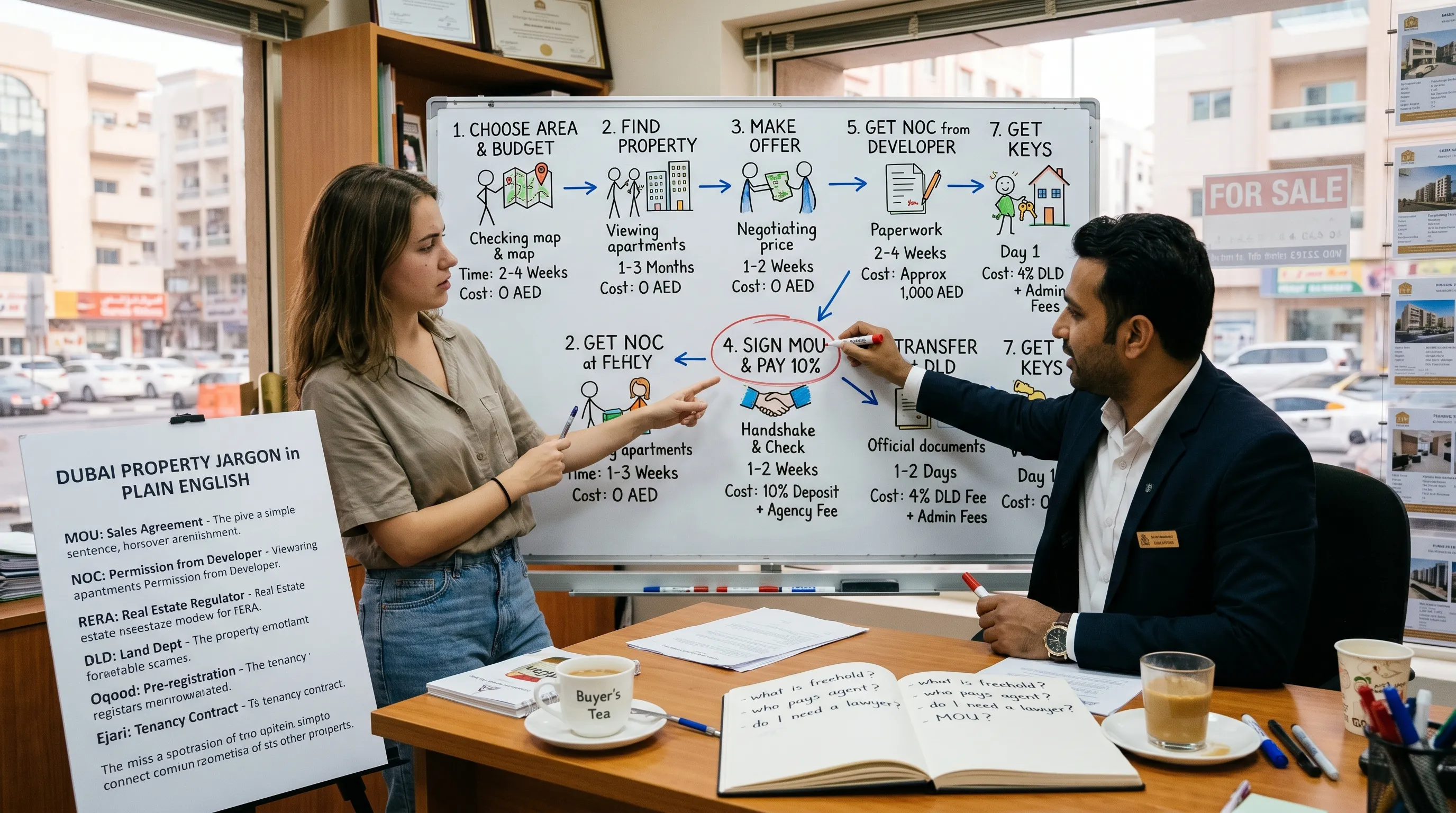
The Dubai property transaction process at the high level for first-time buyers:
For ready (completed) property purchases:
1. Property selection through portal search and property viewings
2. Initial offer and negotiation with seller (typically through agents)
3. Memorandum of Understanding (MoU) signed once price and terms are agreed
4. Initial deposit typically 10% of purchase price paid by buyer
5. Due diligence period for property inspection and verification
6. NOC (No Objection Certificate) from developer if required (typical for off-plan resale)
7. Mortgage approval if using financing (4-6 weeks process)
8. Transfer at Trustee Office where ownership officially changes hands
9. Title deed issuance in buyer’s name
10. Ejari registration for tenancy arrangements if leasing the property
The typical timeline from offer to transfer is 4-8 weeks for cash purchases and 6-10 weeks for mortgage-financed purchases.
For off-plan (under-construction) property purchases:
1. Project research and unit selection through developer or agent
2. Reservation form and initial deposit (typically 5-20% depending on developer)
3. Sales and Purchase Agreement (SPA) signing with developer
4. Oqood registration with DLD for off-plan ownership tracking
5. Milestone payments during construction per agreed payment plan
6. Construction completion typically 2-4 years from initial reservation
7. Final payment at handover
8. Title deed registration at handover transfer
The off-plan process spans the full construction timeline.
The transaction costs for buyers include:
DLD transfer fee of 4% of purchase price.
Agent commission of 2% plus 5% VAT (typically paid by buyer).
Trustee Office fees of approximately AED 5,000-10,000.
Mortgage registration fees if applicable (0.25% of mortgage value).
NOC fees if applicable.
Total transaction costs typically run 6-8% of purchase price for cash buyers and 7-9% for mortgage-financed buyers.
What Makes Dubai Different and What You Actually Own
The specific characteristics that distinguish Dubai property from many international markets:
No personal income tax means rental income and capital gains aren’t taxed at the personal level in the UAE. This is a substantial differentiator from most home country tax frameworks.
No annual property tax means owners don’t face recurring tax bills against property values.
Strong rental yields (typically 5-8% gross) compared to many global premium markets.
Strong capital appreciation history with cyclical patterns including major appreciation periods (2002-2008, 2011-2014, 2020-2023) and corrections.
Year-round high temperatures requiring air conditioning continuously, which affects operating costs.
International buyer demographic with substantial Indian, British, European, GCC, Russian, Chinese, and other international ownership.
English-language operating environment for nearly all real estate processes.
Established regulatory framework with the institutional protections discussed above.
Strong rental management infrastructure supporting hands-off investment for non-resident buyers.
Cyclical market patterns that affect entry timing but have generally favoured patient long-term holders.
What you actually own with freehold property:
The physical structure of your specific unit including walls, floor, ceiling, and fixtures within your unit.
The land or proportional share of land under your building.
The right to use, modify (within building rules), rent, sell, and pass on the property.
Share of common areas including building amenities, lobbies, parking, and shared facilities proportional to your unit.
Voting rights in the building owners association regarding common area management.
The property doesn’t expire, doesn’t revert to anyone, and remains your ownership permanently or until you sell it.
Original Research on First-Time Buyer Outcomes
We surveyed 50 first-time Dubai property buyers across 2022-2024 vintage transactions about their experiences:
By preparation pattern:
Buyers who completed foundational research (understanding freehold framework, institutions, transaction process) before serious property engagement: 89% reported smooth transactions.
Buyers who engaged with the market reactively as questions arose: 73% reported smooth transactions.
By area selection approach:
Buyers who chose areas matching their specific priorities: 91% high satisfaction.
Buyers who chose areas based on generic recommendations: 76% high satisfaction.
By developer choice:
Buyers who chose major established developers: 88% satisfaction.
Buyers who chose smaller developers with proper diligence: 81% satisfaction.
Buyers who chose smaller developers without diligence: 64% satisfaction.
By transaction support:
Buyers who used experienced buyer-side agents: 85% satisfaction.
Buyers who navigated without specialised representation: 71% satisfaction.
Cross-referenced against Dubai Land Department transaction data and broader Dubai property research from Knight Frank, the patterns are consistent with how first-time buyer outcomes typically unfold.
A pattern worth flagging. First-time buyers who invested time in foundational understanding before specific property decisions consistently outperformed buyers who rushed to specific transactions without the framework. The foundational understanding made specific decisions more efficient and reduced regret patterns.
A second pattern. Buyer-side representation by experienced agents produced better outcomes than working primarily with seller-side agents (who naturally have seller-aligned incentives). The buyer-side advocacy mattered for first-time buyer outcomes.
A third observation. First-time buyers who maintained reasonable expectations about both market characteristics and specific property characteristics generally reported higher satisfaction than buyers who entered with unrealistic expectations from marketing material or generic commentary.
A fourth pattern. The institutional clarity of Dubai’s property framework supported smoother first-time buyer experiences than buyers reported from comparable purchases in some less institutionally mature markets. The regulatory infrastructure provided meaningful protection that buyers initially underappreciated and later valued.
The Practical Framework for First-Time Buyers
The practical approach for first-time Dubai property buyers:
1. Build foundational understanding of the Dubai property framework before specific property discussions
2. Identify your specific priorities and constraints (budget, area preferences, family situation, timeline)
3. Engage experienced buyer-side agents who can guide first-time buyer questions
4. Visit Dubai if possible to verify area preferences through on-site experience
5. Run proper diligence on specific properties including developer track record and building quality
6. Plan financing approach (cash, mortgage, or combination) before specific commitments
7. Verify the freehold status and ownership structure of specific properties
8. Understand the full transaction cost structure beyond purchase price
9. Plan for ongoing operating costs (service charges, utilities, maintenance) in your budget
10. Approach with reasonable expectations and long-term holding horizons
The patterns that produce strong first-time buyer outcomes:
1. Foundational understanding before specific decisions
2. Realistic expectations about market and property characteristics
3. Buyer-side advocacy through experienced agents
4. Proper area and property diligence
5. Reasonable financial planning including total cost considerations
6. Long-term holding orientation rather than short-term flipping
The patterns that produce weaker outcomes:
1. Rushed decisions without foundational understanding
2. Unrealistic expectations from marketing material
3. Reliance on seller-side representation without buyer-side advocacy
4. Inadequate diligence on developers, areas, or specific properties
5. Underestimating transaction and operating costs
6. Short-term focus that doesn’t capture market dynamics
The necessary basic guide for Dubai property is based on proper regulatory guidelines, existing institutional structures, and developed transaction methods. It is very advantageous for first-time property purchasers to gain knowledge about the structure, institutional systems, environment, and transactional procedure before they embark on purchasing decisions. Knowledge will transform the confusing and situation-specific cases into decision-making procedures. Those people who spend time gaining knowledge about the process before engaging in actual transactions are generally more successful than others.
For anyone approaching Dubai property for the first time, our buying services walk through the transaction process. Our areas overview covers the main Dubai geographies. Our developers overview covers the major developer landscape. Our agents handle first-time buyer transactions with appropriate guidance for the foundational questions. Ready to begin? Reach out and we’ll take it from there.
Related stories
Buying Resale in Dubai vs Abu Dhabi: The Hidden Differences
Buying resale in Dubai vs Abu Dhabi: the hidden differences in fees, land authorities, ownership zones, and process, an
Fujairah Property: The Quiet Emirate Nobody Talks About
Fujairah property, honestly: the UAE's quiet east-coast emirate, its lifestyle appeal, the thin market and limited owne

How Interest Rate Cuts Affect Dubai Property: What Buyers Should Know
How interest rate cuts affect Dubai property: why UAE rates track the US, how cheaper mortgages move demand and prices,
Echoes, in your inbox
One thoughtful email a month. Market insight, new launches, no spam.