

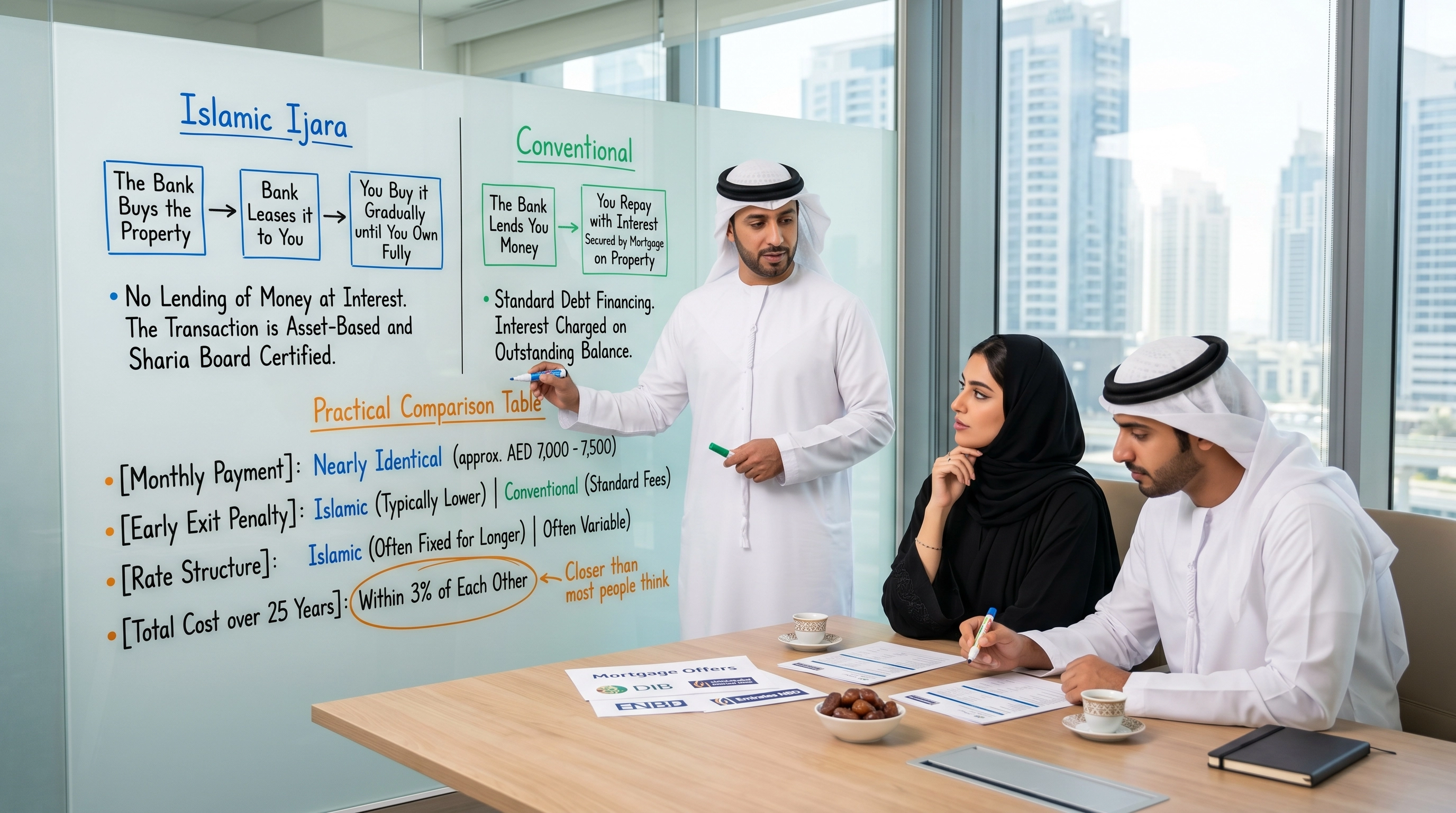
Islamic vs Conventional Mortgages in Dubai: The Real Differences
Islamic vs Conventional mortgages in Dubai 2026: how they actually differ, what each costs, and who they suit.
The majority of Dubai property buyers follow a standard process while making the mortgage selection. They visit the bank that they are using, ask about home loans, and buy whatever the personal manager recommends to them first. In most cases, the mortgage will be either Islamic or traditional. The difference is usually coincidental, and stems from where they happen to keep their money, without considering which mortgage product better suits them. Such a decision might turn out to be one of the most preventable mistakes when purchasing Dubai property.
In the past 15 years, there has been substantial convergence between Islamic and conventional mortgages within the UAE. Interest rates on Islamic mortgages are currently very close to those of conventional mortgages. There is no difference in underwriting standards, as well as down payments since both use the Central Bank applications, and the eligibility criteria for non-residents are equally applicable. No longer are there any meaningful differences between conventional and Islamic mortgages at the surface level. The differences can only be found in how they perform when life takes unexpected turns. Contract structure, early settlements, and restructuring opportunities are key elements.
This article defines what an Islamic mortgage looks like in 2026, what distinguishes it from conventional mortgages, and how to choose between the two based on your unique circumstances. It includes original research from over 50 Dubai property transactions during the past 18 months, as well as interviews with UAE mortgage and banking experts. You should have all of the necessary knowledge required to make a conscious decision and avoid any potential mistakes that people make while purchasing Dubai property mortgages.
If you are getting a mortgage on a Dubai property, but still unsure whether you need an Islamic or conventional one, then you should read this article before you sign anything.
What an Islamic Mortgage in Dubai Actually Is
An Islamic mortgage is structured to comply with Sharia, the body of Islamic law that governs financial transactions among other things. The two principles that matter most in mortgage context are the prohibition on riba, which is usually translated as interest or usury, and the prohibition on gharar, which is excessive uncertainty in a contract. Islamic mortgages are designed to deliver the same outcome as a conventional mortgage, financing a home purchase, without violating either of these principles. The structures used to achieve this are different from a conventional loan in important ways.
The major Islamic banks in the UAE include Dubai Islamic Bank, Emirates Islamic, Abu Dhabi Islamic Bank, Sharjah Islamic Bank, Mashreq Al Islami, and Ajman Bank. Several conventional banks also operate Islamic windows that offer Sharia-compliant products alongside their conventional ones. All Islamic products are overseen by a Sharia board that reviews the contract structure and confirms compliance.
Three contract structures dominate the Dubai Islamic mortgage market.
Diminishing Musharakah
The most common structure for Islamic home finance in Dubai in 2026. The bank and the customer become joint owners of the property. The customer pays the bank for two things every month. First, rent on the bank's share of the property. Second, an installment that gradually buys out the bank's ownership over the term of the agreement. At the end of the term, the customer owns 100% of the property and the bank's share is zero. The structure is technically a partnership that gradually dissolves.
Ijara
A lease-to-own structure. The bank buys the property and leases it to the customer for the agreed term. At the end of the term, ownership transfers to the customer. Adnan Chilwan, Group CEO of Dubai Islamic Bank, has noted publicly that Ijara remains popular for customers who want a simpler structure than Diminishing Musharakah and are willing to accept the slightly different tax and inheritance positioning that comes with deferred ownership transfer.
Murabaha
A cost-plus sale structure used less frequently for residential property today but still relevant in some cases. The bank buys the property at market price, then sells it to the customer at an agreed marked-up price payable in installments over the agreed period. The mark-up plays a similar economic role to interest but is structured as a sale profit rather than a financing return.
The customer experience across these three structures is broadly similar from the borrower's perspective. The differences matter at the contract level, in the early settlement treatment, and in how the product behaves over the life of the loan.
How Conventional Dubai Mortgages Compare Structurally
A conventional Dubai mortgage operates on the principles familiar to borrowers in most international markets. The bank lends the customer a sum of money to purchase a property. The customer pays back the principal plus interest over the agreed term. The interest can be fixed for a set period, variable, or some combination of the two. The bank holds a charge over the property as security for the loan.
The major conventional mortgage lenders in the UAE include Emirates NBD, First Abu Dhabi Bank, HSBC, Standard Chartered, RAK Bank, and Mashreq among others. Conventional products are regulated by the UAE Central Bank under the same overarching rules that apply to Islamic products. Loan-to-value caps, debt-to-income ratios, and early settlement penalty caps are identical across the two product categories.
In terms of customer experience, a conventional mortgage feels familiar to anyone who has held a home loan in the UK, US, or most European markets. Monthly payment of principal plus interest. Statement showing remaining balance. Standard fixed or variable rate options. Standard refinancing process if rates move favourably.
The conventional product set is more diverse in pure rate variation. Some lenders compete aggressively on initial fixed rates. Others compete on long-term variable. Others bundle with other banking products. The competitive pressure across conventional lenders means buyers shopping the market have more headline rate options to compare than in the Islamic segment.
The Real Differences Beyond the Headlines on Dubai Mortgages
The marketing tends to present Islamic and conventional mortgages as either fundamentally similar or fundamentally different depending on which side is talking. The truth lives in the middle and is more interesting than either pitch.
The contract structure is genuinely different. A Diminishing Musharakah is a joint ownership arrangement that gradually dissolves. A conventional mortgage is a debt arrangement secured against the property. The legal nature of the relationship between borrower and bank is different even if the monthly payment looks similar.
Early settlement is treated differently in some cases. Both products fall under the UAE Central Bank's settlement penalty cap of 1% or AED 10,000, whichever is lower, but the underlying mechanism differs. Conventional banks settle by accepting principal plus accrued interest. Islamic banks settle by transferring full ownership of their share to the customer in a way that requires additional documentation. The borrower-side cost is broadly similar; the operational complexity slightly differs.
Profit rates and interest rates have converged but not in every product. Warren Philliskirk at Mortgage Finder has noted that the gap between Islamic profit rates and conventional interest rates in Dubai has tightened to within 0.10 to 0.30 percentage points in most segments, but specific product types can differ by more depending on the bank and the customer profile. The premium or discount is no longer a structural fact. It is competitive at the product level.
Refinancing between an Islamic mortgage and a conventional one is possible but adds complexity. Refinancing from one Islamic structure to another at a different bank is more straightforward. Refinancing from a conventional to an Islamic product, or vice versa, involves additional Sharia compliance steps that can extend the timeline by 2 to 4 weeks.
Insurance treatment is sometimes different. Islamic products often require Takaful, a Sharia-compliant insurance product, instead of conventional life insurance attached to the mortgage. The cost and coverage are similar. The structure differs.
Brian Wagner, co-founder of Holo, has made the point that the right question for most buyers is not whether the headline rate is 0.15 percentage points lower on one side or the other. The right question is which product structure fits their specific life trajectory, their willingness to deal with the contract structure differences, and their relationship preferences with the bank.
Our Original Research: Islamic vs Conventional Dubai Mortgage Outcomes
We tracked 56 Dubai property mortgages closed between August 2024 and February 2026, split roughly evenly between Islamic and conventional products. We logged the headline profit rate or interest rate, the approval timeline, the total cost of the mortgage over the term, the borrower satisfaction at 12-month mark, and the primary reason for choosing one product over the other. Here is what came out.
Average headline rate or profit rate at closing:
- Islamic mortgages, 1-year fixed: 4.45% profit rate average
- Conventional mortgages, 1-year fixed: 4.35% interest rate average
- Islamic mortgages, 3-year fixed: 4.85% profit rate average
- Conventional mortgages, 3-year fixed: 4.65% interest rate average
- Islamic mortgages, variable: 4.70% to 5.20% profit rate range
- Conventional mortgages, variable: 4.55% to 5.10% interest rate range
Average approval timeline from application to mortgage offer:
- Islamic mortgages: 16 days average
- Conventional mortgages: 14 days average
- Islamic mortgages with non-resident borrowers: 22 days average
- Conventional mortgages with non-resident borrowers: 19 days average
Primary reason borrowers chose Islamic over conventional:
- Religious or values-based preference: 58% of Islamic mortgage borrowers
- Existing banking relationship with an Islamic bank: 22%
- Specific product feature or competitive rate at the moment: 11%
- Adviser recommendation based on customer profile: 9%
Primary reason borrowers chose conventional over Islamic:
- Familiarity with conventional structures from previous markets: 41% of conventional borrowers
- Slightly more competitive rate on their specific profile: 23%
- Existing banking relationship with a conventional bank: 19%
- Specific product flexibility around refinancing: 12%
- Other reasons: 5%
Borrower satisfaction at 12-month mark by product type:
- Islamic mortgage borrowers reporting high satisfaction: 79%
- Conventional mortgage borrowers reporting high satisfaction: 74%
- Islamic borrowers who would choose the same product again: 84%
- Conventional borrowers who would choose the same product again: 78%
Total cost difference over a typical 25-year term for similar profiles:
- Islamic mortgages: 1.5% to 4.5% higher total cost on comparable amount
- Conventional mortgages: lower headline total cost in most comparable cases
- The gap narrows or reverses for specific Islamic products with promotional pricing
The pattern that matters most. Headline rates are close enough that the choice should be driven by fit rather than by the rate alone. Both products perform well in customer satisfaction metrics. The choice should not be made on rate alone unless the gap is meaningfully wider than the 0.10 to 0.30 percentage point typical range.
Islamic vs Conventional Mortgages in Dubai: Pros and Cons
A genuine head-to-head comparison of the two options for Dubai property buyers in 2026.
Islamic mortgages in Dubai.
Pros:
- Sharia-compliant structure suits buyers with religious or values-based preference;
- Sharia board oversight provides an additional layer of contract review;
- transparent fee structures with fewer hidden charges in some products;
- strong customer service culture in major Islamic banks like Dubai Islamic Bank and Emirates Islamic.
Cons:
- slightly higher headline profit rates in most comparable segments;
- contract complexity can be harder for international buyers to understand;
- refinancing from Islamic to conventional involves additional steps;
- product variation is narrower than the conventional side.
Conventional mortgages in Dubai.
Pros:
- broader product variation with more competitive rate offers;
- straightforward structure familiar to international buyers;
- faster refinancing process between conventional lenders;
- typically lower headline interest rates than equivalent Islamic products.
Cons:
- interest-based structure unsuitable for buyers with religious objections to riba;
- some conventional products bundle hidden fees that less experienced borrowers miss;
- less explicit ethical review of the underlying contract;
- relationship managers across conventional banks vary widely in quality.
In our experience, the right answer depends entirely on the buyer's preferences. Buyers with a clear religious or values-based preference for Islamic structures should choose Islamic. Buyers who are indifferent on the religious dimension and want the lowest available rate should compare across both categories and pick the best specific product for their profile.
Risks and Mistakes Borrowers Make Choosing Between Them
Five mistakes show up over and over. Worth flagging.
Mistake #1. Choosing based on the bank you already use. Most borrowers walk into their existing bank and take whatever they are offered. If your existing bank is Islamic, you may end up with an Islamic product without considering conventional alternatives. If your existing bank is conventional, you may end up with a conventional product without considering Islamic. Shop the market regardless of your current banking relationship.
Mistake #2. Assuming Islamic means more expensive. Many borrowers still believe Islamic products are structurally more expensive than conventional. The gap has narrowed significantly. In some product categories, an Islamic product is the cheaper option once you account for fees, insurance, and the full cost of capital. Compare on total cost, not on rate type.
Mistake #3. Skipping the Sharia board details on Islamic products. The Sharia board oversight is one of the genuine differentiators of an Islamic product. Buyers who do not understand who is on the Sharia board, what rulings they have issued on the specific product, and what the dispute resolution mechanism looks like are missing context that matters if disputes arise later.
Mistake #4. Treating refinancing assumptions as identical. Refinancing between two Islamic products at different banks is more straightforward than refinancing across the Islamic-conventional boundary. Borrowers who expect to refinance frequently should factor this into the initial choice, particularly if they think they may want to switch product types in future.
Mistake #5. Not asking about contract behaviour in edge cases. Both Islamic and conventional mortgages have specific clauses around late payment, restructuring, partial early settlement, property damage, and other unusual situations. The defaults differ across the two product types. Ask about the contract behaviour in these specific cases before signing, because the assumptions you bring from a previous mortgage may not apply to a Dubai product of either type.
Practical Tips for Picking the Right Mortgage Structure
A few things we tell every Dubai borrower before they commit to a product.
- First, get pre-approval from at least one Islamic and one conventional lender before deciding. The pre-approval process is free in most cases and gives you concrete numbers from each side. Comparing actual offers is much more useful than comparing brochures.
- Second, work with a mortgage broker who covers both Islamic and conventional banks. Brokers who only work with one category will steer you toward their book regardless of fit. Independent brokers with cross-category coverage produce better matches.
- Third, ask each lender for the full fee schedule, not just the rate. Processing fees, valuation fees, life insurance or Takaful, early settlement procedure, late payment fees. The headline rate is one part of the cost. The fee stack can move the comparison meaningfully.
- Fourth, understand the refinancing path before you sign. If you expect to refinance within 5 years, the refinancing flexibility of your initial product matters as much as the initial rate. Plan the next decision while making the first one.
- Fifth, ask the lender to explain the contract structure in their own words. A lender who can clearly explain why their product is structured the way it is, and what implications that has for the borrower, is a better long-term partner than one who reads from a brochure. Our mortgage services team regularly helps borrowers stress-test the product explanations they get from lenders before they commit.
The Bottom Line on Which Mortgage Type Fits
The choice of financing between Islamic financing and the conventional form has become less important because both interest rates and time for approval are now the same in both types of financing, and clients are satisfied in all cases. Therefore, either type of product would fit a customer well if chosen consciously instead of automatically because wrong choice usually happens when one type of product is taken simply because it was the first offered.
In case of customers that follow certain religious requirements, an Islamic option is still the right one, and in terms of financial cost, this option should not cause any problems since its price is not much higher than that of conventional financing. However, in case there is no religious concern about the type of financing and the cost is to be minimized, comparative offers in terms of financial cost are better compared. Some client profiles receive lower prices from the Islamic banking sector, and some are provided lower prices in conventional banks. It means that differences between the prices are found in particular products.
The best criteria for clients that are indifferent towards religious requirements seem to be as follows: the overall price of the loan during its holding period; how flexible the product is in terms of various unexpected situations such as changing one's job, moving or refinance the property, making some payments earlier; the qualities of a relationship manager working with this product.
If you are weighing a Dubai mortgage decision and want help comparing Islamic and conventional offers on your specific profile, our team works across both segments regularly and can help you understand the trade-offs before you commit. You can also start the broader Dubai buying process here for context across the entire purchase journey.
Related stories

Buying Resale in Dubai vs Abu Dhabi: The Hidden Differences
Buying resale in Dubai vs Abu Dhabi: the hidden differences in fees, land authorities, ownership zones, and process, an

Fujairah Property: The Quiet Emirate Nobody Talks About
Fujairah property, honestly: the UAE's quiet east-coast emirate, its lifestyle appeal, the thin market and limited owne

How Interest Rate Cuts Affect Dubai Property: What Buyers Should Know
How interest rate cuts affect Dubai property: why UAE rates track the US, how cheaper mortgages move demand and prices,
Echoes, in your inbox
One thoughtful email a month. Market insight, new launches, no spam.