

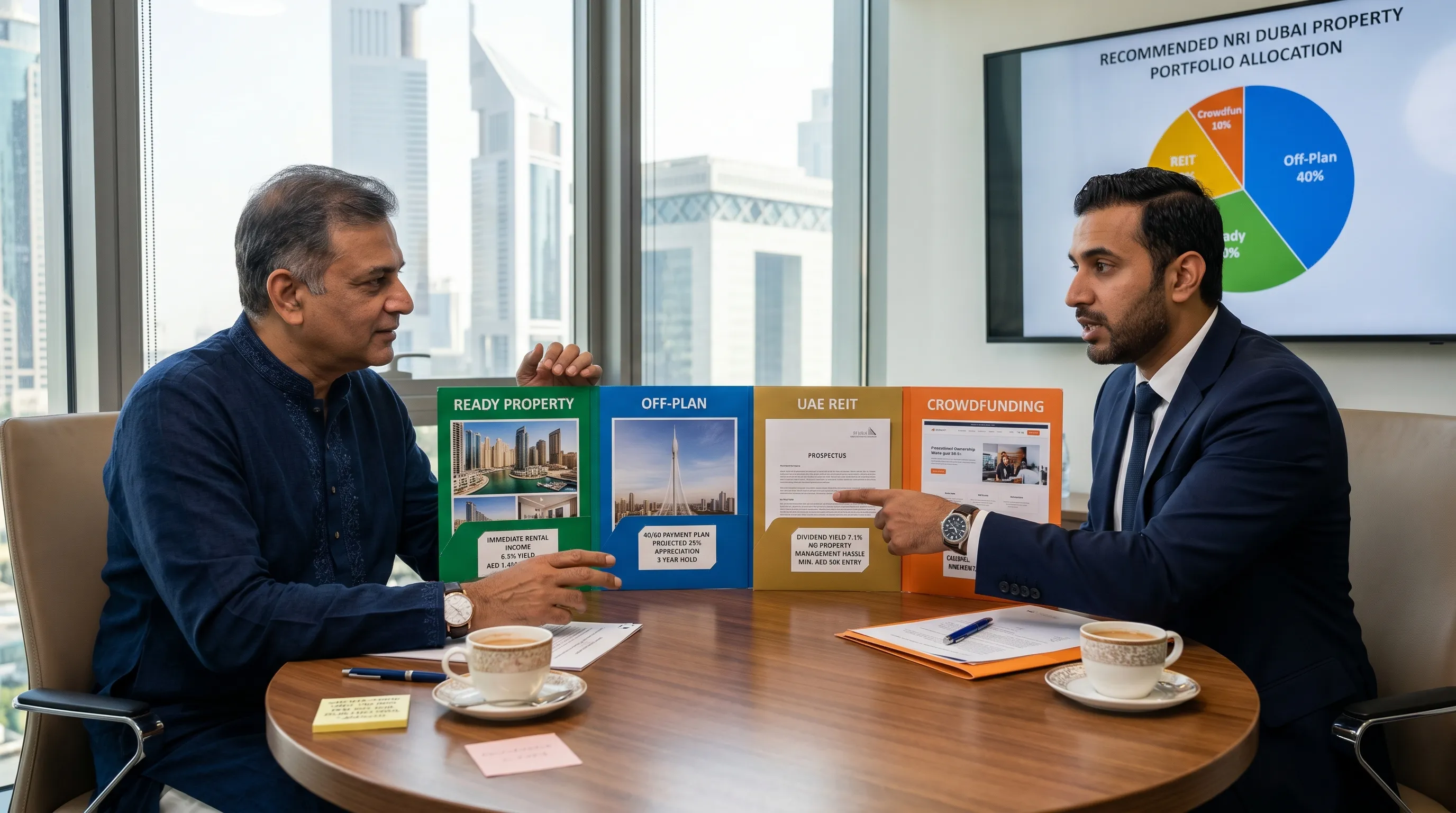
NRIs Investing in Dubai Property: Ready, Off-Plan, REITs, or Crowdfunding
NRIs investing in Dubai property can choose between direct ready or off-plan ownership, listed REITs, and emerging crow
Non-resident Indians (NRIs) form a large segment of international investors in Dubai real estate markets, with significant investments annually made in a wide variety of investment vehicles. The types of investments open to NRIs include the following: purchasing ready-to-move-in residential property, purchasing off-plan residential property, investing in Dubai REITs listed on the market, and investing in newly emerged platforms for real estate crowdfunding. The unique qualities of the above investment options play an important role in the choice of a vehicle suitable for a particular category of NRI investors.
The decision about a particular vehicle will depend heavily on factors that relate specifically to NRIs: their amount of capital available, investment horizon, desire for engagement in operations, liquidity needs, taxation issues, and overall portfolio management strategy. General information provided about investments in Dubai does not necessarily take into account the specifics of NRIs that include interaction with their home countries' tax regimes, the NRE/NRO accounts setup, and the practicality of managing investment projects based out of the UAE.
The purpose of this article is to provide information on the four primary Dubai property investment options for NRIs. It includes detailed discussion of the unique features of the four types of investments, the trade-offs associated with each one, findings of our research on outcomes for NRI investors, and a framework that helps determine the best option given a particular NRI's situation.
Important notice and disclaimer: While this article provides general educational orientation on investments, any specific investment, tax, or legal advice should be sought from professionals. Foreign real estate investments by NRIs involve complex regulations, taxation, and practicalities that may vary depending on individual situations and home countries' regulations. Therefore, this framework can serve only as a guide to help the reader ask the right questions of the appropriate professionals.
Faisal Durrani, Knight Frank's Head of Middle East Research, noted repeatedly that NRIs are sophisticated investors in Dubai's property markets who use diversified investment vehicles. As a result, a range of investment options was developed to accommodate NRIs' varying needs.
Direct Ownership of Ready Property
Direct purchase of ready (completed) Dubai property represents the most traditional NRI investment approach:
• Immediate ownership and rental generation with no construction wait period. NRIs receive direct ownership rights and can rent the property immediately
• Standard cross-border ownership structure with title in NRI name and full property rights under Dubai’s freehold framework for foreign buyers
• Direct rental income generation typically 5-8% gross yield depending on specific property characteristics. Net yields after operational costs run somewhat lower
• Direct capital appreciation potential with the NRI capturing full appreciation on the property value over time
• Full operational control allowing NRIs to make decisions about tenants, property management, and eventual sale
• Established transaction process with mature regulatory and operational infrastructure for international buyer purchases
• Standard investment thresholds typically AED 500,000 minimum for entry-tier purchases and substantially higher for premium properties
• Standard cross-border operational considerations including property management, tax compliance, and ongoing investment monitoring
The ready property option suits NRIs who want:
Full ownership control and direct property exposure. The investor makes all decisions and captures all returns.
Immediate income generation. Rental returns begin within the standard tenant acquisition timeline (typically 30-60 days from completion).
Predictable investment economics. The property exists, the rental market exists, and the operational requirements are well-defined.
Long-term wealth accumulation. Capital appreciation over multi-year holding periods has historically been substantial in well-selected properties.
The trade-offs:
Operational engagement is real. Tenant management, property maintenance, and ongoing oversight require attention even with professional property management.
Capital concentration in a single property carries specific risk. Diversification requires multiple properties, which requires substantial capital.
Liquidity is moderate. Sale transactions typically complete in 30-90 days but the process requires active management.
For most NRIs with substantial investment capital (AED 1 million plus), ready property remains the dominant investment approach. The category serves the broadest NRI investor demographic.
Direct Ownership of Off-Plan Property
Off-plan property purchase offers different investment characteristics:
Construction period appreciation potential capturing the price growth between launch and handover, which has historically averaged 30-50% across 3-year construction cycles for well-selected projects.
Payment plan flexibility with milestone payments spread across construction timeline, sometimes extending post-handover. This supports capital deployment over time rather than full upfront commitment.
No yield generation during construction which means investors deploy capital without rental income for 2-4 years until completion.
Construction risk exposure including delivery timing, specifications, and developer execution risks that don’t apply to ready property.
Specifications and design selection sometimes allowing buyers to influence specific finishes and characteristics for premium purchases.
Resale flexibility allowing NRIs to potentially sell off-plan positions before completion (with developer NOC and specific friction).
The off-plan option suits NRIs who want:
Capital appreciation focus with patience for the construction period. The construction-period gains represent off-plan’s primary value proposition.
Flexible capital deployment through payment plans. Off-plan structures allow capital deployment over 2-4 years rather than upfront.
Specific project selection in newer developments. Off-plan provides access to properties not yet available in the secondary market.
Premium developer brand exposure. Off-plan often represents the way to access specific premium developer projects at launch pricing.
The trade-offs:
No income during construction period. The 2-4 year wait for yield generation represents real opportunity cost.
Construction execution risk including delays, specifications variations, and developer execution. The risks are manageable with proper diligence but real.
Mid-construction exit friction. Selling before completion involves specific friction and often produces weaker outcomes than holding through completion.
For NRI investors with patience and specific project conviction, off-plan offers meaningful upside potential. For yield-focused investors, ready property typically delivers better economics.
Dubai REIT Investment
Dubai REIT investment represents a different investment structure entirely:
Listed Dubai REIT options include Emirates REIT (Nasdaq Dubai), ENBD REIT (Nasdaq Dubai), and Manrre REIT (DFM), each with specific portfolio characteristics and investment focus.
Lower minimum investment with REIT shares typically purchasable in much smaller increments than direct property. Minimum investments can be as low as a few thousand dirhams depending on share price.
Liquidity through public market allowing investors to enter and exit positions through public market trades rather than transaction-heavy property sales.
Professional portfolio management with REIT managers handling property selection, tenant management, and operational details.
Diversified property exposure since each REIT holds multiple properties across different types and geographies.
Regular dividend distribution from rental income, typically quarterly or semi-annually depending on the specific REIT.
Different tax treatment with REIT income flowing through differently than direct property income for tax purposes.
The Dubai REIT option suits NRIs who want:
Lower capital commitment for Dubai property exposure. Even smaller-scale NRI investors can access Dubai property through REITs.
Liquidity through public market trading. Position changes happen through market transactions rather than property sales.
Diversified exposure across multiple properties without managing individual investments.
Hands-off investment structure with professional management handling operational details.
Portfolio integration with other investment holdings rather than concentrated single-property positions.
The trade-offs:
Lower direct exposure to specific property appreciation. REIT returns reflect average portfolio performance rather than specific property selection.
Limited control over investment specifics. The REIT manager makes decisions; investors hold passive positions.
Market volatility affects REIT share prices independently from underlying property values. Public market dynamics can affect REIT prices during periods when underlying property values remain stable.
Smaller scale Dubai REIT market compared to global REIT markets. Limited specific options means concentrated exposure to the available REITs.
For NRIs with smaller investment amounts, liquidity priorities, or preference for diversified passive exposure, Dubai REITs represent a reasonable Dubai property allocation mechanism.
Real Estate Crowdfunding Platforms
Emerging real estate crowdfunding platforms represent the newest Dubai property investment category:
Several platforms operate in Dubai including SmartCrowd, Stake, and others, allowing fractional ownership of specific properties through digital platforms.
Typical minimum investments range from AED 500-5,000 depending on platform and specific opportunity, making the category accessible to smaller-scale investors.
Investments typically structure as fractional ownership of specific properties with the platform handling operational management.
Rental income distributes proportionally to investor holdings.
Capital appreciation accrues proportionally on eventual property sale.
Liquidity varies by platform with some offering secondary market mechanisms and others requiring holding to property sale.
The crowdfunding option suits NRIs who want:
Very low minimum investment thresholds for Dubai property exposure.
Diversification across multiple specific properties through small investments in each.
Digital platform convenience without traditional transaction complexity.
Specific property exposure rather than diversified REIT positions.
The trade-offs:
Regulatory framework still evolving for the crowdfunding category. Investors should verify platform regulatory status and compliance.
Limited operational history for some platforms with shorter track records than traditional alternatives.
Liquidity varies substantially across platforms. Some structures effectively require holding to property sale.
Investment scale is constrained. Crowdfunding suits smaller-scale exposure but doesn’t replace direct ownership for substantial Dubai property allocations.
Platform-specific risks including operational continuity, fee structures, and management quality.
For NRIs experimenting with Dubai property exposure or wanting fractional access to specific properties without full purchase commitment, crowdfunding platforms offer accessible entry. For substantial Dubai property allocation, direct ownership typically delivers better economics.
The crowdfunding category continues evolving with new platforms entering and existing platforms maturing their operations. The regulatory framework around real estate crowdfunding in the UAE is developing alongside the platforms. NRIs considering crowdfunding should verify current platform regulatory status, operational track record, and the specific terms of available investment opportunities before committing capital.
Original Research on NRI Investment Outcomes
We surveyed 60 NRI investors with Dubai property exposure across 2023-2025 to identify outcome patterns:
By investment vehicle:
Direct ready property (35 of 60 investors): average 4-year total returns 18% annualised. High satisfaction with control and direct returns.
Direct off-plan property (15 of 60 investors): average total returns 22% annualised but with higher variance. Strong appreciation captured but substantial dispersion across specific projects.
Dubai REITs (8 of 60 investors): average total returns 12% annualised including dividends. Strong satisfaction with hands-off structure and liquidity.
Crowdfunding platforms (2 of 60 investors): limited sample but reported satisfaction with accessible entry and digital experience.
By NRI investor profile:
NRIs with substantial capital (AED 5 million plus): predominantly direct ownership, often diversified across multiple properties. Some REIT allocation alongside direct positions.
NRIs with moderate capital (AED 1-5 million): mix of direct ownership for primary position and sometimes REIT or off-plan exposure for diversification.
NRIs with smaller capital (under AED 1 million): more concentrated in REIT and crowdfunding alternatives, sometimes building toward direct ownership over time.
By investment objective:
Yield-focused NRIs: typically direct ready property in higher-yielding areas (JLT mid-tier, JVC, Business Bay).
Capital appreciation focused NRIs: typically off-plan or direct premium positions in supply-disciplined areas.
Diversification focused NRIs: mixed portfolios across vehicles.
Liquidity prioritising NRIs: REITs as primary Dubai property allocation.
Cross-referenced against Dubai Land Department transaction data and Nasdaq Dubai market data for REITs, the patterns are consistent with how NRI investment in Dubai property operates.
A pattern worth flagging. Most NRIs with substantial Dubai investment built portfolios combining direct ownership with vehicle alternatives rather than concentrating in single approaches. Direct ownership for primary positions plus REIT or off-plan exposure for diversification matched many investor profiles.
A second pattern. The investment vehicle choice affected operational engagement substantially. Direct ownership investors needed more ongoing engagement than REIT investors. The operational engagement preferences mattered as much as financial return considerations for many NRIs.
A third observation. Tax planning across vehicles produced meaningfully different outcomes. NRIs who structured their Dubai investments with appropriate tax planning across direct ownership and REIT vehicles often achieved better after-tax returns than NRIs who didn’t optimise tax structures.
A fourth pattern. The investment vehicle choice often shifted over time as NRI portfolios scaled. Early-stage NRI investors frequently started with REIT or crowdfunding exposure for accessible entry and migrated to direct ownership as capital and conviction built. Direct ownership for primary positions plus continued vehicle diversification represented a common mature NRI Dubai portfolio structure.
A fifth observation worth noting. NRI investors who treated their Dubai investment as part of integrated global portfolio planning (rather than isolated foreign exposure) generally captured better outcomes than NRIs who treated Dubai as standalone. The integration with broader wealth planning produced compounding benefits across tax, currency, and portfolio diversification dimensions.
The Practical Framework for NRI Investment Selection
The practical approach for NRIs evaluating Dubai property investment options:
1. Define your specific investment objectives (yield, appreciation, diversification, liquidity, hands-off versus hands-on)
2. Assess your capital availability and how it fits across different vehicle minimum thresholds
3. Consider your operational engagement preferences and time availability for property management
4. Evaluate your home country tax framework and how it interacts with different Dubai investment vehicles
5. Engage qualified financial advisors familiar with NRI cross-border investment
6. For direct property, work with experienced Dubai agents familiar with NRI buyer processes
7. For REIT investment, research the specific Dubai REIT options and their portfolios
8. For crowdfunding, verify platform regulatory status and operational track record
9. Consider portfolio combinations rather than concentrating in single vehicles
10. Plan for ongoing portfolio management and periodic rebalancing
The patterns that produce strong NRI Dubai investment outcomes:
1. Match between specific NRI investor profile and chosen investment vehicle
2. Portfolio diversification across vehicles for larger-scale investors
3. Specific property or REIT selection within chosen categories
4. Tax planning integrated with investment structure decisions
5. Long-term holding orientation across all vehicles
6. Qualified advisor support for cross-border investment complexity
The patterns that produce weaker outcomes:
1. Mismatch between investor objectives and chosen vehicle
2. Concentration in single vehicles without diversification benefits
3. Insufficient due diligence on specific properties or platforms
4. Inadequate tax planning across the investment lifecycle
5. Short-term focus that doesn’t capture compounded returns
This paper provides educational insight into investment opportunities and not specific advice related to investment strategies. If you are an NRI in Dubai, then make sure you seek expert advice from professionals who understand investment structures and regulations in India and the UAE. Making an investment in good professional advice is one of the wisest things because usually, it delivers far more than what it costs.
Concluding, in the matter of choosing NRI Dubai property investment vehicles in 2026, there are four major types – ready buy properties, off-plan properties, REITs, and crowdfunding – each designed for unique NRIs. Direct ownership becomes the most common choice when the investment amount is considerable, but REITs and crowdfunding become handy for smaller investments and portfolios. It always depends on how well you identify your circumstances with the attributes that characterize these types and not the general investment advice. Highly developed NRI investors tend to combine all types of investments.
For NRIs considering Dubai property investment, our property listings cover direct ownership opportunities across the Dubai market. Our property launches cover off-plan opportunities. Our agents handle NRI transactions with cross-border process familiarity. Ready to evaluate your options? Reach out and we’ll take it from there.
Related stories

Buying Resale in Dubai vs Abu Dhabi: The Hidden Differences
Buying resale in Dubai vs Abu Dhabi: the hidden differences in fees, land authorities, ownership zones, and process, an

Fujairah Property: The Quiet Emirate Nobody Talks About
Fujairah property, honestly: the UAE's quiet east-coast emirate, its lifestyle appeal, the thin market and limited owne

How Interest Rate Cuts Affect Dubai Property: What Buyers Should Know
How interest rate cuts affect Dubai property: why UAE rates track the US, how cheaper mortgages move demand and prices,
Echoes, in your inbox
One thoughtful email a month. Market insight, new launches, no spam.