

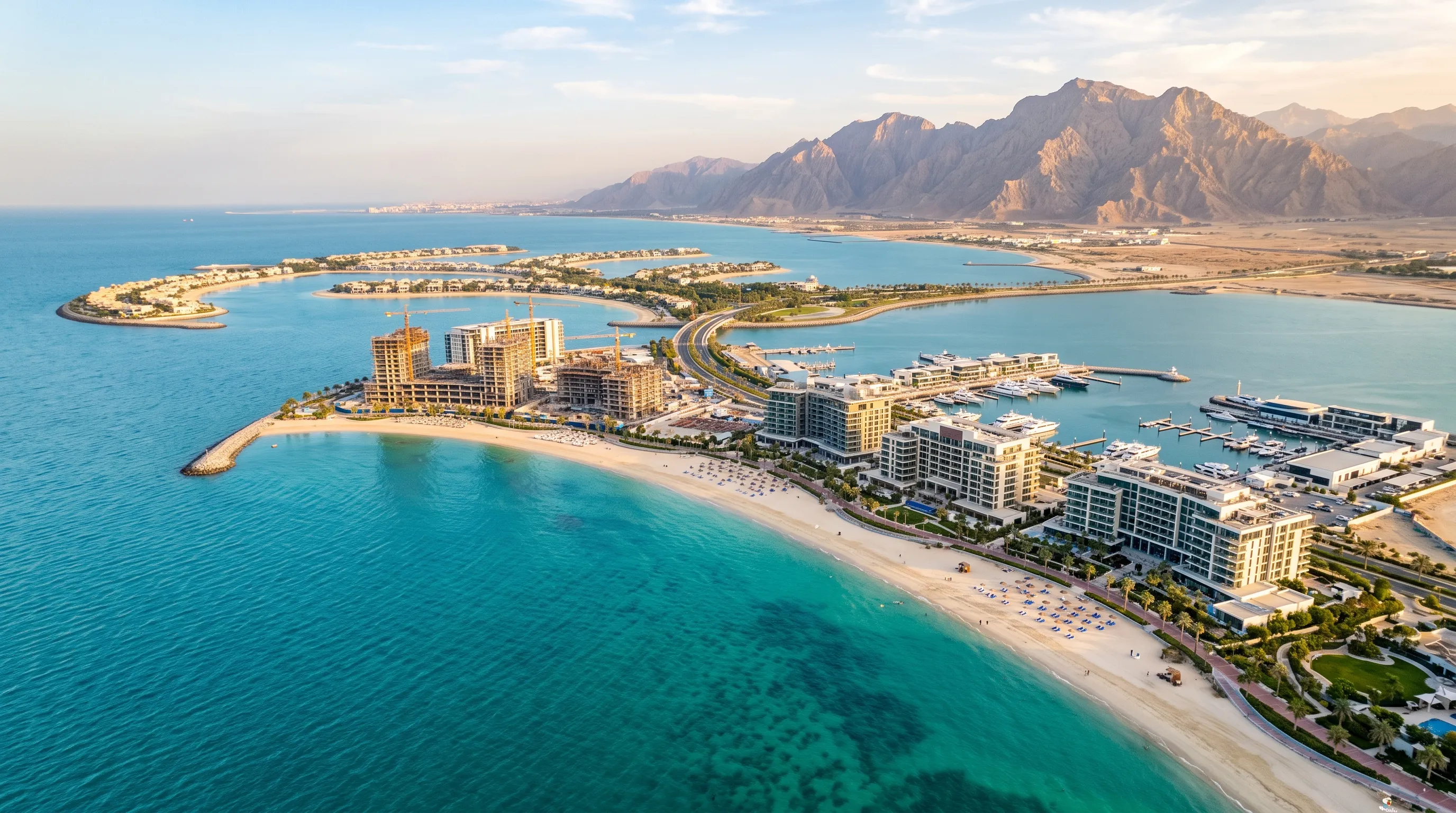
Why RAK Is Pulling Investors Away From Dubai's Outer Areas
RAK vs Dubai's outer areas for investors: the real reasons RAK is drawing money, why it is a higher-risk bet, and how t
It has been told to you by now the story. Ras Al Khaimah (RAK) is a new destination, where the capital flows from the outskirts of Dubai to RAK. It is a true story – RAK provides lower initial prices, better rental yields, and a huge tourist factor in Wynn resort on Al Marjan Island. All these factors attract an investor looking for affordability and good yield like JVC or Dubai South.
However, there are at least two things that need to be noted before becoming excited about it. First of all, it is a legitimate competitive advantage that we can describe, not a proved mass exodus of funds that we can count, and the exact amounts and allocation cannot be defined. Secondly, the RAK narrative rests on the catalyst which can appear or not according to its expectations in a thin and not very liquid market. Hence, a realistic appraisal of the situation can be formulated like that: it is not RAK that wins over the outer districts of Dubai, but just the place of higher risks and potentials located next to the reliable one.
Here is our open predisposition. We deal in selling property in both Dubai and RAK, and the story about the hotness of RAK and the arrival of the mass of the capital works for our benefit. This is exactly why we try to be sincere with you. When people say about the surge of some market, it usually means that it is better to take your time and look carefully.
This guide will tell you the whole story: why RAK attracts investors; what the truth about it is; how the yields are; how it differs from the Dubai outskirts; and an honest scorecard.
A serious disclaimer is needed right away. This text is an investment analysis and should be considered the general information and not financial advice. The numbers used are illustrative and do not make any predictions about future prices or the results of the Wynn project. RAK is a developing market, and you need to check the current prices and the state of the project yourself before doing anything. But now let us see the honest assessment of the situation.
Why RAK Is On Investors' Radar
Let us start with why this is even a conversation. The pull is real, even if the headlines oversell it. RAK has gone from a quiet northern emirate to a place investors actively consider, and the reasons are straightforward. It is cheaper to buy into than most of Dubai. It offers higher headline yields. And it has a genuine growth story built around tourism. For an investor whose budget points them toward affordable, income-focused property, RAK now competes directly with the outer Dubai communities that used to be the default choice.
That competition is the honest core of the story. Someone with a modest budget looking for a rental investment used to weigh up JVC against Dubailand against Dubai South. Now RAK is on that shortlist too, and for some buyers it wins on price and yield on paper. Our Ras Al Khaimah area guide covers what the emirate offers in more detail. That is the real dynamic, a new option pulling at the same pool of affordable-investment money.
Here is why it is on the radar:
- Cheaper entry. Lower prices than most of Dubai.
- Higher headline yields. On paper, from that lower entry.
- A tourism story. Real growth plans behind it.
- Same buyer pool. It competes with Dubai's outer areas.
- Freehold for foreigners. In designated RAK areas.
- The early angle. Investors like getting in before prices rise.
One honest note on the premise. We can explain why RAK pulls at investors, but we cannot confirm a mass exodus from Dubai, because we do not have reliable numbers on exactly how flows are shifting, and Dubai's outer areas remain very active in their own right. Broader context on the emirates sits within the UAE government portal. So read this as a real competitive pull, not a proven stampede, which matters because the two call for very different levels of caution.
The Real Draw
So what is actually drawing the money? Two things, mostly. The first is simple, price. RAK is meaningfully cheaper per square foot than most Dubai communities, so a budget of, say, AED 800,000 that buys a modest studio or one-bed in parts of Dubai can stretch to more space in RAK. That lowers the capital you put at risk and lifts the yield on paper, and for a price-sensitive investor, that alone gets attention.
The second is the catalyst, and it is a big one. The Wynn integrated resort on Al Marjan Island is a major development, notable for including the UAE's first regulated gaming operation, and the expectation is that it brings tourists, jobs, and demand to RAK on a new scale. That is the engine behind most of the RAK investment thesis, the bet that a wave of tourism lifts rental demand and prices. Our Al Marjan Island area guide covers the area at the centre of it. It is a real project with real momentum, but the exact timeline, scale, and impact are things to verify rather than assume, because a catalyst is a forecast until it actually happens.
Here is the real draw:
- Lower price per square foot. The same budget buys more.
- Less capital at risk. A cheaper entry point.
- The Wynn resort. A major tourism catalyst on Al Marjan.
- New demand expected. Tourists, jobs, and rental interest.
- The growth bet. That tourism lifts prices and rents.
- Momentum. A real project drawing real attention.
The honest summary is that the draw is a genuinely cheaper entry point plus a genuinely significant tourism catalyst, and both are real. But notice that half the appeal, the catalyst, is about the future, not the present. You are partly buying a forecast, and forecasts can run late or fall short. That does not make it a bad buy, it makes it a bet, and the next thing to check is whether the yield actually rewards that bet or just looks good on paper.
The Yield Reality
Here is where a lot of investors trip up. RAK's higher yield is largely a maths effect. Rental yield is rent divided by price, so a cheaper entry price mechanically produces a higher gross yield, even if the actual rent is modest. A high gross number looks great in a brochure, but it is not the same as a high net return, and the gap between the two is where RAK's risks live.
Those risks are real. RAK's rental market is thinner and more seasonal than Dubai's, so voids can be longer and demand less certain, especially outside peak tourism periods. Much of the investment case rests on short-term and holiday rentals tied to that tourism story, and our holiday homes service sees how variable that income can be from season to season. A property sitting empty for weeks earns nothing, no matter how high its headline yield.
For a grounded view of demand rather than a promotional one, market analysis from firms like Knight Frank is worth reading before you rely on any yield projection.
Here is the yield reality:
- Higher gross is arithmetic. Cheaper price, higher percentage.
- Gross is not net. Voids and costs eat into it.
- A thinner market. Fewer tenants than Dubai.
- More seasonal. Tourism-linked demand rises and falls.
- Short-term income varies. Great weeks, empty weeks.
- Empty earns nothing. A high yield on paper is not cash.
The honest summary is that RAK's headline yields are real but flattering, because the low entry price does most of the work and the thinner, more seasonal market makes the net return less certain than the gross suggests. That does not mean the yields are fake, it means you should model them conservatively, assume some voids, and judge the net figure, not the brochure one. A useful habit is to run the numbers twice, once on the optimistic assumptions a seller will hand you and once on cautious ones with longer void periods and softer rents, and to make your decision on the cautious version. An investor who does that clear-eyed can still find RAK attractive. An investor who buys the gross number at face value is likely to be disappointed.
How RAK Compares to Dubai's Outer Areas
So how do the two actually stack up? Dubai's outer areas have real advantages that the RAK excitement tends to skip over. They sit in a much deeper, more liquid market, with a far larger pool of tenants and buyers, more transaction data, better-established infrastructure and transport in many cases, and a longer track record you can actually check. When you want to sell, a JVC apartment usually finds a buyer faster than a comparable RAK unit, because more people are shopping there.
That liquidity is not a small thing. Being able to exit when you need to, at a price you can see other people paying, is one of the most valuable and most underrated features of an investment. Our JVC area guide covers one of the most active of these outer Dubai communities, and areas like Dubai South, Dubailand, and DAMAC Hills 2 offer similar affordable, proven options.
Dubai transaction data through the Dubai Land Department shows just how much trades in these areas, which is exactly the kind of depth RAK does not yet have.
Here is the comparison:
- Market depth. Dubai outer is far deeper than RAK.
- Liquidity. Easier and faster to sell in Dubai.
- Tenant pool. Many more renters in Dubai's outer areas.
- Track record. A longer, checkable history in Dubai.
- The RAK edge. Cheaper entry and higher potential upside.
- The trade-off. More potential, more risk, less liquidity.
The honest summary is that this is not RAK beating Dubai's outer areas, it is a straight trade-off between two different bets for the same money. Dubai's outer areas give you depth, liquidity, and a proven market at a fair yield. RAK gives you a cheaper entry, a higher potential upside, and a real growth story, in return for more risk and a harder exit. Neither is the right answer for everyone, and it is not zero-sum, both can do well. The point is to know which bet you are actually making.
The Honest Scorecard
So how does RAK really stack up against Dubai's outer areas for an investor? We scored it straight, each on one line:
- Entry price: RAK is cheaper per square foot than most Dubai outer areas.
- Gross yield: higher in RAK on paper, because the entry price is lower.
- The catalyst: RAK's story leans on tourism and the Wynn resort playing out.
- Market depth: Dubai's outer areas are deeper, more liquid, and more proven.
- Liquidity and exit: easier in Dubai, thinner and slower in RAK.
- Risk profile: RAK is higher-risk and higher-potential, Dubai outer is steadier.
- The honest read: it is a different bet for the same money, not one beating the other.
The pattern is that RAK wins on price and potential, Dubai's outer areas win on depth, liquidity, and certainty, and the higher RAK yield is largely a function of its lower price rather than proof of a better return. Look past the excitement and you are choosing between a cheaper, higher-upside, higher-risk bet and a proven, more liquid, steadier one. Both are legitimate. Neither is a free lunch.
Read the list and the takeaway is that the RAK-versus-Dubai question is really a risk question, not a which-is-better one. If you can afford the risk, understand the catalyst is a forecast, and model your yield conservatively, RAK can be a fair addition to a portfolio. If you need liquidity, certainty, or a proven track record, Dubai's outer areas are the safer home for the same money. The single most important line is the last one, that this is a different bet, not a winner and a loser.
The honest summary of the scorecard is that RAK genuinely competes with Dubai's outer areas for affordable-investment money, on cheaper entry and a real growth story, but it does so as the higher-risk, less liquid, more catalyst-dependent option, not as an obvious upgrade. Judge it on the net yield and the risk you can carry, verify the current prices and project status, and choose the bet that fits you rather than the one with the loudest story. That is the real comparison.
What We Would Actually Do
To summarize, RAK appears to be drawing investment capital similar to that invested in Dubai outer area for a number of good reasons: lower initial cost, higher yield and tourism catalyst. Yet this seems to be the less certain and more risky and illiquid alternative rather than an upgrade. The high yield is mostly due to the low price, and much of the attractiveness of this place depends on future developments and not present-day performance.
Were you to ask us to recommend a place for affordable investment, we would not do that in one word, since the right recommendation always depends on the level of risk that you can bear. If you want depth, liquidity and a tested market where you could easily find a buyer, we would suggest you to invest into Dubai outer districts like JVC or Dubai South. If you are ready to take a bigger risk, believe in the future tourism potential of this region and have patience to deal with a thinner market, we would call RAK an acceptable high-potential choice, provided that you model the yields conservative enough and take the catalysts as predictions rather than a guarantee.
Our motives in this matter are quite obvious: we work in both markets, so there is no point in pushing you to any of them in favor of the other, on the contrary, all reasons are in favor of making you understand that the strongest narrative does not necessarily mean the best investment. When you see a market advertised, it is better to cool down and check out the figures yourself.
The major mistake that we see made time after time is when investors are chasing the RAK yield forgetting about thin market, seasonality and the possibility that the narrative might take much longer time to develop than expected. Model net yield rather than gross. Expect some weeks without tourists. Make sure about current prices and about current state of the key development projects. Evaluate your risk-bearing capacity. If you go through this process, RAK might prove to be the right choice for you or Dubai outer areas might turn out to be better suited, but in any case you will be doing a thoughtful choice.
If you want help comparing a specific RAK investment against a Dubai one, on real numbers, that is exactly what we do. Our property buying service works across both markets.
And if you want a straight, no-hype conversation about where your money actually fits, we are glad to help. Get in touch and we will take it from there.
Related stories
Buying Resale in Dubai vs Abu Dhabi: The Hidden Differences
Buying resale in Dubai vs Abu Dhabi: the hidden differences in fees, land authorities, ownership zones, and process, an
Fujairah Property: The Quiet Emirate Nobody Talks About
Fujairah property, honestly: the UAE's quiet east-coast emirate, its lifestyle appeal, the thin market and limited owne

How Interest Rate Cuts Affect Dubai Property: What Buyers Should Know
How interest rate cuts affect Dubai property: why UAE rates track the US, how cheaper mortgages move demand and prices,
Echoes, in your inbox
One thoughtful email a month. Market insight, new launches, no spam.