

Renting a Dubai Apartment From Japan: Timeline, Documents, and Setup
Renting in Dubai from Japan is doable but takes planning. Here’s the timeline, documents, and what catches people out.
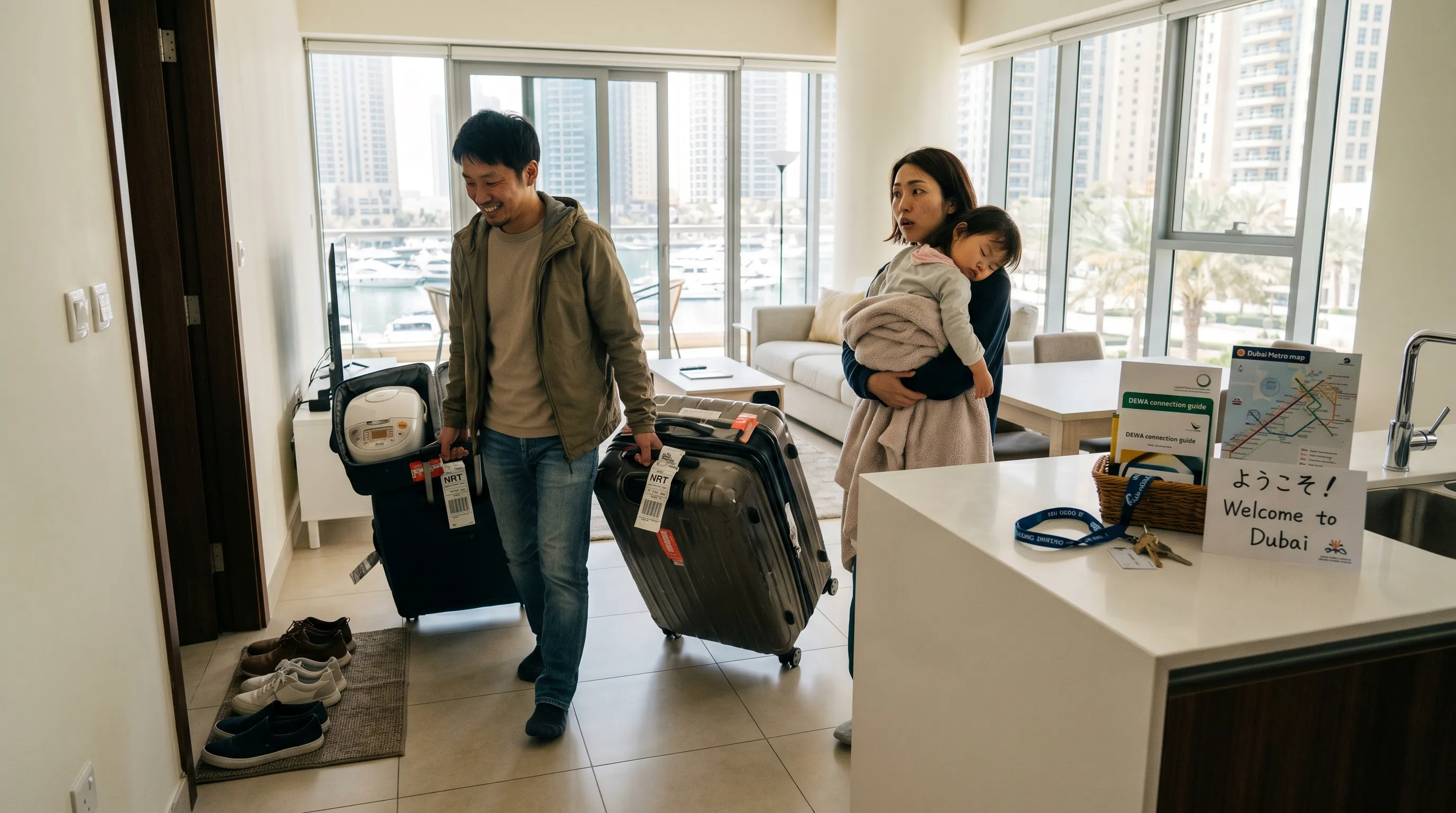
One of our friends living in Tokyo contacted us a few months ago and shared about the situation he is in. His company offered him a job position in Dubai with the commencement period of two months in which he knows nothing about the Dubai real estate market. Questions like: Is it necessary to travel to Dubai in advance? Can he sign contracts online? What are the documents he needs to provide from Japan and what is necessary in Dubai? He was trying to organize schooling of his children and relocation of his wife’s pets and it all seemed to be quite confusing.
Such kind of conversation we’ve already had several times with Japanese people planning to move to Dubai from Tokyo, Osaka, and other big cities in Japan. This is possible and it is not that hard as it seems. But there are some very specific frictions that usually confuse Japanese tenants and are not mentioned in the "how to move to Dubai" manuals.
This article is the version of such advice we wish our friend got before starting. Here we describe the real time schedule from the moment the searching starts in Japan until getting keys in Dubai. Here we explain which documents are required and where they should be obtained. Here we talk about the visa issue which is the cornerstone of this process. Also we will discuss the money aspect which is way more complicated than you may expect. Finally, here we list the common obstacles which can delay the process even for weeks if you are not prepared for them.
This article is based on the story of how an ordinary salaried employee with the family relocated to Dubai: a tourist visa for the search, residence visa organized in Dubai after finding a job. Apartments were considered in the price range AED 90,000-AED 200,000 per year. The goal was to move in two months.
There will be certain distinctions depending on how you move (alone, with kids), what visa type you apply (freelancer, Golden Visa), whether you own any property in Dubai (self-sponsor). But still, the general scheme of the process remains the same for almost all Japanese people moving to Dubai.
It is important to add that the process described below does not imply that you can do everything without a professional agent if you never lived in Dubai before. The market operates fastly, there is plenty of listings, and bargaining traditions are completely different compared to Japan. An experienced agent would help you to save several weeks, or even months in some cases.
Before You Start: The Visa Reality Check
The first thing to understand is that Dubai’s rental contracts are tied to your visa status. You can view apartments on a tourist visa. You cannot sign a binding contract registered with Ejari (the official tenancy registration system) without a valid UAE residence visa.
This sequence matters because it determines your timeline.
For most working professionals moving to Dubai, the path is. Get hired by a UAE employer. Receive an employment offer. The employer initiates the visa process, which takes 2 to 6 weeks depending on the freezone or mainland setup. You arrive on an entry permit, complete medical and Emirates ID procedures, and receive your residence visa. Only then can you sign a registered rental contract.
If you try to rent before residence visa issuance, your options are. Short-term furnished rental (1 to 3 months) through Airbnb or a holiday home operator. Hotel apartment with a monthly rate. Or a short-term lease from a landlord willing to skip Ejari registration, which is technically against regulations and removes your tenant protections.
Most Japanese renters end up doing a 4 to 8 week stay in serviced apartments while their visa processes and they search for a permanent home. Plan for that bridge accommodation explicitly. It costs more than long-term rental but it’s necessary for most cases.
The exception is if you’re moving on a Golden Visa as a self-sponsor (typically property owners or specialized professionals) or you already hold UAE residence from a previous stay. In those cases you can sign immediately.
Marwan Bin Ghalita at RERA has overseen multiple updates to Dubai’s tenancy framework in recent years. The system has gotten more renter-friendly, but the visa-before-Ejari requirement remains firm.
For Japanese professionals moving on the Golden Visa pathway, the timeline shrinks considerably. If you’ve purchased a Dubai property worth AED 2M or more, or qualify under the specialized professional categories, the visa can be issued in 7 to 14 days from application. This bypasses most of the employer-dependent timeline and lets you sign a long-term rental immediately if you want one. Some Japanese investors who own a Dubai property end up renting in a different building or area while their owned unit is leased out, which is more common than people assume.
For freelance and remote workers, the Dubai virtual working visa or freelance permit pathways exist but add complexity. These visas are sponsored by free zones (DMCC, DIFC, IFZA, RAKEZ) rather than by an employer. The visa process is similar in duration to employer-sponsored but the paperwork is different. If you’re moving from Japan to Dubai as a remote worker for a Japanese company, talk to a free zone consultant before you arrive about the most appropriate visa structure.
Documents You’ll Need to Rent a Dubai Apartment From Japan
The document list isn’t huge but the order matters.
Before you arrive in Dubai (gather in Japan):
• Valid passport with at least 6 months remaining validity
• Employment offer letter or contract from UAE employer (if employed)
• Bank statements for the last 3 to 6 months from your Japanese bank
• Salary certificate or proof of income translated to English
• Reference letter from current landlord or employer in Japan
• Marriage certificate and birth certificates for spouse and children, attested and apostilled
• Apostille of any official documents through the Japanese Ministry of Foreign Affairs
• Vaccination records for children if planning school enrollment
• Pet documentation if relocating animals (this takes its own 2 to 4 month process)
After arrival in Dubai (assemble locally):
• Emirates ID (issued after medical and biometrics)
• Residence visa in passport
• UAE bank account opened (this is itself a 1 to 3 week process)
• Tenancy application form from the property agent
• Security deposit cheque equivalent to 5% of annual rent
• Rent payment cheques (typically 1 to 4 post-dated cheques covering the year)
• DEWA (utilities) account setup, which requires Ejari first
The piece that catches Japanese renters out most often is the post-dated cheque requirement. Dubai landlords expect rent payment via post-dated cheques drawn on a UAE bank. International transfers or credit card payments are rarely accepted by landlords directly. This means you need a UAE bank account before you can finalize a rental contract, and opening a UAE bank account requires a residence visa.
The sequence locks together. Visa → Bank account → Cheques → Contract → Ejari → DEWA → Move in.
The Timeline From Japan to Keys in Hand
Realistic timeline for a salaried professional moving from Japan to Dubai with family:
• Week 1 to 4 (in Japan): Job offer, document gathering, apostille processing, employer initiates visa
• Week 4 to 6 (in Japan): Begin remote apartment research, shortlist 8 to 12 properties
• Week 6 to 8: Arrive Dubai on entry permit, complete medical and Emirates ID, residence visa issued
• Week 8 to 10: Open UAE bank account, finalize school enrollment for kids, narrow apartment shortlist
• Week 10 to 12: In-person viewings, negotiation, contract signing, Ejari registration
• Week 12 to 14: DEWA setup, internet and TV setup, move in
The compressed version takes about 12 weeks from job acceptance to moving into a permanent apartment. The expanded version with school enrollment, pet relocation, or any complication can stretch to 16 to 20 weeks.
Bridge accommodation during this window is essential. Most Japanese families we’ve helped have used serviced apartments in Business Bay, Dubai Marina, or JLT for the bridge period. Cost runs AED 15,000 to AED 30,000 per month for a 1 or 2 bedroom serviced apartment.
If you’d rather skip serviced accommodation entirely, you can sign a holiday home rental for 2 to 3 months directly. This costs slightly less than serviced apartments and gives more space. The downside is less flexibility on extending if your visa or apartment search takes longer than expected.
How to Search for an Apartment Without Flying In
The good news is that Dubai’s rental market is fully digital. Listings are on Property Finder, Bayut, Dubizzle, and direct from major brokers. Photos and floor plans are standard. Video tours are increasingly common.
The bad news is that listing quality varies a lot. Photos can be old. Asking prices can be aspirational. Some listings are bait, designed to draw inquiries to broker offices. Filtering through this from Tokyo or Osaka takes time.
What works well for remote searching:
• Set up alerts on Property Finder and Bayut for your specific area and price range
• Work with a single agent rather than calling multiple, to consolidate the search
• Request video walkthroughs of any property before flying in
• Verify the Ejari status of any listing you’re seriously considering
• Cross-check the asking rent against the area’s actual let prices on Property Monitor
• Use Google Street View to validate the building’s location and surroundings
• Ask about specific amenity working condition (gym, pool, elevators) which photos don’t show
• Check the building’s developer and look up that developer’s quality reputation
Areas that work well for first-time Japanese arrivals tend to be Downtown Dubai for proximity to business districts, Dubai Marina for waterfront lifestyle, JLT for value pricing with metro access, Business Bay for downtown convenience at lower price points, and Al Barsha for family living near schools. The Dubai Marina area page is one place to start exploring listings.
For families specifically, school catchment becomes the major filter. Many Japanese families end up choosing apartment location based on proximity to the Japanese School in Dubai, the British International School, GEMS schools, or specific international curricula.
The Money Side: Banking, Currency, and Deposits
This is where the process gets more complicated than most Japanese arrivals expect.
Cheque-based rent payment is the standard. Dubai landlords expect 1 to 4 post-dated cheques covering the year. The fewer cheques you pay in, the lower the rent (single-cheque payment can save 5% to 10%). Multi-cheque payment spreads cash flow but costs slightly more in total.
The UAE bank account requirement is what slows things down. To open an account at HSBC, Emirates NBD, Mashreq, ADCB, or any UAE bank, you need Emirates ID, residence visa, and salary certificate. Most banks process accounts in 1 to 3 weeks. Some Japanese banks (SMBC, MUFG) have UAE branches that can streamline the process if you have an existing relationship.
Currency conversion is its own consideration. JPY to AED conversion volumes are not high, so transfer fees and spreads can be larger than for major pairs. Wise, Revolut, and traditional bank wires all work, but compare the all-in cost. For a family-sized rental deposit of AED 50,000 (roughly JPY 1.9 million), the spread between cheap and expensive transfer methods can be JPY 30,000 or more.
A practical workaround that several Japanese clients have used. Keep a multi-currency account with a Japanese international bank like SMBC or MUFG that has UAE branch presence. When the Dubai bank account is being set up, the transfers between accounts can happen at preferential institutional rates rather than retail rates. Over the course of a year of rent payments, the savings can run into the JPY 100,000+ range for higher rent levels.
Security deposit math:
• Standard security deposit: 5% of annual rent for unfurnished, 10% for furnished
• Agent commission: 5% of annual rent paid by the tenant in most cases
• Ejari registration fee: AED 220
• DEWA connection fees: AED 130 to AED 2,030 depending on connection type and security deposit
• Move-in fees charged by some buildings: AED 500 to AED 2,000
• Cooling charges and chiller deposits if district cooling: variable, can be AED 1,000 to AED 5,000
The upfront cash requirement for a Japanese family signing a typical AED 150,000 annual rent apartment is roughly AED 20,000 to AED 25,000 above the first rent cheque. Budget for that explicitly.
Common Setbacks Japanese Renters Hit (and How to Avoid Them)
The setbacks we see most often:
• Trying to sign before residence visa is issued, and losing the apartment to another tenant who could move faster
• Underestimating the time to open a UAE bank account, particularly for spouses without independent income
• Document attestation gaps, especially for marriage and birth certificates that weren’t apostilled before leaving Japan
• Pet relocation timing, since the import process for pets coming from Japan can take 8 to 12 weeks
• School enrollment timing, with the Japanese School and major international schools having waitlists
• Underestimating the bridge accommodation cost during the visa wait, which adds AED 30,000 to AED 90,000 to the total move cost
• Choosing a building based on photos without verifying actual maintenance and amenity condition
• Signing an Ejari-unregistered short-term lease and losing tenant protections in disputes
In other words, the solution can be found in preparation. Get apostilles before leaving Japan. Organize school placements beforehand. Start with pets' relocation at least four months before your move date. Allocate eight weeks for bridge accommodation. Choose an agent who already has experience working with the Japanese clientele.
Other considerations which are less known to new Japanese immigrants are the following ones. There is a tax agreement between Japan and the United Arab Emirates that affects Japanese citizens being relocated to Dubai and becoming their residents concerning taxation of rental income for the year when the move took place. Consult your tax consultant back in Japan about the process of filing the taxes both in Japan and in UAE depending on your immigration process. Rental income in Dubai for individual investors is not taxable; however, Japan can still classify you as its resident.
Another popular issue for Japanese citizens concerns the school system and related issues. Schools in Japan work from April to March of the next year. However, UAE international schools work from September to June. Thus, if you relocate with kids, make sure that you have planned for a single period of changeover. The easiest way to cope with this task is to attend the Japanese School in Dubai (JSD), which also operates according to the Japanese calendar. If this variant is unattractive to you, then be ready to adapt to the British, American, and IB curriculum international schools starting in September.
Last but not least, we need to mention the issue of cultural adaptation. Dubai welcomes Japanese expatriates; however, certain differences in business culture exist. It is absolutely acceptable to negotiate the rent in this country, and asking direct questions regarding the property, its services, and landlord's behavior cannot be viewed as impolite. A significant number of Japanese immigrants initially fail to do that because of their shyness.
If you’re planning a move from Japan to Dubai and want help structuring the process, relocation services handle the logistics of search, contracting, Ejari, DEWA, and move-in coordination. We’ve worked with several Japanese families and the process is much smoother with one coordinator handling the moving parts rather than trying to assemble specialists from Japan and Dubai independently. Reach us through the contact page and we’ll set up a call.
Related stories
Buying Resale in Dubai vs Abu Dhabi: The Hidden Differences
Buying resale in Dubai vs Abu Dhabi: the hidden differences in fees, land authorities, ownership zones, and process, an
Fujairah Property: The Quiet Emirate Nobody Talks About
Fujairah property, honestly: the UAE's quiet east-coast emirate, its lifestyle appeal, the thin market and limited owne

How Interest Rate Cuts Affect Dubai Property: What Buyers Should Know
How interest rate cuts affect Dubai property: why UAE rates track the US, how cheaper mortgages move demand and prices,
Echoes, in your inbox
One thoughtful email a month. Market insight, new launches, no spam.