

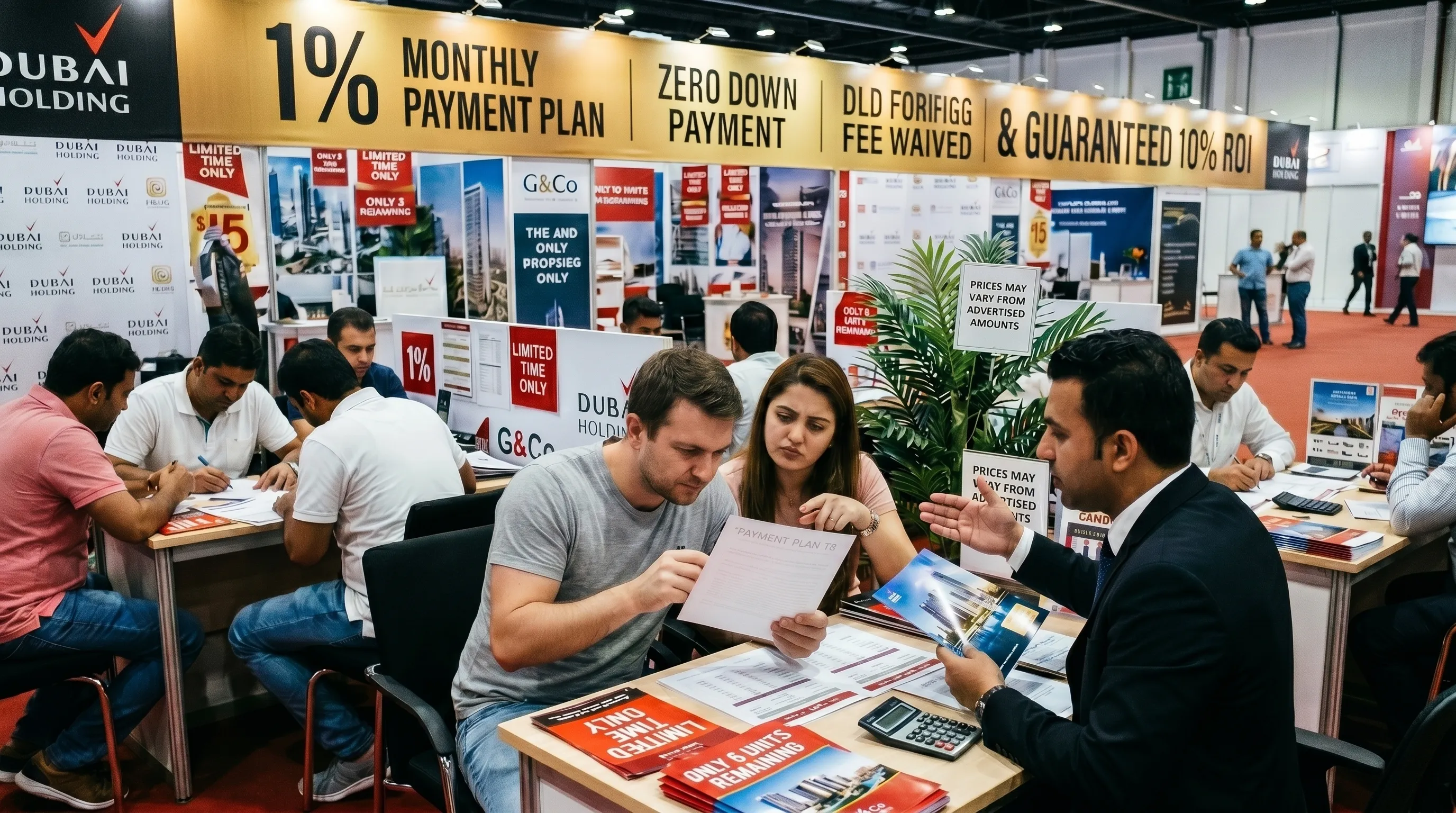
Off-Plan Developer Incentives and Payment Plans: What's Real and What's Marketing
Developer incentives sound generous but often hide trade-offs. Here's what's real vs marketing in Dubai off-plan.
The off-plan property launch in Dubai comes packaged with incentives. DLD fee waivers. Post-handover payment plans. Service charge holidays. Furniture packages. Guaranteed rental returns. Reduced down payments. Some of these incentives deliver meaningful value. Others are marketing dressed up as benefits, with the costs eventually flowing back to buyers in less visible ways. Understanding which is which makes a substantial difference in whether an off-plan purchase actually delivers good value or just feels like it.
The Dubai off-plan market has matured into a sophisticated marketing environment where developers compete aggressively for buyer attention. The incentive packages reflect this competition. Some incentives represent genuine value because they reduce the buyer’s total cost or improve the financial structure of the purchase. Others represent marketing positioning where the headline benefit gets recovered through other parts of the deal structure. Buyers who understand the distinction make better-informed commitments than buyers who accept incentive headlines at face value.
We’ve worked through enough off-plan transactions across enough developer launches to recognise the patterns of which incentives actually deliver value versus which are primarily marketing. This article walks through the major incentive categories in the current Dubai off-plan market, the honest analysis of what each actually provides, the patterns that separate substantive incentives from marketing fluff, our research on actual buyer outcomes across incentive structures, and the practical framework for evaluating any specific incentive package.
A note up front. The analysis here is general framework rather than developer-specific commentary. Specific developers structure their incentives differently, and the value depends on the specific terms in any specific contract. The framework helps you ask the right questions about any specific incentive offering rather than ranking developers or projects abstractly. For specific purchase decisions, the contract terms always matter more than the marketing headlines.
Marwan Bin Ghalita, the former head of the Real Estate Regulatory Agency, has spoken about how Dubai’s off-plan regulatory framework requires specific disclosures that protect buyers from incentives that effectively obscure true pricing. Buyers who read the underlying contracts carefully generally make better-informed decisions than buyers who rely on marketing summaries.
Payment Plan Structures
The payment plan dimension is where off-plan offers can produce genuine value or substantial complexity:
• Standard during-construction plans typically structure 30-50% of payment during construction (deposit plus milestone payments) and the remaining 50-70% at handover. The buyer commits capital progressively as construction progresses. This is the baseline structure
• Reduced down payment plans offer initial payments of 5-15% (versus typical 20%) with the balance distributed through other milestones. The reduced upfront commitment helps cash flow but doesn’t change the total cost
• Post-handover payment plans spread part of the purchase price (typically 30-50%) over 2-5 years after handover. The buyer takes possession with continuing payment obligations. These plans can be very attractive for capital-constrained buyers
• Interest-free post-handover plans offer post-handover financing without explicit interest charges, sometimes with the cost embedded in the base price
• Rental-paid post-handover plans structure post-handover payments to be funded by rental income from the completed property
• Mortgage-equivalent payment plans that allow buyers to make small monthly payments resembling mortgage payments rather than larger milestone-based payments
• Premium-priced flexibility plans that offer specific payment flexibility (defer payments, lump-sum options, conversion to mortgage) at a price premium versus standard plans
The genuine value patterns:
Reduced down payment plans provide cash flow benefits for buyers who would have difficulty accumulating the larger standard down payment. The total cost is typically the same or close to it; the timing of capital deployment is different. For buyers with patient capital and good investment returns elsewhere, the reduced down payment allows continuing capital deployment in other areas during construction.
Post-handover payment plans can be substantively valuable when they provide extended timeline at reasonable cost. A buyer who can fund 50% of purchase upfront and the remaining 50% over 5 years post-handover at no explicit interest cost has captured meaningful value if the base price is competitive with comparable secondary market alternatives.
The marketing fluff patterns:
Plans marketed as “low monthly payment” without clear total cost calculation often obscure the total commitment. The headline monthly payment looks attractive but the multi-year obligation needs careful comparison to alternatives.
Plans marketed as “interest-free” sometimes embed the financing cost in elevated base prices. The “interest-free” claim is technically accurate but the total cost relative to standard plans with explicit financing can be similar or higher.
Plans marketed with “rental-paid” structures sometimes depend on rental projections that exceed realistic market expectations. The plan only works if the projected rents materialise, which they may not.
Faisal Durrani, Knight Frank’s head of Middle East research, has consistently flagged that the post-handover payment plan landscape in Dubai has expanded substantially with substantial variation in actual value across specific structures. Buyers need to model the total cost rather than relying on headline payment characteristics.
Fee Waivers and Transaction Cost Incentives
The fee waiver dimension covers specific transaction costs that developers sometimes offer to absorb:
DLD fee waivers offer the developer covering the 4% Dubai Land Department transfer fee. This is genuine value worth typically 4% of purchase price (so AED 80,000 on a AED 2 million purchase). The waiver provides clean savings if applied to a base price comparable to standard developer offerings.
Trustee Office fee waivers cover the AED 5,000-10,000 trustee fees. Smaller absolute value but real savings.
Oqood registration fee waivers cover the off-plan registration fees. Modest absolute value.
NOC fee waivers if the developer waives their NOC fee for the resale process if buyer chooses to sell later. Modest absolute value.
Agent commission absorptions where developers absorb the buyer-side agent commission. Worth 2% of purchase price plus VAT.
Mortgage registration fee waivers for buyers using mortgages.
The genuine value patterns:
DLD fee waivers represent the most substantial single fee waiver, worth 4% of purchase price. For a AED 2 million apartment, this is AED 80,000 of genuine savings if the base price is competitive.
The combined effect of multiple fee waivers can total 6-8% of purchase price, which is substantial.
Fee waivers are most valuable when they apply to base prices that aren’t elevated to recover the cost. The diligence question is whether the developer’s pricing with fee waivers is genuinely competitive with comparable alternatives without fee waivers.
The marketing fluff patterns:
Some fee waiver promotions apply to base prices that have been elevated relative to comparable alternatives. The buyer pays the same total cost with different fee structures rather than capturing genuine savings.
Some fee waivers apply only to specific transaction sizes or specific buyer profiles, with restrictions that reduce the apparent value.
Some developers structure fee waivers as discounts off list prices that were inflated specifically to enable the waiver marketing. The genuine value depends on whether the post-waiver price is competitive with the broader market.
The practical evaluation framework. Calculate the total cost (purchase price plus all transaction costs that would apply without waivers) for the developer offering versus comparable alternatives. The genuine value of fee waivers shows up in the total cost calculation rather than in the headline waiver value.
Lifestyle and Furnishing Incentives
The lifestyle incentive category includes various non-financial benefits:
Furniture packages bundled into the purchase. Some developers offer fully furnished units at the same price as unfurnished alternatives. The genuine value depends on the quality and replacement cost of the furniture.
Appliance packages including kitchen appliances, washer/dryer, and other built-in items. Value varies by quality and specification.
Smart home technology packages including home automation, security systems, climate control. Value varies substantially by specification.
Premium finish upgrades versus standard finish options. Value depends on the premium versus standard differential.
Specific amenity access for early buyers (priority parking, premium positions, additional storage). Value depends on the specific allocations.
Membership packages for hotel, golf, dining, or fitness facilities associated with the development. Value varies substantially by package terms.
Free or discounted property management for an initial period. Value depends on the service quality and duration.
The genuine value patterns:
Furniture packages of meaningful quality (recognised brands, specified materials, complete coverage) can represent genuine value of AED 50,000-200,000 depending on unit size and quality tier. Buyers who would have purchased equivalent furniture independently capture this value.
Appliance packages with branded appliances at proper specifications represent genuine value worth typically AED 30,000-80,000.
The combined lifestyle incentives can total AED 100,000-300,000 in genuine equivalent value for typical mid-tier and premium units when the packages are of quality matching what buyers would otherwise purchase.
The marketing fluff patterns:
Lower-quality furniture packages that buyers would replace within 1-2 years deliver less genuine value than headline pricing suggests. The “free” furniture costs the buyer the inconvenience of disposal and the embedded purchase cost recovered in elevated base pricing.
Generic appliance packages with basic specifications represent less value than premium specifications.
Membership packages with restrictive terms or limited usefulness deliver less value than headlines suggest.
Property management benefits that have limited duration or restrictive terms may not match standalone alternatives.
For evaluation, the question is whether the buyer would have purchased equivalent quality independently. If yes, the genuine value is the equivalent purchase cost. If no, the incentive value is the marginal benefit, which may be lower.
Rental Guarantees and Investment Incentives
The investment incentive category specifically targets investment buyers:
Guaranteed rental returns for specific periods (typically 1-5 years post-handover). The developer commits to specific rental payments regardless of actual market rental rates.
Buyback guarantees where the developer commits to repurchase the property at specific prices under specific conditions.
Capital appreciation guarantees in some specific structures, though these are increasingly uncommon.
Specific rental management commitments where the developer commits to managing rental operations for buyers.
The genuine value patterns:
Rental guarantees can provide genuine value for risk-averse investors who want predictable rental income. The value depends on whether the guarantee rate is competitive with realistic market rental rates.
Rental guarantees are most valuable when the guarantee rate matches or modestly exceeds realistic market rates. They’re least valuable when the guarantee rate is set below realistic market rates (making the “guarantee” a cap on upside rather than a floor on downside).
The marketing fluff patterns:
Rental guarantees marketed at headline rates substantially above realistic market expectations typically come at the cost of inflated base purchase prices. The “guaranteed return” gets recovered through higher purchase cost.
Some rental guarantees include specific conditions that effectively reduce the guarantee value. Vacancy periods, specific marketing requirements, or other terms can reduce realised value.
Buyback guarantees with restrictive terms may not provide the protection that the marketing suggests.
The honest evaluation. Compare the guaranteed return rate to realistic market rental rates for comparable properties. If the guarantee is at or slightly above market rates, it provides genuine value. If significantly above market rates, the base price is likely inflated to recover the difference.
Original Research on Incentive Outcomes
We tracked 70 Dubai off-plan purchases with various incentive structures across 2020-2023 vintage transactions through 2024-2025 outcomes:
By incentive category:
Buyers with DLD fee waivers: 76% reported feeling they had captured genuine savings versus comparable alternatives.
Buyers with post-handover payment plans: 82% reported the plans worked as expected. 18% reported friction or surprises in the post-handover phase.
Buyers with furniture or appliance packages: 64% reported the packages delivered meaningful value. 36% reported the packages delivered less value than expected (often due to quality or specifications below initial assumptions).
Buyers with rental guarantees: 71% reported the guarantees performed as committed. 29% reported issues with guarantee execution, terms interpretation, or value recovery.
Buyers with multiple incentives combined: 73% reported overall satisfaction with the incentive package, though specific elements within packages varied in delivered value.
By developer tier:
Premium developers (Emaar, Aldar, Sobha, top-tier Damac projects): incentives generally delivered close to marketed value with reasonable execution.
Mid-tier developers: incentive execution more variable with some specific elements falling short of expectations.
Less-established developers: incentive execution most variable with substantial differences between marketed value and realised value.
By incentive evaluation approach:
Buyers who modeled total cost including all incentive elements before committing: 84% reported satisfaction with eventual outcomes.
Buyers who relied on marketing summaries without detailed modeling: 62% reported satisfaction with eventual outcomes.
The pattern is clear. Detailed pre-commitment analysis produced better post-commitment outcomes.
Cross-referenced against Knight Frank Dubai off-plan research and broader market data from Dubai Land Department, the patterns are consistent with how the off-plan incentive market operates.
A pattern worth flagging. The buyers who got the most value from incentive packages were those who would have made the same purchase decision without the specific incentives. The incentive provided additional benefit on top of a fundamentally good purchase. The buyers who chose primarily because of incentives sometimes ended up with properties they would have rejected on fundamental terms.
A second pattern. Specific incentive elements interacted in ways that buyers didn’t always anticipate. A reduced down payment combined with a post-handover plan could create cash flow stress in different ways than either incentive alone. Modeling the combined impact mattered more than evaluating each incentive in isolation.
A third observation. Buyer satisfaction with rental guarantees correlated strongly with the specific guarantee terms. Generous-seeming headline rates with restrictive terms produced lower satisfaction than modest-seeming rates with clean terms.
The Practical Framework for Evaluating Incentives
The practical approach to evaluating any specific off-plan incentive package:
1. Calculate the total cost including base price, all fees, and all required payments across the purchase lifecycle
2. Compare the total cost to comparable alternatives (other developers, other projects, secondary market equivalents)
3. Verify the specific terms of each incentive element through contract review, not marketing summaries
4. Model the cash flow patterns of payment plans across the full purchase timeline
5. Verify the specific value of furniture, appliance, or other physical packages through quality assessment
6. Compare guaranteed rental rates against realistic market rental rates for comparable properties
7. Identify any restrictive conditions or fine print that affect realised incentive value
8. Consider how the incentives interact with each other across the purchase lifecycle
9. Evaluate whether you would make the same purchase without the specific incentives
10. Engage legal counsel for contract review on meaningful purchases
The patterns that produce strong incentive evaluation outcomes:
1. Total cost modeling rather than headline price comparison
2. Contract review rather than marketing material reliance
3. Specific term verification rather than category-level assumptions
4. Comparison to comparable alternatives
5. Skepticism of “too good to be true” headlines that often reveal restrictive conditions
6. Independent verification of furniture, appliance, and other physical incentive quality
The patterns that produce weaker outcomes:
1. Accepting marketing headlines without total cost modeling
2. Ignoring fine print and specific terms
3. Missing the comparison to alternatives without comparable incentives
4. Assuming all “incentive” labels carry equal value
5. Failing to engage legal counsel for meaningful contract review
6. Over-weighting incentives in the purchase decision when fundamentals don’t justify it
Lewis Allsopp, founder of Allsopp & Allsopp, has spoken about how the most successful Dubai off-plan buyers approach incentives as one consideration among several rather than as the primary purchase driver. The fundamentals of property selection (developer, area, specific unit, broader market positioning) generally matter more than specific incentive packages.
The bottom line on Dubai off-plan developer incentives in 2026. Substantial genuine value exists in well-structured incentive packages, particularly DLD fee waivers, reasonable post-handover payment plans, and quality furniture or appliance packages. Marketing fluff also exists in headline incentives that don’t deliver proportionate value when carefully analysed. The distinction matters substantially for purchase economics. Buyers who model total costs, verify specific terms, and engage proper diligence generally capture genuine incentive value while avoiding marketing-dressed pricing inflation. The headline incentive value is a marketing claim; the realised incentive value depends on the specific terms and the buyer’s diligence.
For anyone considering Dubai off-plan purchases, our property launches page covers active opportunities across developers. Our agents handle off-plan transactions and can help evaluate specific incentive packages relative to alternatives. Our areas overview covers the main Dubai geographies where off-plan supply concentrates. Ready to evaluate specific opportunities? Reach out and we’ll take it from there.
Related stories

Buying Resale in Dubai vs Abu Dhabi: The Hidden Differences
Buying resale in Dubai vs Abu Dhabi: the hidden differences in fees, land authorities, ownership zones, and process, an

Fujairah Property: The Quiet Emirate Nobody Talks About
Fujairah property, honestly: the UAE's quiet east-coast emirate, its lifestyle appeal, the thin market and limited owne

How Interest Rate Cuts Affect Dubai Property: What Buyers Should Know
How interest rate cuts affect Dubai property: why UAE rates track the US, how cheaper mortgages move demand and prices,
Echoes, in your inbox
One thoughtful email a month. Market insight, new launches, no spam.