

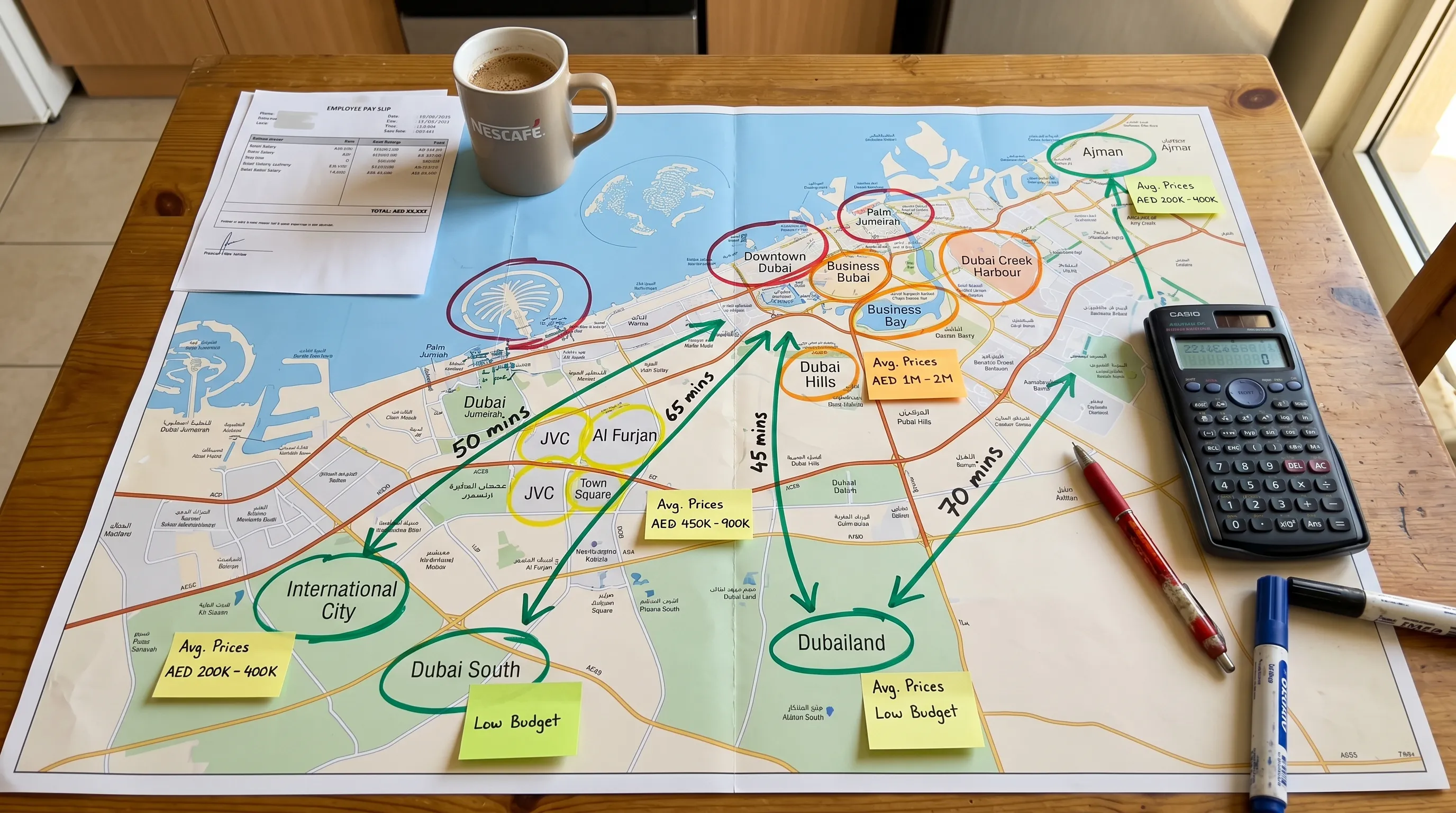
Where Are the Cheapest Apartments Right Now
Dubai has accessibly priced apartments at multiple tiers. Here's where the genuinely cheapest options are right now.
The question of where to find the most accessible Dubai apartments comes up frequently from buyers and renters working with constrained budgets. The honest answer requires going beyond the obvious budget areas and understanding what specifically drives pricing differences across the Dubai apartment market in 2026.
The cheapest apartments in absolute terms aren’t always the right answer for budget-conscious buyers. The lowest price points often come with trade-offs (longer commutes, less developed amenities, specific building quality concerns) that may not justify the savings. The right answer balances price with practical livability factors that affect quality of life.
We’ve worked with enough Dubai apartment buyers and renters across budget tiers to know which accessible options actually deliver good value versus which look cheap but produce regret. This article walks through where the genuinely affordable Dubai apartments are located in 2026, the specific price ranges across budget-friendly areas, the trade-offs that matter when choosing between options, our research on resident outcomes in budget-tier areas, and the practical framework for finding good value at accessible price points.
A note up front. Pricing in Dubai shifts month to month, so the specific numbers in this article reflect 2026 ranges that may evolve. The patterns and area characteristics are more durable than specific price points. For current specific pricing, working with active agents and current portal data provides more accurate snapshots than any static article.
Faisal Durrani, Knight Frank’s head of Middle East research, has consistently flagged that Dubai’s entry-tier apartment market has expanded substantially with new supply across multiple areas. The competition among budget-tier areas has produced genuine value for buyers and renters who explore the options carefully.
The Cheapest Apartments by Area
The Dubai areas where genuine budget apartments are available in 2026:
• International City offers the most accessible entry point with studios from around AED 25,000-35,000 annual rent or AED 350,000-550,000 purchase. Diverse demographic mix and basic but functional amenities. The cluster organisation (China Cluster, Russia Cluster, etc.) gives the area distinctive character
• Discovery Gardens provides garden-style apartments with mature landscaping. Studios and one-bedrooms typically AED 40,000-65,000 annual rent or AED 450,000-750,000 purchase. Community character noticeably more residential than International City
• Dubai Sports City offers tower apartments with sports infrastructure integration. Studios and one-bedrooms typically AED 35,000-70,000 annual rent or AED 450,000-800,000 purchase
• JVC (Jumeirah Village Circle) lower tier sub-areas provide accessible apartments. Studios and one-bedrooms in older JVC buildings typically AED 45,000-75,000 annual rent or AED 500,000-900,000 purchase. Newer JVC buildings command premium pricing
• Liwan and Queue Point offer accessible villa and apartment communities. Apartments typically AED 35,000-60,000 annual rent or AED 400,000-650,000 purchase
• Dubai South at the city periphery provides newer supply at accessible prices. Apartments typically AED 35,000-65,000 annual rent or AED 450,000-750,000 purchase
• International Media Production Zone (IMPZ) offers accessible apartments. Studios from AED 30,000-50,000 annual rent or AED 400,000-650,000 purchase
• Al Furjan offers entry mid-tier pricing slightly above the budget tier. Apartments typically AED 50,000-90,000 annual rent or AED 600,000-1,100,000 purchase
The cheapest options in absolute terms concentrate in International City, IMPZ, and parts of Liwan and Queue Point. The slightly higher budget tier in Discovery Gardens, Dubai South, and Sports City offers improved amenities and community character at modest price increase.
The pricing patterns within each area:
Specific buildings within each area command different pricing. Older buildings, less-favoured positions within the area, and units with specific characteristics (lower floor, less-favourable view, layout inefficiency) typically price below the area average. Newer buildings, premium positions, and high-quality units price above the area average.
Studios consistently price lowest within each area. One-bedrooms add roughly 30-50% to studio pricing. Two-bedrooms add roughly another 40-60% to one-bedroom pricing.
Furnished apartments price 15-30% above unfurnished equivalents.
What You Get at Budget Tier Pricing
The trade-offs that come with budget tier Dubai apartment pricing:
Distance from central business areas is the most consistent trade-off. Budget areas typically sit 20-45 minutes from Dubai’s central business districts (Marina, Downtown, DIFC) depending on traffic. The commute time matters substantially for daily quality of life.
Amenity infrastructure varies by area. International City has basic amenities (small retail, food options, basic services). Discovery Gardens has more developed community amenities. Dubai South amenities are still developing. The level of nearby retail, dining, healthcare, and services affects daily life convenience.
Building quality varies substantially within budget areas. Some buildings in these areas have specific maintenance issues, management problems, or service charge volatility. Others are well-managed and provide good lived experience. Building-level due diligence matters substantially at budget pricing.
Tenant mix and community character varies. Budget areas typically house diverse demographics with significant transient populations. This creates active community feel but also more turnover than higher-tier areas.
Transport accessibility varies. Some budget areas have metro access (parts of Sports City, IMPZ via specific routes). Others require car dependency. The transport access affects commute options and lifestyle flexibility. The metro versus car-dependent distinction can affect daily life patterns substantially over years of residence.
Resale and rental dynamics vary. Budget areas typically have weaker capital appreciation than mid-tier and premium areas, though they generally deliver stronger gross yields. The investment characteristics differ. For investment buyers prioritising yield generation, budget tier areas often produce attractive economics. For buyers prioritising capital appreciation, mid-tier and premium areas typically perform better.
For buyers prioritising savings to fund other priorities (travel, investments, business creation, family commitments), budget tier areas can produce strong overall life outcomes despite the trade-offs. For buyers prioritising daily lifestyle quality, the modest savings of budget tier versus entry mid-tier may not justify the trade-offs. The honest assessment of which category fits your situation matters more than abstract preferences about price tiers.
What Drives the Pricing Gap
The specific factors that produce the pricing gap between budget tier and mid-tier Dubai areas:
Location proximity to central business and lifestyle areas. The mid-tier areas (Marina, JLT, Business Bay, Dubai Hills) sit closer to where many Dubai residents work and socialise. Budget areas sit further out.
Master plan and infrastructure investment. Mid-tier areas typically benefit from more developed master plans with integrated amenities, retail, healthcare, and community infrastructure. Budget areas have less developed infrastructure.
Developer prestige and brand value. Mid-tier areas often feature major developer projects (Emaar, Aldar, Sobha, Damac) with the brand and quality reputation. Budget areas have more mixed developer profiles.
Building quality and finishing standards. Mid-tier buildings typically have higher specifications for finishes, amenities, and building services. Budget buildings often have more basic specifications.
Resale market depth. Mid-tier areas have deeper buyer pools supporting stronger resale dynamics. Budget areas have narrower buyer pools and slower resale velocity.
International buyer presence. Mid-tier and premium areas attract international buyer flows. Budget areas attract more local resident demand. The buyer pool differences affect pricing dynamics.
Specific lifestyle and amenity character. Mid-tier areas typically offer richer dining, retail, and social infrastructure than budget areas. The lifestyle amenity matters for daily life quality.
The pricing gap reflects real differences in what each tier provides. Buyers and renters who consciously trade specific amenities and locations for lower pricing can find good value at budget tier. Buyers expecting mid-tier amenities at budget pricing typically experience disappointment.
The pricing gap also varies by specific destination patterns. For residents whose work and social activity centres in Dubai Marina, Downtown, or DIFC, the commute cost from budget tier areas erodes the housing cost savings substantially. For residents whose work is in Dubai South, near International City, or in less-central areas, the budget tier areas offer genuine total cost advantages. The destination patterns matter for evaluating whether budget tier savings actually translate to net household savings.
Finding Genuine Value at Budget Pricing
The patterns that produce strong outcomes for budget tier apartment seekers:
1. Select areas matching your specific commute and lifestyle requirements rather than choosing purely on lowest price
2. Verify specific building quality, management, and service charge stability before committing
3. Compare multiple specific buildings within your shortlisted area
4. Check transport accessibility for your specific work and family destinations
5. Verify amenity availability for the specific lifestyle priorities that matter to you
6. Consider longer commute time costs alongside housing cost savings
7. Look at newer supply in established budget areas as new buildings often provide better quality than older alternatives
8. Engage with current residents to understand actual lived experience in your shortlisted buildings
9. Verify tenant and community patterns through building visits at multiple times
10. Plan for potential capital appreciation differences across budget areas
The specific value opportunities in current Dubai budget tier:
International City offers genuine accessibility for residents prioritising savings. The clusters have different characters; specific clusters work better for specific residents.
Discovery Gardens offers garden-style community character at modest premium to International City. The mature landscaping and community feel justify the slight premium for residents valuing those features.
Dubai Sports City offers tower-living at accessible pricing with sports infrastructure for active residents.
JVC entry tier (older buildings) offers transition pricing between budget tier and mid-tier, useful for buyers wanting JVC area characteristics at lower price points.
Dubai South newer supply offers contemporary buildings at accessible pricing for buyers comfortable with continuing area development.
Lewis Allsopp, founder of Allsopp & Allsopp, has spoken about how Dubai’s budget tier apartment market has matured substantially over the past several years. The current generation of budget tier properties generally offers better quality than what was available in earlier periods at comparable real pricing.
Original Research on Budget Tier Outcomes
We tracked 60 Dubai residents who chose budget tier apartments across 2020-2023 vintage purchases or rentals through 2024-2025 outcomes:
Resident satisfaction by area:
International City: 62% high satisfaction. The lower price was the primary driver of satisfaction for residents who valued savings. Specific complaints centred on amenity development and commute distance.
Discovery Gardens: 75% high satisfaction. The community character and landscaping produced higher satisfaction than International City despite similar pricing.
Dubai Sports City: 71% high satisfaction. The sports infrastructure and accessibility worked well for active residents.
JVC entry tier: 73% high satisfaction. The improving amenity environment in JVC supported resident outcomes even in older budget buildings.
Dubai South: 68% high satisfaction. Newer residents reported the area was still developing but trajectories were positive.
IMPZ: 70% high satisfaction.
Liwan and Queue Point: 65% high satisfaction.
Al Furjan: 78% high satisfaction (slightly above pure budget tier).
By resident profile:
Single residents prioritising savings: 75% high satisfaction across budget tier areas.
Couples without children: 73% high satisfaction.
Families with school-age children: 60% high satisfaction (the family infrastructure limitations affected this group most).
International transient residents: 78% high satisfaction (the short-term horizon made budget tier work well).
Local residents with broader networks: 70% high satisfaction.
Capital outcomes for budget tier purchases:
• Average 3-4 year capital appreciation: 18-28% (lower than mid-tier and premium but still positive)
• Average gross yield: 7-9% (higher than mid-tier and premium areas)
• Total return: 12-15% annualised including yield (broadly comparable to higher-tier areas though with different yield-appreciation mix)
Cross-referenced against Dubai Land Department transaction data and Bayut market research, the patterns are consistent with broader market analysis on budget tier Dubai apartment performance.
A pattern worth flagging. Budget tier residents who explored multiple specific buildings before choosing reported higher satisfaction than residents who chose first available options at acceptable price points. The within-area selection mattered substantially even within budget tier.
A second pattern. Budget tier residents who matched their area choice to their actual daily life patterns (commute destinations, family needs, social activity patterns) reported higher satisfaction than residents who chose primarily on price.
A third observation. Budget tier purchases often delivered strong overall financial outcomes (yield plus appreciation plus tax-free income) for residents using the savings strategically. The lower housing cost combined with Dubai’s tax-free income environment supported substantial total wealth accumulation for residents who managed the savings deliberately.
A fourth pattern. Budget tier residents who maintained option flexibility (renting rather than buying in early Dubai residence years) reported better outcomes than residents who locked into budget tier purchases that they later wanted to upgrade from. The lower transaction friction of rentals matched the typical residence patterns of budget tier residents better than ownership commitments.
A fifth observation worth noting. The narrative around budget tier areas sometimes lags actual conditions. Areas with reputations from earlier Dubai periods (when they were genuinely less developed) sometimes offer better current conditions than the reputation suggests. Discovery Gardens, parts of JVC, and Al Furjan in particular have improved substantially from earlier reputations.
The Practical Framework for Budget Tier Selection
The practical approach to finding the right budget tier apartment:
1. Define your specific budget honestly including all costs (not just rent or mortgage but service charges, utilities, operating costs)
2. Identify your top priorities (commute, family, amenities, savings, lifestyle)
3. Filter budget tier areas by your specific priorities
4. Visit shortlisted areas at multiple times of day to verify lived experience
5. Review specific buildings within your shortlisted areas
6. Verify building management quality, service charge stability, and overall condition
7. Check transport access for your specific destinations
8. Engage with current residents if possible to understand actual experience
9. Verify amenity availability for your specific needs
10. Make the choice that delivers best value for your priorities rather than purely lowest price
The patterns that produce strong budget tier outcomes:
1. Conscious trade-off acceptance rather than expecting mid-tier amenities at budget pricing
2. Specific building diligence revealing quality differences within budget areas
3. Area matching that fits actual daily life patterns
4. Strategic use of housing savings for other priorities
5. Realistic expectations about commute and amenity trade-offs
The patterns that produce weaker outcomes:
1. Choosing purely on lowest price without considering trade-offs
2. Insufficient building-level diligence within budget areas
3. Underestimating commute and amenity impacts on daily life
4. Stretching for budget tier when entry mid-tier might fit better
5. Failing to consider lifestyle and family infrastructure needs
The bottom line on the cheapest Dubai apartments in 2026. Genuine budget tier options exist across multiple Dubai areas, with International City, IMPZ, Liwan, and Queue Point offering the most accessible pricing. The right choice depends on matching your specific priorities to specific areas rather than simply seeking the lowest absolute price. Budget tier areas can produce strong overall life outcomes for residents who consciously trade specific amenities for savings and use the savings strategically. The matching of area to priorities matters more than the absolute price point for resident satisfaction. The lowest-price apartment in the wrong area often produces worse outcomes than a slightly more expensive apartment in an area matching your actual needs.
For anyone looking at budget tier Dubai apartments, our property listings cover the full Dubai market including accessible price points. Our areas overview covers the main Dubai apartment areas across budget tiers. Our agents handle apartment transactions across the full market and can help match budget priorities to specific opportunities. Ready to explore options? Reach out and we’ll take it from there.
Related stories
Buying Resale in Dubai vs Abu Dhabi: The Hidden Differences
Buying resale in Dubai vs Abu Dhabi: the hidden differences in fees, land authorities, ownership zones, and process, an
Fujairah Property: The Quiet Emirate Nobody Talks About
Fujairah property, honestly: the UAE's quiet east-coast emirate, its lifestyle appeal, the thin market and limited owne

How Interest Rate Cuts Affect Dubai Property: What Buyers Should Know
How interest rate cuts affect Dubai property: why UAE rates track the US, how cheaper mortgages move demand and prices,
Echoes, in your inbox
One thoughtful email a month. Market insight, new launches, no spam.