

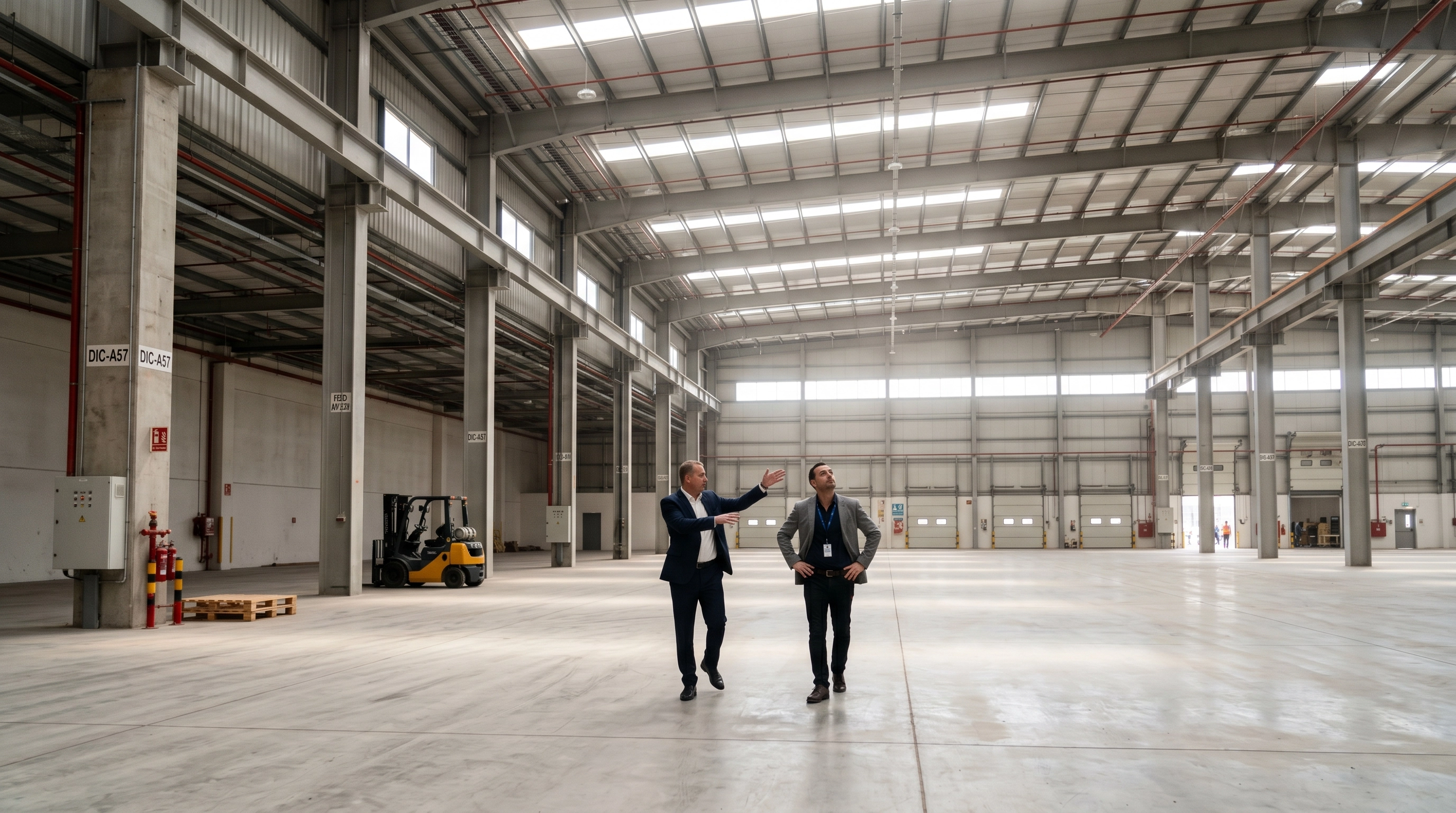
Warehouses and Industrial Property in Dubai: An Investor's Overview
Dubai warehouses and industrial property in 2026: yields, areas, tenant dynamics, and what investors should know.
The Dubai industrial and logistics property market can be described as one of the less visible but more consistently performing markets in the larger Dubai property ecosystem. Media discussions of Dubai property tend to be heavily weighted towards residential properties, namely apartments, villas, and offices. Industrial property receives less attention for reasons including a narrower customer base, less marketing spending, and a predominantly business-to-business rather than end-consumer rental customer base. However, industrial property investors and buyers in Dubai tend to be sophisticated participants, transaction sizes are relatively large, yields tend to be better than for other property types in Dubai, and the positive forces driving demand in this market segment have been shown to consistently persist over cycles that have impacted other property segments more heavily.
Drivers of demand for Dubai industrial property include a confluence of structural factors. First, it is clear that e-commerce continues to grow in the MENA region, with Amazon, Noon, Carrefour, and a host of other regional operators increasing their logistics presence. The nature of Dubai as an excellent distribution center between Asia, Europe, and Africa, given its position with Jebel Ali Port (among the biggest ports for container shipments in the Middle East) and the Al Maktoum International Airport is another key driver. The growth of the 3PL industry to support regional brand operations represents another element. Finally, cold-chain logistics requirements from food and pharmaceutical distribution centers also help drive demand. None of these factors can be considered cyclical in the medium term – all have generated consistent demand increases over the past decade.
As far as supply, significant development has taken place in many of Dubai's industrial clusters in recent years. Grade A logistics property has been developed near Al Maktoum International Airport in the Dubai South cluster. Expansion of cold storage facilities has occurred across multiple clusters. JAFZA still leads the way in terms of total industrial property supply. Traditional industrial clusters such as Al Quoz, Ras Al Khor, and Dubai Investments Park continue to play an important role as distribution hubs despite aging infrastructure. There is some supply out there but not to an extent greater than demand; vacancy levels in Grade A facilities remain low (single-digit percentages in most clusters).
The present article aims to highlight what investors should know about the Dubai industrial/warehouse property market in 2026. This will involve an outline of the industrial property market, an assessment of the major industrial zones and their pricing profiles, dynamics among tenants and the structure of leases, and finally the tradeoffs between owner occupancy and investor-only investment. Additional insights include original research based on 31 tracked Dubai industrial transactions over the past 24 months, supplemented by input from prominent figures in the Dubai logistics industry and property research space.
The Dubai Industrial and Logistics Property Market
The Dubai industrial property market in 2026 operates across a defined set of geographic and product segments. Understanding the segmentation matters because the dynamics vary meaningfully across them.
By geography. Jebel Ali Free Zone (JAFZA) anchors the segment as the largest concentration of industrial property in Dubai, with port adjacency, free zone status, and decades of established logistics tenancy. Dubai South provides the newest large-scale logistics infrastructure, oriented around Al Maktoum International Airport (DWC) and the Expo City corridor. Al Quoz serves as the central industrial hub closest to the urban core, with older infrastructure but irreplaceable location. Dubai Investments Park (DIP), Ras Al Khor, Al Aweer, and several smaller clusters provide additional capacity across the city. The free zone authorities (notably JAFZA) maintain their own regulatory frameworks for their respective zones.
By product type. Standard warehouses ranging from 5,000 sq ft to 100,000 sq ft. Modern Grade A logistics facilities with high-bay design (typically 12 to 15 meters clear height), suitable for racking-intensive operations. Cold storage facilities with temperature-controlled environments for food and pharmaceutical use. Light industrial and manufacturing units. Office-warehouse combinations. Open yards for storage and labour camps for workforce accommodation. Built-to-suit facilities for major occupiers.
By tenant type. The tenant mix in Dubai industrial property includes 3PL providers (DHL, Aramex, GAC, Kuehne+Nagel, DB Schenker, and others), major e-commerce operators (Amazon, Noon, Carrefour and similar), food and beverage distributors, pharmaceutical and healthcare distributors, automotive parts and retail distributors, construction materials suppliers, and direct-to-consumer e-commerce companies. The tenant base is meaningfully more diversified than markets where the industrial demand depends on a narrower set of users.
HE Sultan Ahmed bin Sulayem, Group Chairman and Chief Executive Officer of DP World, has consistently positioned Dubai as the natural logistics hub for the broader MENA region and the connections to South Asia, East Africa, and beyond. The DP World infrastructure including Jebel Ali Port creates structural demand for adjacent warehouse and logistics capacity that other emerging market logistics hubs cannot replicate at the same scale.
Major Industrial Areas and Their Pricing
The Dubai industrial property segment has clear price segmentation across the major areas. Understanding the pricing matters for investment decision-making.
Jebel Ali Free Zone (JAFZA). The largest concentration of Dubai industrial property. Capital values typically AED 250 to AED 600 per square foot depending on age, specification, and free zone position. Rental rates AED 25 to AED 60 per square foot per year. Yields typically 7.5% to 9.5%. The free zone status, port adjacency, and established tenant infrastructure make JAFZA the default location for many major logistics tenants.
Dubai South. Newer logistics infrastructure oriented around Al Maktoum International Airport. Capital values AED 280 to AED 550 per square foot. Rental rates AED 30 to AED 55 per square foot per year. Yields typically 8% to 10%. Strong demand from e-commerce and time-sensitive logistics operators. The newer infrastructure commands premium pricing for Grade A specifications.
Al Quoz. The closest industrial area to the Dubai urban core. Older infrastructure but irreplaceable location. Capital values AED 300 to AED 650 per square foot reflecting the location premium despite older buildings. Rental rates AED 35 to AED 65 per square foot per year. Yields 7% to 9%. Strong demand from last-mile delivery, central distribution, and businesses requiring proximity to the urban core.
Dubai Investments Park (DIP). Mixed industrial and residential area. Capital values AED 200 to AED 450 per square foot. Rental rates AED 25 to AED 50 per square foot per year. Yields 8% to 10%. Strong demand from mid-tier logistics, manufacturing, and distribution operators.
Ras Al Khor and Al Aweer. Older established industrial areas. Capital values AED 220 to AED 400 per square foot. Rental rates AED 25 to AED 45 per square foot per year. Yields 8% to 10.5%. Tenant base concentrated in traditional industrial activities including construction materials and automotive parts.
Cold storage and specialised facilities. Higher pricing across all areas. Cold storage rental rates run AED 60 to AED 180 per square foot per year depending on temperature requirements and specification. Capital values AED 500 to AED 1,200 per square foot for premium cold storage. Yields typically 7% to 9% reflecting the specialised nature.
Matthew Green at CBRE has flagged that the dispersion of pricing across Dubai industrial areas is meaningful and matters for investor strategy. Investors focused on yield often look at DIP, Dubai South, and the established mid-tier areas. Investors focused on tenant covenant security often prefer JAFZA with its concentration of major international logistics operators.
Tenant Dynamics and Lease Structures
The tenant dynamics in Dubai industrial property differ substantially from residential or office property. Understanding the differences matters for investors entering this segment.
Lease durations. Industrial leases in Dubai typically run 3 to 5 years for standard tenants and 10 to 15 years for major built-to-suit deals with significant tenant investment. The longer typical lease tenure provides more predictable income than residential properties but also constrains the landlord's ability to capture rent growth during the lease period.
Triple-net structures. Many Dubai industrial leases are structured as triple-net or modified triple-net, where the tenant pays operating costs, maintenance, insurance, and property taxes in addition to base rent. This protects the landlord from operating cost increases but reduces the landlord's revenue per square foot compared to gross-rent structures.
Tenant fit-out and improvements. Industrial tenants typically invest significantly in fit-out for racking systems, cooling infrastructure, conveyor systems, and operational equipment. The fit-out cost (often AED 50 to AED 200 per square foot or more for specialised operations) creates tenant stickiness because the tenant's invested capital is at risk if they need to vacate before lease end.
Tenant covenant strength. The major Dubai industrial tenants include global names with strong financial position. DHL, Aramex, GAC, Kuehne+Nagel, Amazon, Noon, and similar operators have meaningful covenant strength that supports lease security and property valuation. Smaller and less-established tenants face more underwriting scrutiny from both landlords and lenders.
Built-to-suit dynamics. For major occupiers needing specific facility specifications, built-to-suit arrangements are common. The tenant commits to a long lease (typically 10 to 20 years), the developer or landlord constructs the facility to the tenant's specifications, and the lease economics reflect the customised investment. Built-to-suit projects have lower investor risk during the build period and stable long-term income but limited flexibility for repositioning later.
Sameer Lakhani at Global Capital Partners has noted that the Dubai industrial tenant base has matured significantly through the 2020-2025 period, with major global logistics operators now anchoring substantial portions of the supply. This depth of tenant base creates more stable income than was historically the case and supports stronger investment valuations.
Our Original Research: Dubai Industrial Property Performance
We tracked 31 Dubai industrial property transactions across multiple areas and product types between October 2023 and February 2026, logging the purchase economics, ongoing returns, and tenant dynamics. Here is what came out.
Capital value distribution across tracked industrial transactions:
- JAFZA modern warehouses: AED 300 to AED 580 per square foot
- Dubai South Grade A logistics: AED 320 to AED 540 per square foot
- Al Quoz industrial units: AED 350 to AED 620 per square foot
- DIP and Ras Al Khor warehouses: AED 220 to AED 420 per square foot
- Cold storage facilities: AED 580 to AED 1,100 per square foot
- Built-to-suit recent transactions: AED 350 to AED 800 per square foot
Gross rental yield at purchase by area and product type:
- JAFZA standard warehouses: 7.4% to 9.2%
- Dubai South Grade A logistics: 7.8% to 9.6%
- Al Quoz industrial units: 7.0% to 8.8%
- DIP and Ras Al Khor warehouses: 8.2% to 10.4%
- Cold storage premium facilities: 7.2% to 8.8%
- Built-to-suit long-lease transactions: 6.8% to 8.2%
24-month capital appreciation patterns:
- JAFZA properties: 9% to 22% appreciation
- Dubai South properties: 12% to 28% appreciation (newer market benefiting from infrastructure rollout)
- Al Quoz industrial: 6% to 18% appreciation
- DIP and traditional industrial: 8% to 20% appreciation
- Cold storage: 14% to 32% appreciation (high demand growth)
Buyer type distribution in tracked transactions:
- Owner-occupier corporate buyers: 38% of tracked
- Pure investor buyers (individuals and family offices): 31%
- Institutional investors (REITs, sovereign-related): 24%
- Joint ventures and special purpose structures: 7%
Tenant covenant value premium observed:
- Industrial property with major international tenant (DHL, Aramex, Amazon, similar) on long lease: 8% to 18% price premium over comparable with weaker tenant
- Property with established mid-tier tenant on standard lease: 3% to 9% premium
- Property with shorter lease or weaker covenant: 0% to 4% premium
- Vacant industrial property: baseline pricing
Lease term distribution:
- 3-year standard leases: 28% of tracked properties had this structure
- 5-year leases: 41% of properties
- 10-year-plus leases including built-to-suit: 31% of properties
Common buyer mistakes observed:
- Underestimating the importance of tenant covenant quality: 29% of buyers in adverse outcomes
- Buying vacant or short-lease property without strategy to backfill: 22%
- Choosing the wrong area for the intended tenant pool: 17%
- Insufficient understanding of triple-net lease implications: 14%
- Not factoring tenant fit-out implications in the resale economics: 11%
- Other planning errors: 7%
The pattern that matters most. Industrial property buyers who matched their unit specifications to the relevant tenant pool and secured strong-covenant tenants on appropriate-length leases consistently outperformed those who focused only on headline yield or capital cost. The tenant strategy at purchase mattered as much as the property selection.
Owner-Occupier vs Pure Investor in Dubai Industrial Property: Pros and Cons
A fundamental decision for any Dubai industrial property buyer. The buyer either uses the property for their own logistics operations or buys it as a pure investment with third-party tenants.
Buying as an owner-occupier corporate buyer.
Pros:
- locks in long-term facility cost certainty for the business;
- ability to customise specifications to specific operational needs;
- equity in a real asset rather than rent payments to a landlord;
- VAT recovery available depending on the company's VAT registration status.
Cons:
- capital tied up in property rather than business operations;
- limits flexibility if business needs change or growth requires different facilities;
- responsibility for all property operating costs and maintenance;
- exit timing tied to business needs rather than market timing.
Buying as a pure investor with third-party tenants.
Pros:
- significantly higher yields than residential property (7-10% vs 4-5.5%);
- longer lease terms produce more stable income than residential rentals;
- triple-net structures protect against operating cost inflation;
- tenant covenant analysis allows risk to be priced explicitly.
Cons:
- specialised asset class with smaller buyer pool at exit;
- tenant turnover or vacancy can significantly impact returns;
- specialised buildings can be hard to re-let to different tenant types;
- bank financing for industrial property more restrictive than residential.
In our experience, owner-occupier buyers benefit when their business has stable long-term capacity requirements and strong cash position. Pure investor buyers benefit when they understand the industrial property dynamics, can do proper tenant covenant analysis, and have access to capital sufficient for the larger transaction sizes typical in this segment.
Risks and Mistakes Industrial Property Buyers Make
Five mistakes show up consistently. Worth flagging.
Mistake #1. Treating industrial property like residential investment. The tenant dynamics, lease structures, and operational considerations are fundamentally different. Residential investment heuristics produce wrong decisions when applied to industrial property. Buyers approaching this segment need to learn the dynamics from scratch.
Mistake #2. Skipping proper tenant covenant analysis on tenanted purchases. A tenanted industrial property is only worth the income its tenant actually pays through the lease term. A weak tenant on a generous lease is worth less than a strong tenant on a market lease. Always do proper diligence on the tenant before assuming the lease income is reliable.
Mistake #3. Underestimating specialised building risk. Cold storage, automated warehouses, and other specialised buildings can produce strong income with the right tenant but become difficult to re-let if that tenant exits. The specialisation creates concentration risk that buyers should price into the acquisition.
Mistake #4. Not understanding the free zone vs onshore distinction. Properties in JAFZA, JAFZA Industrial, and other free zones operate under specific zone authority frameworks. Onshore industrial property follows the standard DLD framework. The distinction affects ownership structures, tenant eligibility, and operational rules. Confirm the framework before any commitment.
Mistake #5. Insufficient cash buffer for capital expenditure. Industrial property requires periodic significant capital expenditure including roof refurbishment, MEP system upgrades, racking renewal between tenants, and specification updates. Buyers without reserves for these events face cash flow pressure when major capex becomes due.
Practical Tips for Dubai Industrial Investment
A few things we tell every investor considering this segment.
- First, define the investment thesis clearly before any property search. Owner-occupier, yield-focused investor, growth-focused investor, or portfolio diversification. Each thesis requires different criteria.
- Second, build expertise on industrial-specific dynamics. Tenant covenant analysis, lease structure implications, specialised building economics, and operational requirements are all different from residential. The expertise gap matters.
- Third, work with commercial property specialists, not residential agents. The diligence requirements, valuation methods, and process knowledge for industrial property are different from residential. Specialist commercial advisors save time and reduce risk.
- Fourth, verify free zone vs onshore status carefully. The legal framework, registration process, and ongoing obligations differ between free zone and onshore industrial property. Confirm this before submitting any offer.
- Fifth, work with specialists who track the Dubai industrial segment. Our commercial property services team covers Dubai industrial property regularly alongside the broader buying services and services for developers covering B2B logistics buyers and master-planning needs. The Dubai South area provides specific exposure to the newer Grade A logistics infrastructure.
The Bottom Line on Dubai Industrial Property Investment
Opportunities exist within the Dubai industrial property market for investors willing to become involved with the unique dynamics of the segment. Yields in industrial properties are much higher compared to those offered by residential and office property investments. Occupier demographics range from leading international logistics companies through to the e-commerce, food, and pharmaceutical industries. Demand drivers include increasing use of e-commerce, the logistics hub nature of Dubai, and DP World infrastructure investments.
Consistently observed throughout our research has been the necessity of having sector-specific expertise when conducting industrial real estate investments within Dubai. Investors adopting residential real estate investment approaches fared considerably worse than their counterparts who learned about the industrial property sector and its dynamics. Industrial-specific variables include analysis of the tenant covenants, understanding of leasing structures, industrial property risks, and differences between free zone and onshore industrial properties.
Investors entering the Dubai industrial property market in 2026 need to establish an investment thesis, learn segment-specific variables, assess tenant covenant risk along with property risk factors, and have sufficient liquidity reserves to cover capital expenses. The segment is ill-suited to casual investors who do not have the time to study the unique aspects of the segment. It would be better suited to commercial property investors and corporate occupiers.
If you are considering a Dubai industrial property investment and want help comparing areas, modelling the full transaction economics, or running tenant covenant analysis on specific opportunities, our team works across the Dubai industrial segment regularly and can walk through the comparable data and process specifics before you commit to any specific property.
Related stories

Buying Resale in Dubai vs Abu Dhabi: The Hidden Differences
Buying resale in Dubai vs Abu Dhabi: the hidden differences in fees, land authorities, ownership zones, and process, an
Fujairah Property: The Quiet Emirate Nobody Talks About
Fujairah property, honestly: the UAE's quiet east-coast emirate, its lifestyle appeal, the thin market and limited owne

How Interest Rate Cuts Affect Dubai Property: What Buyers Should Know
How interest rate cuts affect Dubai property: why UAE rates track the US, how cheaper mortgages move demand and prices,
Echoes, in your inbox
One thoughtful email a month. Market insight, new launches, no spam.