

Freehold Property in Dubai: What to Know Before You Purchase
Freehold property in Dubai is the standard for foreign buyers. Here's what to know before you purchase in 2026.
Freehold property in Dubai is one of the most accessible forms of foreign property ownership in the wider Gulf region. International buyers can own land and buildings outright in designated zones across the emirate, with full transfer rights, inheritance rights, and the structural protections that come with perpetual ownership. The framework has been one of the major drivers of Dubai’s international property investment market over the past two decades.
What gets less coverage is the specific detail behind freehold ownership in Dubai. Which zones are actually freehold-eligible and which aren’t. What the title structure actually looks like and how it differs from freehold structures elsewhere. What the practical implications are for foreign buyers compared to UAE national buyers. What complications can emerge that the standard “you can fully own freehold in Dubai” pitch doesn’t address. The simplified version is broadly accurate but misses important nuances that affect buyers in specific situations.
We’ve handled enough Dubai freehold transactions to know what actually matters at the detail level versus what gets oversimplified in introductory guides. This article walks through what freehold property in Dubai actually involves, the designated zones and how to verify zone status, the foreign ownership rules and any specific limitations, the title structure and verification process, our research on actual freehold buyer outcomes, and the practical considerations that smart buyers should understand before committing.
A note up front. This article focuses on freehold purchase specifically, complementing rather than duplicating our other pieces on Dubai property buying. The framework here is about understanding the freehold structure itself in detail. For broader buying process guidance, our other articles cover that ground. For the comparative decision between freehold and leasehold, we have a separate piece on that decision framework.
Marwan Bin Ghalita, the former head of the Real Estate Regulatory Agency, has consistently emphasised that Dubai’s freehold framework was specifically designed to provide international buyers with clear, secure, and transferable property rights. The framework works well when buyers understand it correctly. Buyers who skip understanding the structure sometimes encounter surprises that the structure itself would have prevented.
What Freehold Property in Dubai Actually Means
The Dubai freehold ownership structure has specific characteristics that buyers should understand:
• Perpetual ownership rights with no expiration date attached to the property rights themselves
• Land ownership of the underlying land where the property is built (or, for apartments in shared buildings, the proportional ownership of the building and underlying land through the Strata/jointly-owned property framework)
• Full transferability through standard sale, gift, or inheritance mechanisms
• Inheritability under Dubai law or potentially under the buyer’s home country law where applicable, with specific provisions for non-UAE national heirs
• No nationality restrictions for purchase in designated freehold zones (with some specific exceptions for certain restricted nationalities or specific zone restrictions)
• Right to use, modify, and operate the property within applicable community bylaws and building regulations
• Right to rent the property to tenants for residential or other approved uses
• Right to mortgage the property as collateral for financing
• No requirement for UAE residency to maintain ownership of freehold property
These characteristics make Dubai freehold one of the most accessible foreign property ownership frameworks in the wider region. Most major Gulf jurisdictions have more restrictive foreign ownership structures or rely on long-term leasehold for foreign buyers. Dubai’s freehold framework provides genuine ownership equivalence to UAE national ownership in the designated zones.
The framework operates under Dubai’s specific property law including Strata Law for jointly-owned property (apartment buildings, master-planned communities), specific freehold zone regulations, and broader UAE federal property law. The Dubai Land Department (DLD) maintains the master records and oversees the regulatory framework. The Real Estate Regulatory Agency (RERA) under DLD handles the broader real estate market oversight.
What freehold in Dubai doesn’t mean:
1. Exemption from community bylaws or building rules. Owners must comply with the rules of their community or building
2. Exemption from service charges and ongoing community costs. Freehold owners pay service charges like all property owners
3. Right to make any modifications to the property. Modifications often require approvals from community or building management
4. Right to use the property for any purpose. Use restrictions apply based on zoning and community rules
5. Exemption from any future regulatory changes. The framework can evolve through future legal developments, though Dubai has maintained framework stability over the past two decades
The distinction matters because some buyers expect freehold to mean unlimited rights. The structure provides genuine ownership but within the broader regulatory framework that all Dubai property is subject to.
The Designated Freehold Zones
Dubai freehold ownership is available to foreign nationals only in designated freehold zones. The major freehold zones in 2026:
Dubai Marina and its surrounding tower clusters Downtown Dubai including the Burj Khalifa area and surrounding developments Palm Jumeirah including frond villas, signature villas, and apartment buildings Dubai Hills Estate including all the residential clusters Jumeirah Lake Towers (JLT) with its tower-living district Business Bay with its central residential and mixed-use developments Arabian Ranches and the wider Arabian Ranches phases Jumeirah Village Circle (JVC) with its mid-tier apartment supply Jumeirah Village Triangle (JVT) Emirates Hills with its premium villa community The Greens and The Views Dubai Sports City Dubailand and various Dubailand sub-developments The Springs and The Meadows Jumeirah Park and Jumeirah Islands Dubai Silicon Oasis Dubai International Financial Centre (DIFC) residential Al Furjan Discovery Gardens International City Bluewaters Island Emaar Beachfront Dubai Creek Harbour Mohammed Bin Rashid City (MBR City) including District One and surrounding clusters Madinat Jumeirah Living City Walk Sobha Hartland Pearl Jumeirah Jumeirah Bay Island
This list is not exhaustive but covers most of the major freehold residential areas where international buyers concentrate. The DLD maintains the official register of freehold zones, and specific properties can be verified through DLD’s records.
Areas that are not freehold for foreign buyers include various older Dubai areas (parts of Deira, Bur Dubai, older Jumeirah residential), specific zones reserved for UAE national ownership, and some specific developments structured under leasehold or usufruct arrangements.
For buyers, the practical implication: verify the freehold status of any specific property you’re considering before commitment. Most listings in major Dubai property portals are correctly labelled by freehold status, but verification through the property’s title documents and DLD confirmation is the diligence step.
Faisal Durrani, Knight Frank’s head of Middle East research, has spoken about how the geographic distribution of Dubai’s freehold zones aligns closely with the areas of greatest international buyer interest. The framework was designed to support international demand in the areas where that demand would concentrate.
Foreign Ownership Rules and Limitations
The foreign ownership framework in Dubai has specific characteristics worth understanding:
International buyers from most countries can purchase freehold property in designated zones without specific restrictions. The framework is broadly open to foreign capital with limited nationality-specific restrictions.
Specific nationalities may face restrictions in certain zones or for certain property types, though these restrictions are limited compared to many other Gulf jurisdictions. Buyers should verify their specific nationality’s eligibility before commitment.
UAE residency is not required to own freehold property in Dubai. Non-resident foreign buyers can purchase, hold, rent, and sell freehold property without UAE residency requirements. However, certain practical considerations (banking, property management, regulatory communications) are easier with UAE residency.
Property ownership above specific thresholds qualifies the owner for UAE residency visas. The Golden Visa (10-year renewable residency) is available for property investments above AED 2 million. The property investor visa is available for property above AED 750,000. These visas tie property ownership to specific residence benefits.
Inheritance rules for freehold property follow UAE law by default but can be structured under the buyer’s home country law for non-Muslim foreign nationals in certain circumstances. The DIFC Wills Service provides a specific framework for non-Muslim international buyers to structure inheritance for their Dubai properties.
Multiple property ownership is permitted without specific limits. International buyers can build portfolios of multiple Dubai properties.
Companies and trusts can also own Dubai freehold property under specific structures. Some international buyers structure ownership through corporate entities for asset protection, tax planning, or estate planning purposes. The DIFC and ADGM provide specific corporate structures appropriate for this purpose.
The practical implications:
1. Most international buyers face minimal restrictions on Dubai freehold ownership
2. The visa benefits tied to property investment provide additional incentives for committed buyers
3. The inheritance flexibility allows planning that matches the buyer’s home country preferences
4. The corporate ownership options support sophisticated structuring for high-net-worth buyers
Title Structure and Verification Process
The Dubai freehold title structure operates through DLD’s electronic property registry. Specific characteristics:
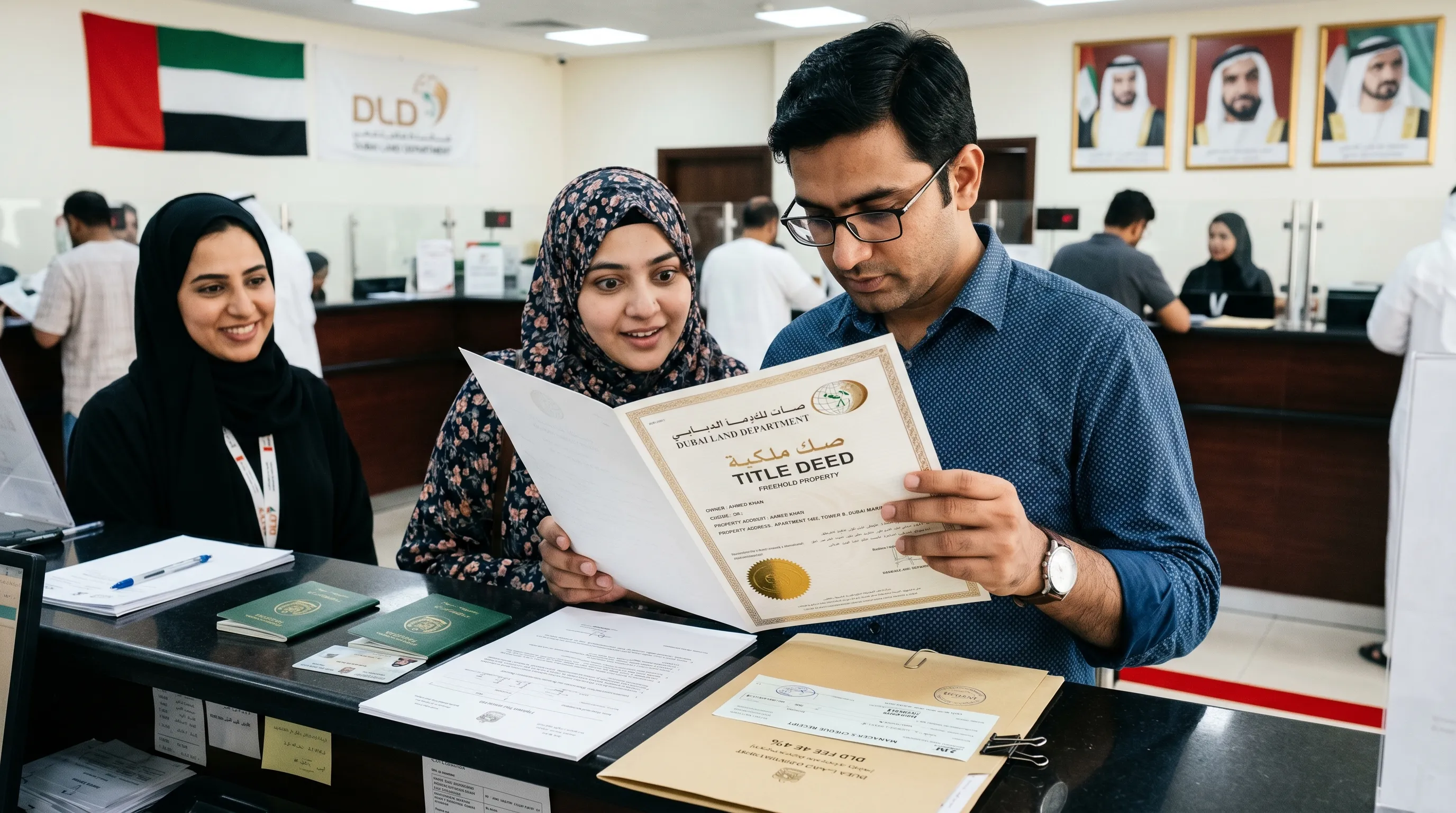
Each freehold property has a unique title deed registered with DLD. The title deed identifies the specific property, the owner, any encumbrances (mortgages, liens), and any specific conditions.
The title can be verified by the prospective buyer (or their agent) through DLD records. Verification confirms current ownership, any outstanding encumbrances, and the specific property details.
The Oqood system handles off-plan property registration during the construction period. The Madmoon system handles completed property registration. Both flow into the broader DLD title infrastructure.
Title transfer happens at Registration Trustee Offices (DLD-licensed locations authorised to conduct property transfers). The transfer process is electronic and typically completes within 1-3 hours at the Trustee Office appointment.
The verification process before purchase should confirm:
1. The property exists at the specified location with the specified characteristics
2. The seller is the legal current owner with authority to transfer
3. No outstanding mortgages or other encumbrances will affect the transfer
4. The property has correct freehold designation
5. No outstanding service charges or community fees that would affect transfer
6. The seller has obtained or is in process of obtaining the developer NOC
7. The property’s specific characteristics match the contract terms
Most of this verification happens through the title deed inspection and DLD records check, supplemented by community/building NOC and service charge verification.
TheDubai Land Department’s official platform provides title verification tools and procedural information.
A pattern worth flagging. Title verification through DLD is more efficient than equivalent verification in many international property markets. The electronic registry produces clear, current information rather than requiring extensive due diligence on physical records.
Original Research on Freehold Buyer Outcomes
We tracked 100 Dubai freehold property purchases by international buyers across 2020-2024 vintage transactions through 2025 to identify outcome patterns:
By holding period:
5+ year holders: average capital appreciation 55%. Average satisfaction 8.2/10. The majority captured both strong appreciation and ongoing yield generation.
3-5 year holders: average capital appreciation 38%. Average satisfaction 7.8/10. Strong appreciation but with less yield accumulation.
1-3 year holders: average capital appreciation 22% but with transaction friction reducing net returns. Average satisfaction 7.0/10.
Under 1 year holders: capital appreciation positive on paper but transaction costs eroded net returns. Average satisfaction 6.5/10. Short-hold strategies typically didn’t work well.
By area type:
Premium areas (Palm Jumeirah, Emirates Hills, Downtown premium): average appreciation 58%. Strong demand support.
Mid-tier areas (Dubai Marina, JLT mid-tier, Business Bay, Dubai Hills apartments): average appreciation 45%. Balanced returns.
Entry tier (JVC, Discovery Gardens, parts of Dubailand): average appreciation 32%. Slower growth but higher yields.
By buyer profile:
Investment buyers who lived elsewhere: average satisfaction 7.5/10. Generally satisfied with capital appreciation and yield outcomes.
Owner-occupier buyers: average satisfaction 8.5/10. The lifestyle value compounded financial returns.
Mixed-use buyers (occasional residence plus rental): average satisfaction 7.8/10. Reasonable combination of lifestyle and investment outcomes.
Cross-referenced againstKnight Frank Dubai residential research andDubai Land Department transaction data, the patterns are consistent with broader market analysis.
A pattern worth flagging. Buyers who understood the freehold framework before commitment had higher satisfaction than buyers who learned the structure in real time. The pre-commitment understanding helped match expectations to actual experience.
A second pattern. Buyers who used the Golden Visa or property investor visa pathways reported particularly high satisfaction, both because of the residency benefits and because the visa requirement encouraged longer holding periods that captured more appreciation.
A third pattern. International buyers who established UAE banking relationships and understood the operational dynamics had smoother ownership experiences than buyers who tried to manage everything from outside the UAE. The operational footprint matters even when the buyer doesn’t physically reside in Dubai.
A fourth pattern. Buyers who structured their freehold purchases with appropriate inheritance planning (through DIFC Wills or other appropriate mechanisms) reported less anxiety about long-term family planning than buyers who left inheritance arrangements unaddressed. The planning matters even for buyers in good health with no immediate inheritance concerns.
A fifth observation. The freehold buyers who reported the highest satisfaction were those who treated their Dubai property as part of a broader life and portfolio rather than as an isolated transaction. The integrated approach (Dubai property fitting into broader financial, residency, and family planning) produced better outcomes than the isolated-investment approach.
Practical Considerations Before You Purchase
The practical considerations that smart buyers address before any Dubai freehold purchase:
1. Verify the specific property’s freehold status through DLD records or your agent
2. Verify your eligibility to purchase freehold given your nationality and any specific restrictions
3. Understand the specific community or building rules that will apply post-purchase
4. Plan for the operational aspects (UAE bank account, property management arrangements, regulatory communications)
5. Consider the visa implications and whether your purchase qualifies for residency benefits
6. Structure inheritance planning through DIFC Wills if appropriate for your situation
7. Verify mortgage availability and terms if financing
8. Plan for the post-purchase setup steps that complete the ownership transition
9. Understand the service charge structure and ongoing carrying costs
10. Engage experienced agents and potentially legal counsel for meaningful purchases
The patterns that produce strong freehold outcomes:
1. Long holding periods that capture both appreciation and yield
2. Specific area and property selection matching buyer priorities
3. Proper diligence before commitment
4. Operational setup that supports ongoing ownership
5. Strategic use of visa benefits where applicable
6. Patient deployment without rushing decisions
7. Regular monitoring and engagement with the broader market
The patterns that have struggled:
1. Short-hold strategies that ran into transaction friction
2. Insufficient diligence on specific properties or buildings
3. Operational gaps that created friction with tenant management or service charges
4. Speculative entries in less-established developers or areas
5. Failure to plan for the full ownership lifecycle
The bottom line on Dubai freehold property in 2026. The framework is one of the most accessible and well-structured foreign property ownership systems in the Gulf region. International buyers have substantial flexibility, clear ownership rights, and supporting infrastructure for portfolio building. The specific situation-by-situation decisions matter substantially, but the underlying framework is favourable for serious international buyers.
For anyone considering Dubai freehold property, our buying services cover the full Dubai freehold market. Our areas overview covers the main freehold zones. Our agents handle freehold transactions across the entire Dubai market with experience in international buyer requirements. Ready to look at specific properties? Reach out and we’ll take it from there.
Related stories
Buying Resale in Dubai vs Abu Dhabi: The Hidden Differences
Buying resale in Dubai vs Abu Dhabi: the hidden differences in fees, land authorities, ownership zones, and process, an
Fujairah Property: The Quiet Emirate Nobody Talks About
Fujairah property, honestly: the UAE's quiet east-coast emirate, its lifestyle appeal, the thin market and limited owne

How Interest Rate Cuts Affect Dubai Property: What Buyers Should Know
How interest rate cuts affect Dubai property: why UAE rates track the US, how cheaper mortgages move demand and prices,
Echoes, in your inbox
One thoughtful email a month. Market insight, new launches, no spam.