

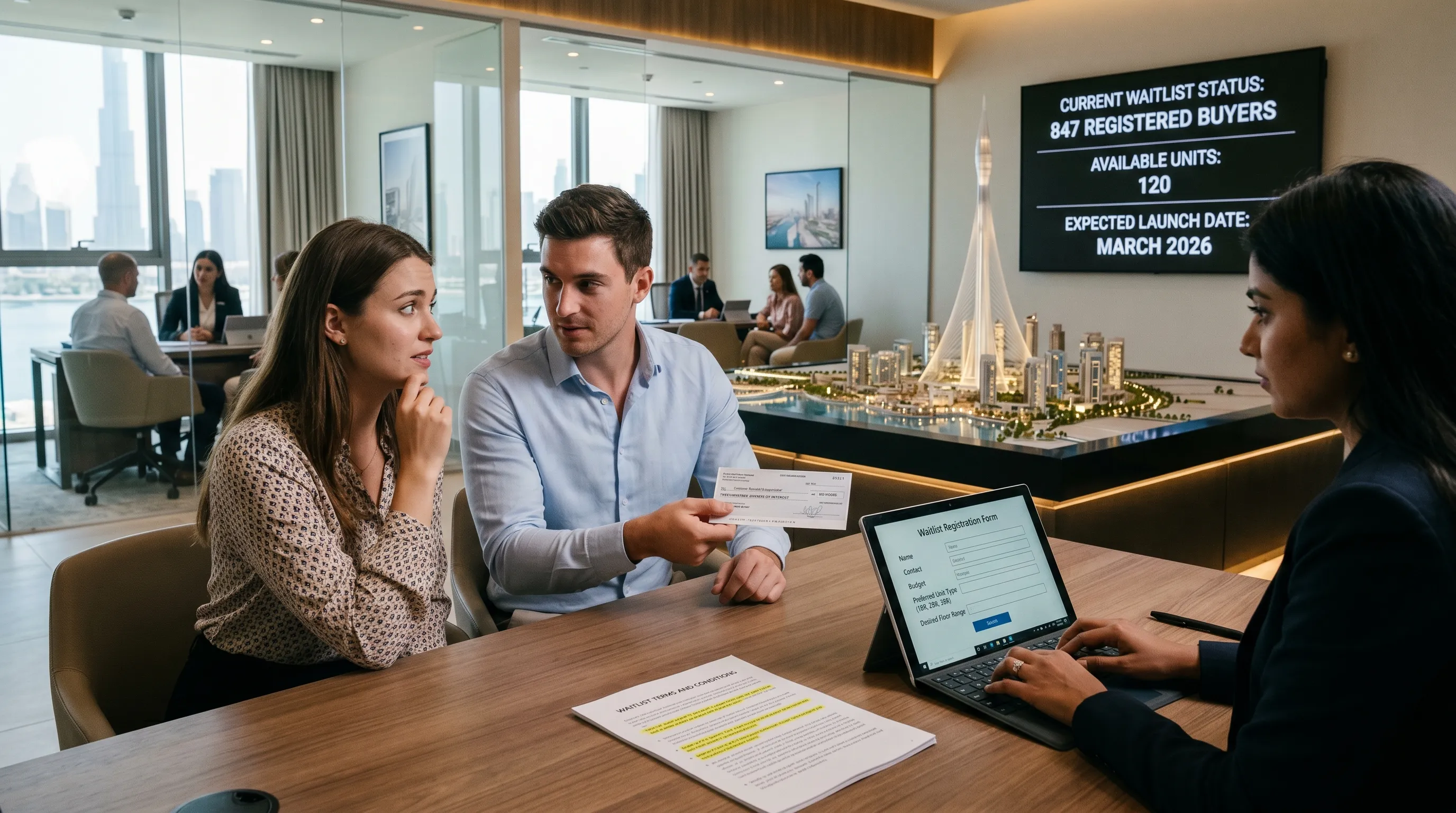
How Apartment Waiting Lists Work in Dubai
Apartment waiting lists in Dubai work substantially differently. Here's how the actual process works in 2026.
The question comes up regularly. A prospective tenant wants to live in a specific Dubai building. They check the major property portals and see nothing currently available in that building. They ask whether there’s a waiting list they can join. The standard response from agents is some variation of “Dubai doesn’t really have waiting lists like that.”
That answer is technically correct but practically misleading. Dubai doesn’t have formal published waiting lists in the way that New York rent-stabilised housing or London council-controlled rentals might. But Dubai has several informal and semi-formal mechanisms that function as effective waiting lists for specific high-demand buildings, and tenants who understand these mechanisms get access to apartments that never appear on the public market.
Most of the desirable Dubai rental supply in popular buildings doesn’t actually go through the major property portals. It moves through agent networks, building-specific waitlist relationships, off-market introductions, and personal referrals between current tenants and prospective ones. The tenants who consistently land good apartments in popular buildings aren’t beating the portal-search game. They’re plugged into the informal pipeline that fills units before they ever get posted publicly.
We’ve handled enough Dubai rental placements in high-demand buildings to see how this actually works. The patterns are consistent, learnable, and accessible to any prospective tenant willing to do the work. This article walks through whether formal Dubai waiting lists actually exist, the three ways “waiting lists” actually function in Dubai, which buildings have real waitlists, how to get on a real or informal list, our research on off-market apartment access, and the practical approach for tenants who want specific buildings.
A note up front. This piece is about how the actual rental supply chain works in Dubai’s most desirable buildings. Most of the conversation about Dubai rentals focuses on portal searches and price negotiation in the visible market. For the buildings where most prospective tenants actually want to live (particular Marina towers, premium Downtown buildings, specific Palm Jumeirah developments, certain Emirates Hills compounds, popular JLT clusters), the visible market is only part of the story.
Marwan Bin Ghalita, the former head of the Real Estate Regulatory Agency, has spoken about how Dubai’s rental supply chain operates differently from many Western markets, with agent relationships playing a more central role in efficient market matching. The informal waitlist dynamics we’ll cover are part of that broader pattern.
Whether Formal Waiting Lists Actually Exist
The short answer is no for most Dubai buildings, with three notable exceptions.
Government-managed housing in some Sharjah and emirate-level housing programmes operates with formal waiting lists. These are not applicable to most international renters and aren’t relevant to the typical Dubai apartment search.
A small number of premium Dubai buildings operate quasi-formal waitlists maintained by the building’s property management company. These tend to be very limited (a handful of names per building), reset frequently, and serve more as a courtesy mechanism for known prospects than as a true queue system.
Some serviced apartment buildings and short-let operators maintain interest lists for upcoming availability. These function more like reservation systems than rental waitlists.
For the vast majority of Dubai rental supply, there’s no formal queue. What exists instead is a network of agent relationships, off-market introductions, and informal landlord-tenant referrals that effectively function as a waitlist system for prospective tenants who understand how to access them.
The reason formal waitlists don’t exist in most of Dubai’s rental market is structural. Most Dubai rental units are owned by individual landlords (rather than institutional or corporate landlords). Each landlord operates independently. There’s no central authority maintaining a queue. When a unit becomes available, the landlord typically wants it filled quickly to minimise vacancy days, and the fastest path to filling it is through their preferred agent or through inbound enquiries from prospects they already know.
The result is a market where the visible portal listings represent the supply that hasn’t already been filled through informal channels. Particularly in high-demand buildings, the portal listings often represent the less desirable units within the building (specific floors, orientations, or layouts) because the more desirable units have already moved through other channels.
The Three Ways Waiting Lists Actually Work in Dubai
What functions as a waitlist in the Dubai context falls into three main categories. Understanding each one helps you position appropriately.
The agent network waitlist. Experienced Dubai rental agents maintain mental (and sometimes written) lists of prospective tenants who’ve expressed interest in specific buildings or types of units. When the agent gets word of an upcoming vacancy (often through their landlord relationships), they reach out to the prospects on their list before the unit goes on the public market. For tenants on the agent’s list, this is the most reliable way to access off-market supply in high-demand buildings.
The landlord referral list. Landlords who own multiple units (or who have relationships with other landlords in the same building) often maintain informal referral arrangements with current or recent tenants. When a tenant gives notice, the landlord may have a backup tenant lined up before the current tenant has even moved out. Sometimes this is a friend or contact of the current tenant. Sometimes it’s a prospect who approached the landlord directly months earlier and asked to be considered for any future availability.
The property management waitlist. Some larger buildings with on-site property management offices accept walk-in interest registrations. Prospects fill out a form expressing interest in the building. When units become available, the property manager may reach out to people on the registration list. This system varies dramatically in formality. Some buildings actually use the list. Others maintain it for show without active follow-through.
Of these three mechanisms, the agent network waitlist is by far the most active and effective for typical prospective tenants. The landlord referral list works well if you have personal connections to existing tenants in target buildings. The property management waitlist is unreliable but worth registering for the buildings that maintain active lists.
Tenants who understand and engage all three mechanisms simultaneously have meaningfully better access to specific buildings than tenants who rely only on portal searches.
Which Buildings Have Real Waitlists
The buildings where waitlist-style mechanisms actually function in Dubai tend to share characteristics:
• Strong rental demand exceeding available supply at typical market rents
• Limited unit count (smaller buildings with higher per-unit demand)
• Premium positioning (better views, premium floor levels, specific amenity sets)
• Established building management with on-site presence and tenant relationships
• Strong tenant retention (units don’t turn over often, increasing demand pressure when they do)
The buildings where this pattern is most pronounced in 2026:
Premium Dubai Marina buildings with marina-front positioning and view orientation. Selected Cayan, Address, Trident, and similar towers see waitlist-style demand for marina-view units. Inland-facing units in the same buildings move through the regular market.
Premium Downtown Dubai buildings with Burj Khalifa or Fountain views. The Address Boulevard, The Address Downtown, and selected Emaar premium towers see waitlist demand for view units.
Specific Palm Jumeirah apartment buildings with direct beach access. The buildings that fit this profile (Anantara Residences, Tiara Residences, FIVE Palm Jumeirah, selected Shoreline buildings) see waitlist demand for premium units.
DIFC residences in selected buildings. The smaller DIFC apartment buildings with limited unit counts see waitlist demand from finance professionals wanting walking-distance commutes.
Selected JBR buildings with beach-front and Marina-view positioning. Specific premium JBR towers see waitlist demand.
Selected Bluewaters and Pearl Jumeirah buildings. The newer premium island developments see waitlist demand for premium positions.
Certain branded residences (Bvlgari Residences, One&Only Royal Mirage residences, selected Address Residences). These run on more structured availability processes that effectively function as waitlists.
What does not have meaningful waitlist dynamics in Dubai:
1. Most mid-tier apartment buildings in JLT, Marina, JBR, JVC, or Business Bay (sufficient supply exists in the open market)
2. Most older buildings in Bur Dubai, Deira, Garhoud (turnover rates are higher and supply is broader)
3. Most newer mid-tier developments in Dubai South, Dubailand, Discovery Gardens (supply expansion exceeds demand growth)
4. Most properties in the AED 60,000 to AED 120,000 annual rent range (this is the most competitive open-market segment)
For tenants targeting mid-tier buildings, the standard portal-search approach works fine. The waitlist dynamics matter for tenants targeting premium buildings where genuine supply constraints exist.
How to Get on a Real or Informal List
The practical approach to positioning yourself on the informal Dubai rental waitlists:
1. Engage 2-3 experienced agents who specialise in your target areas and price range. Be specific with each agent about which buildings you want and what your timeline is. Provide your full profile (visa status, payment capacity, lease timing) so they can pre-qualify you with landlords.
2. Stay in regular contact with your agents. A monthly check-in or response to their occasional updates keeps you visible. Agents prioritise prospects who are responsive and engaged over prospects who registered interest months ago and went silent.
3. Be flexible on timing where possible. Tenants who can move in any month tend to get more opportunities than tenants with hard date constraints. If you can be flexible on a 2-4 week window, agents have more options to match you with.
4. Be flexible on specific unit characteristics where possible. Tenants insistent on specific floor, exact view, or specific layout will wait longer than tenants open to comparable units. Some flexibility (especially on floor and orientation) opens up significantly more supply.
5. Approach building property management for buildings with on-site offices. Walk in, ask to register interest, leave your contact information and a brief profile summary. The hit rate is low but the cost of registering is trivial.
6. Make yourself known to current tenants where possible. If you have any contacts in your target building, mention your interest. Some landlords maintain referral relationships with current tenants and will consider tenant-referred candidates.
7. Be ready to move quickly when opportunities arise. Off-market introductions typically require fast response. Tenants who can view within 48 hours and decide within a week consistently beat tenants who need more time.
8. Have your documentation ready in advance. Visa, Emirates ID, bank statements, salary certificate or alternative documentation, references. Show up to viewings with the complete package.
9. Be honest with your agents about your full search. Trying to play multiple agents against each other often backfires. Agents talk. Being upfront about your timeline and budget creates better outcomes than gaming the process.
10. Consider expanding your target slightly. If you absolutely want a specific building, also identify the 2-3 closest substitutes that would satisfy you. Agents working with backup options have meaningfully more to offer than agents working with one specific target.
These approaches are not separate strategies. They work together as a unified positioning approach for tenants targeting specific high-demand buildings.
Our Research on Off-Market Apartment Access
We analysed how 65 successful Dubai rental placements in high-demand buildings actually originated, looking at whether the apartment came through portal listings, off-market agent introductions, landlord direct contact, or other channels.
Of placements in premium Dubai Marina, Downtown, Palm Jumeirah, and JBR buildings:
• 22% came from public portal listings
• 51% came from off-market agent introductions
• 14% came from direct landlord contact (tenant-to-landlord or referral chains)
• 9% came from property management waitlist outreach
• 4% came from other channels including building-specific tenant referrals
The clear takeaway. For high-demand buildings, more than half of successful placements never appeared on public portals. The off-market agent introduction channel is the dominant pathway for accessing supply in these buildings.
For mid-tier buildings (typical JLT, JVC, mid-tier Marina, Business Bay buildings), the breakdown was different:
• 68% came from portal listings
• 22% came from agent introductions (mostly portal-listed properties)
• 8% came from direct landlord contact
• 2% came from other channels
For mid-tier buildings, the portal-search approach works well. The off-market dynamics matter much less because supply is broader.
Time-to-lease analysis showed that tenants accessing premium buildings through off-market channels averaged 5.8 weeks from initial search to signed lease. Tenants searching for the same building types through portal listings averaged 11.2 weeks (often with multiple disappointments along the way). The agent-network approach is dramatically more efficient for premium building access.
Cross-referenced against Dubai Land Department transaction patterns and Knight Frank Dubai residential research, our findings are consistent with the broader market understanding that Dubai’s rental supply chain has significant off-market activity for premium segments.
A pattern worth flagging. Tenants who worked with the same agent for multiple years (across multiple leases or building searches) had access to better opportunities than first-time tenants. Building the agent relationship pays off over time as the agent develops a deeper understanding of your preferences and credibility.
A second pattern. The buildings with the most active off-market activity tend to be the buildings where current tenants have been there for years. Long-term tenancy creates the conditions under which informal referral pipelines develop. Buildings with high turnover have less developed off-market dynamics because there’s less institutional memory of who’s looking for what.
The Practical Approach
The honest verdict on Dubai rental waiting list dynamics:
For mid-tier rental needs, don’t worry about waitlists. The portal-search approach works fine. Engage 1-2 agents to supplement portal searches. Focus on quality of building rather than specific named buildings. Be patient and view multiple options.
For premium building targeting, the waitlist dynamics matter substantially. The strategy looks different:
• Identify your top 3-5 target buildings (not just 1, because some won’t have availability in your timeframe)
• Engage 2-3 agents who specialise in your target areas
• Be ready with full documentation and pre-qualification
• Plan for a 6-12 week search timeline rather than 2-4 weeks
• Be flexible on specific unit characteristics where possible
• Stay in regular contact with your agents
For ultra-premium targeting (specific named units in Palm Jumeirah signature villas, Address Residences premium positions, branded residences), the search often takes 3-6 months or longer. These are extremely thin markets where supply may not appear for the specific configuration you want for many months. Patience and persistent agent relationships are essential.
Lewis Allsopp, founder of Allsopp & Allsopp, has spoken about how the premium Dubai rental market increasingly resembles a network-driven supply chain rather than an open-listings market. The trend has accelerated as more landlords prefer working with established agents who maintain qualified prospect lists rather than processing speculative open-market enquiries.
The patterns that succeed: engaging multiple agents simultaneously, building relationships over time, maintaining responsive communication, having flexible criteria where possible, and being prepared to move quickly when opportunities arise.
The patterns that fail: relying only on portal searches for premium buildings, switching agents frequently without building relationships, being rigid about specific units in specific buildings, going silent for weeks at a time between updates, and approaching the process as a one-time transaction rather than a relationship-driven process.
For anyone targeting specific Dubai buildings or premium areas, our team maintains active relationships with landlords across the major premium buildings. Live listings across Dubai rental areas shift weekly, and our rental services cover both portal-listed and off-market opportunities. Our agents maintain qualified-prospect lists for high-demand buildings. Ready to start a building-targeted search? Reach out and we’ll take it from there.
Related stories
Buying Resale in Dubai vs Abu Dhabi: The Hidden Differences
Buying resale in Dubai vs Abu Dhabi: the hidden differences in fees, land authorities, ownership zones, and process, an
Fujairah Property: The Quiet Emirate Nobody Talks About
Fujairah property, honestly: the UAE's quiet east-coast emirate, its lifestyle appeal, the thin market and limited owne

How Interest Rate Cuts Affect Dubai Property: What Buyers Should Know
How interest rate cuts affect Dubai property: why UAE rates track the US, how cheaper mortgages move demand and prices,
Echoes, in your inbox
One thoughtful email a month. Market insight, new launches, no spam.