

Renting Near Dubai Airport: The Tradeoffs Nobody Mentions
Renting near Dubai Airport sounds practical, but the tradeoffs aren't always obvious. Here's what nobody mentions.
The conversation about renting near Dubai International Airport tends to go one of two ways. The first is the practical pitch. The airport is close, the rent is cheap, the locations like Garhoud, Deira, and parts of Bur Dubai are well-connected, and for anyone who travels frequently, the savings on airport transfers alone make the math interesting. The second is the dismissive version. Why would anyone live there when Dubai Marina and Downtown exist? The answer is usually some variation of “it’s old,” “it’s noisy,” or “the area is just not for me.”
Both versions miss what’s actually going on. Living near Dubai Airport has real advantages and real disadvantages, and the honest comparison against the alternatives looks very different depending on what kind of resident you are and what you actually do with your weeks.
We’ve placed enough tenants in airport-adjacent areas (Garhoud, Al Qusais, parts of Deira, Bur Dubai, Festival City fringe, Mirdif) to recognise who thrives in these areas and who quietly hates living there. The pattern is consistent enough to write down. This article walks through what the airport-adjacent rental market actually offers in 2026, the tradeoffs that don’t make it into the standard guides, our research on actual living patterns in these areas, the practical considerations frequent flyers should factor in, and the honest read on whether airport-adjacent renting works for you.
A note up front. The areas near Dubai Airport are not luxury areas. They are not new master-planned communities. They are not where the Dubai brochures tell you to live. They are working, residential parts of older Dubai with their own character and their own residents. For some renters that character is a feature. For others it’s a friction. The honest version of this conversation matters because too many renters end up in the wrong area through default rather than choice.
What the Dubai Airport-Adjacent Rental Market Actually Looks Like
The areas within reasonable proximity of Dubai International Airport (DXB) include several distinct districts with different characters and price points:
• Garhoud sits immediately south of the airport, with mid-rise apartment buildings, some villas, and easy DXB access. The area has matured into a settled residential district with established schools and retail
• Deira is the older northern Dubai commercial and residential cluster, with apartment supply ranging from older mid-tier to newer waterfront developments along Dubai Creek
• Bur Dubai is the historic southern Dubai district with older apartment supply, strong proximity to airport and city centre, and a notably international resident mix
• Al Qusais sits east of the airport with primarily mid-tier apartment supply and a growing residential population
• Festival City and the surrounding fringe areas offer newer mid-tier apartment supply with strong amenity access
• Mirdif is south-east of the airport with primarily villa and townhouse supply at moderate prices, popular with families
• Al Nahda straddles the Dubai-Sharjah border with apartment supply at some of the lowest mainland Dubai prices
Each district has a distinct character that affects daily life more than the price differences suggest. Garhoud and Festival City feel the most settled and family-oriented. Deira and Bur Dubai carry older Dubai’s historic urban character. Mirdif feels suburban and family-focused. Al Qusais and Al Nahda lean working-class and ethnically diverse, with strong South Asian and Filipino community presence in some pockets.
Price Ranges Across Airport-Adjacent Areas
The rental price ranges vary significantly across these districts. In 2026:
• Garhoud apartments: 1-bedrooms AED 65,000 to AED 95,000, 2-bedrooms AED 90,000 to AED 130,000
• Deira apartments: 1-bedrooms AED 45,000 to AED 75,000, 2-bedrooms AED 70,000 to AED 115,000 (with waterfront premium)
• Bur Dubai apartments: 1-bedrooms AED 50,000 to AED 80,000, 2-bedrooms AED 75,000 to AED 110,000
• Al Qusais apartments: 1-bedrooms AED 45,000 to AED 70,000, 2-bedrooms AED 65,000 to AED 95,000
• Festival City apartments: 1-bedrooms AED 75,000 to AED 110,000, 2-bedrooms AED 105,000 to AED 145,000
• Mirdif villas: 3-bedroom townhouses AED 130,000 to AED 175,000, 4-bedroom villas AED 160,000 to AED 220,000
• Al Nahda apartments: 1-bedrooms AED 40,000 to AED 65,000, 2-bedrooms AED 60,000 to AED 90,000
These numbers are 30 to 50 percent below comparable space in Dubai Marina, JLT, or Downtown. The trade-off is location, area character, and the daily experience of living in older Dubai versus the newer master-planned areas.
Rental growth in airport-adjacent areas has been measurable but not extreme over the past three years. Garhoud rents have grown roughly 35% to 50% between 2022 and 2025. Deira rents have grown 25% to 45%. Festival City and Mirdif have tracked broader Dubai rental growth at 40% to 60%. The older districts have grown less aggressively than the newer master-planned communities.
What works practically about airport-adjacent renting:
1. The airport access is genuinely fast. DXB is 5 to 15 minutes from most of these districts in normal traffic
2. The metro coverage in these older districts is solid. The Red Line and Green Line cover Deira, Bur Dubai, Garhoud, and Al Qusais effectively
3. Rents are meaningfully lower than comparable space in newer Dubai districts
4. The food scene in older Dubai is genuinely strong, with cuisine variety that the newer districts often lack
5. Healthcare access is mature, with major hospitals (Rashid Hospital, Mediclinic, NMC Royal) within easy reach
6. The schools situation is varied but workable in most districts, particularly Mirdif and Festival City
7. Traffic patterns are well-understood and consistent, even when busy
The Tradeoffs Nobody Mentions
The honest list of what you’re trading off when you choose airport-adjacent renting:
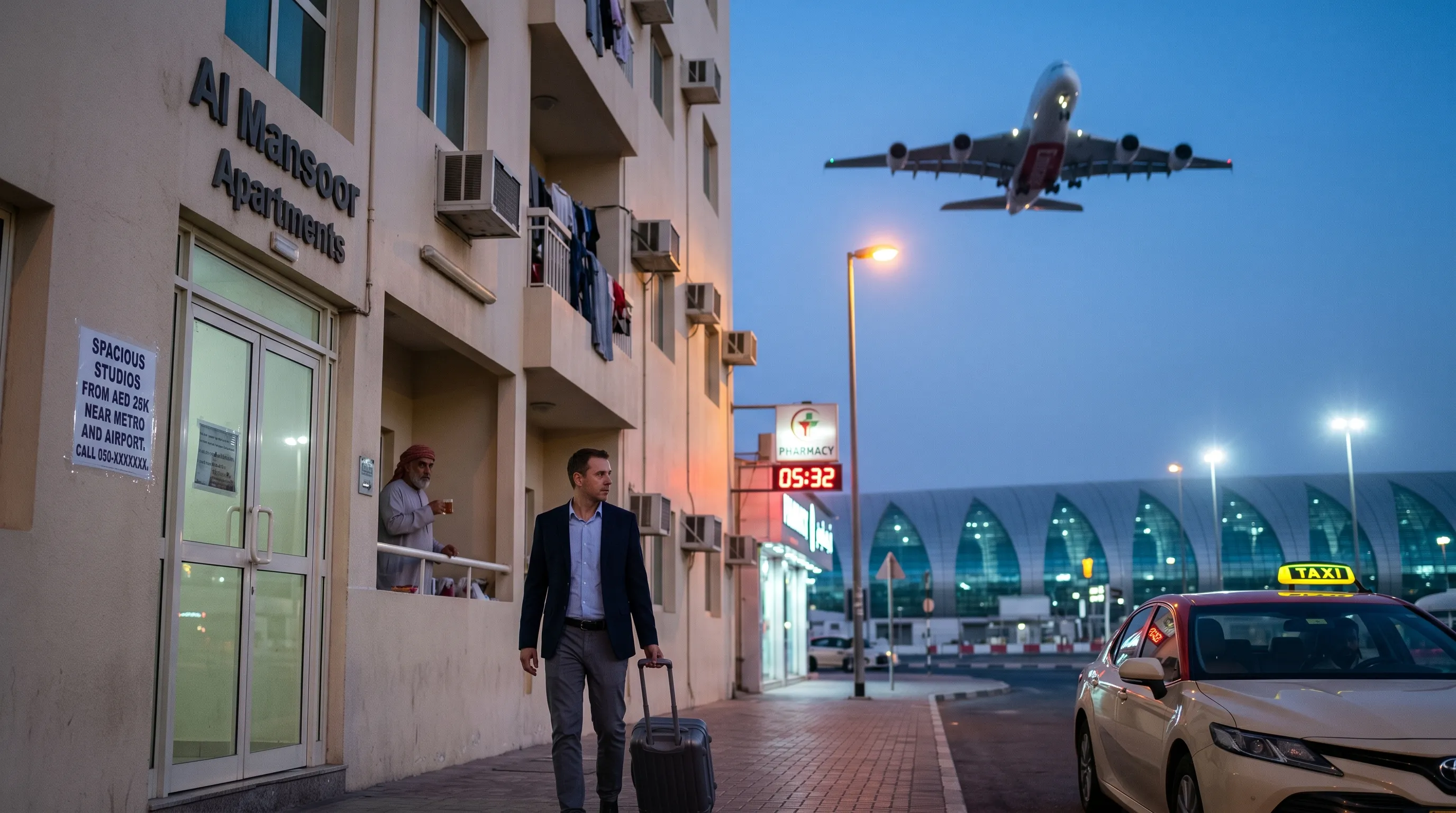
Aircraft noise is real and varies dramatically by exact location. Garhoud buildings within certain flight path corridors can hear aircraft activity throughout the day. Buildings in less direct flight paths hear minimal noise. Always visit the specific building at multiple times of day before signing, ideally including peak airport hours.
The area character is mature and unpretentious, which suits some residents but feels under-polished to others. If you’re moving to Dubai for the gleaming-tower experience, older Garhoud or Deira will feel anti-climactic. If you want a city with character that doesn’t feel like everywhere else, these areas have it.
The community feel is different from newer Dubai districts. In Garhoud and Deira, your neighbours are often long-term Dubai residents who’ve been in the area for years or decades. In Dubai Marina, your neighbours are often other recent arrivals. Both have their appeal but they’re meaningfully different daily experiences.
Walking culture is mixed. Garhoud has decent walkability within sections. Deira has strong walkability in some pockets and weak walkability in others. Bur Dubai is genuinely walkable in its core. The newer districts like Marina were designed for walking the entire community. The older airport-adjacent districts have it in spots.
Beach proximity is real but not immediate. Most airport-adjacent districts are 15 to 25 minutes from the nearest decent beach, longer in traffic. If beach time is a meaningful part of your weekly rhythm, the airport areas work less well than coastal districts.
The schools situation varies considerably. Mirdif has strong school options. Festival City has access to GEMS Modern Academy and others. Garhoud and Deira have some good options but fewer than the major school clusters. Worth checking specific school proximity before committing.
Service charges and ongoing costs in older buildings can be unpredictable. Some Deira and Bur Dubai buildings have well-managed reserve funds and predictable charges. Others have deferred maintenance that shows up as periodic service charge spikes. Building-by-building diligence matters here more than in newer districts.
Air quality varies. Some airport-adjacent districts catch more particulate from the airport itself and from older industrial neighbours. Garhoud is generally fine. Some parts of Al Qusais and Deira can be marginally worse. For residents with respiratory sensitivities, this is worth verifying.
The “I live near the airport” social signal is different from the “I live in Marina” signal. For some renters that doesn’t matter. For others it shapes how they’re perceived by colleagues and friends. The honest read is that newer Dubai arrivals tend to weight this more than long-term residents do.
One pattern that gets missed in most discussions of these areas. The community of long-term residents in older Dubai districts is one of the strongest in the city. Garhoud, Deira, and parts of Mirdif have residents who have been in the same building for 10 or 15 years. They know each other. They know the building staff. They know which restaurants are good and which are tourist traps. For renters who value being inside a real community rather than a transient population, these areas offer something the newer districts cannot replicate.
A second pattern worth flagging. Public transport in older Dubai is generally better than in the newer master-planned districts. The metro stations are closer together, the bus routes are more comprehensive, and the daily reality of getting around without a car is actually more workable than in Marina or JLT for residents who don’t drive or who prefer not to.
Practical Considerations for Frequent Flyers
The case for airport-adjacent renting strengthens considerably for residents who actually use the airport frequently. The math:
A Dubai Marina resident travelling once a week typically spends 45 minutes each way to DXB, or roughly 90 minutes per round trip in airport transit time. A Garhoud resident spends 20 minutes round trip. The differential is 70 minutes per trip, or 60+ hours a year for weekly travellers.
The cost differential, if using taxis or rideshare, is roughly AED 70 to AED 100 per trip from Marina versus AED 25 to AED 40 from Garhoud. The differential is roughly AED 50 to AED 60 per trip, or AED 2,500 to AED 3,000 a year for weekly travellers.
For consultants, sales executives, and business travellers who genuinely spend half their working week elsewhere, the time and cost savings from airport-adjacent renting are real and add up over a multi-year stay in Dubai.
Marwan Bin Ghalita, the former head of the Real Estate Regulatory Agency, has spoken about how Dubai’s residential geography accommodates different lifestyle patterns differently. The airport-adjacent areas serve a specific need that the newer districts don’t replicate. For frequent travellers and certain professional profiles, the airport areas are genuinely the right choice rather than a compromise.
Other professional profiles where airport renting often works well:
1. Long-distance commuters to other GCC cities (Saudi Arabia, Kuwait, Bahrain, Qatar)
2. International consultants based out of Dubai but flying weekly to client sites
3. Senior executives in Dubai-based regional roles requiring frequent regional travel
4. Healthcare professionals with rotational international assignments
5. Crew and aviation industry professionals
6. Business owners with operations across multiple regional markets
For these residents, choosing to live in Dubai Marina specifically and accepting the daily airport access penalty often isn’t the right call.
Our Research on Actual Living Patterns
We pulled data on 80 tenants we placed in airport-adjacent districts (Garhoud, Deira, Bur Dubai, Al Qusais, Festival City, Mirdif) over 2023 and 2024, tracking who renewed, who moved out, and where the movers went. The patterns:
Tenant retention varies meaningfully by district. Garhoud retention is strong, with 72% of placed tenants renewing for at least a second year and 48% staying for three years or longer. Deira retention is lower at 58% second-year renewal, partly reflecting that Deira often serves as an entry-Dubai stop before tenants relocate. Festival City retention is high at 78%, similar to good newer-district performance. Mirdif retention is the highest at 81%, reflecting its family-anchored character.
Of the tenants who moved out, the destinations were instructive. About 35% moved to Dubai Marina, JLT, or Downtown after deciding they wanted the newer-district lifestyle. About 25% moved to Mirdif or Dubai Hills for family-stage reasons (more space, schools). About 20% moved to other airport-adjacent districts because the airport proximity worked for them but the specific building didn’t. About 20% left Dubai or moved to other areas for various reasons.
Among tenants who stayed long-term (3 plus years), the strongest predictors were:
1. Frequent airport usage either professionally or for family reasons
2. Long-term Dubai resident status (5 plus years in the country before the lease)
3. Preference for established neighbourhood character over newer master-planned community feel
4. Cost-consciousness as a meaningful factor in housing budget allocation
5. Specific work locations near the airport corridor (DAFZA, Dubai Airport Free Zone, JAFZA-bound but living near airport for connectivity)
Cross-referenced against the Dubai Statistics Centre rental data, the broad patterns hold. Airport-adjacent districts have lower tenant turnover than the marketing perception suggests, with tenants who stay tending to stay for multiple years.
A pattern worth flagging. The tenants who reported the highest satisfaction with airport-adjacent living were the ones who actively chose it after considering alternatives, not the ones who ended up there because it was cheapest. The intentional choice mattered more than the financial driver for long-term satisfaction.
Is Airport-Adjacent Renting Right for You
The honest verdict comes down to lifestyle priorities and use patterns.
Airport-adjacent renting genuinely works well for:
Frequent business travellers who fly weekly or more often. The time and cost savings are real and add up over a multi-year stay.
Long-term Dubai residents who value established neighbourhood character and aren’t trying to recreate the marketing-version of Dubai life in their daily routine.
Budget-conscious renters who want to maximise other spending categories (travel, dining, family priorities) by saving on housing costs.
Families who specifically want Mirdif’s villa-and-school character at moderate prices.
Senior professionals with regional roles requiring frequent inter-GCC travel.
Crews, aviation professionals, and others whose work specifically anchors to the airport.
Airport-adjacent renting works less well for:
New Dubai arrivals who specifically chose Dubai for the newer-city lifestyle and amenity-rich master-planned community feel.
Renters who weight social signalling (the address itself) heavily in their housing choices.
Residents whose weekly life centres on beach activities, where the geographic gap matters meaningfully.
Renters who want maximum walkability and amenity density within their immediate neighbourhood, where the newer districts deliver more.
The patterns we’ve watched succeed: tenants who picked airport-adjacent districts intentionally after visiting multiple options, who matched the specific district to their lifestyle (Garhoud for couples, Mirdif for families, Festival City for amenity-balanced living), and who held the lease for multiple years to amortise the moving costs.
The patterns that have failed: tenants who picked the cheapest available unit without visiting at multiple times of day, tenants who underestimated the cultural difference between older Dubai and newer Dubai, and tenants who tried to recreate Dubai Marina lifestyle in Bur Dubai or Deira and found the daily reality jarring.
For anyone weighing airport-adjacent versus newer-district renting, the team can pull live data on specific buildings and neighbourhoods you’re considering. Live listings across Dubai rental areas shift weekly, and our rental services cover the full Dubai rental market across both new and established districts. Our agents handle rental placements across all the major Dubai districts. Ready to look at specific options? Reach out and we’ll take it from there.
Related stories
Buying Resale in Dubai vs Abu Dhabi: The Hidden Differences
Buying resale in Dubai vs Abu Dhabi: the hidden differences in fees, land authorities, ownership zones, and process, an
Fujairah Property: The Quiet Emirate Nobody Talks About
Fujairah property, honestly: the UAE's quiet east-coast emirate, its lifestyle appeal, the thin market and limited owne

How Interest Rate Cuts Affect Dubai Property: What Buyers Should Know
How interest rate cuts affect Dubai property: why UAE rates track the US, how cheaper mortgages move demand and prices,
Echoes, in your inbox
One thoughtful email a month. Market insight, new launches, no spam.