

Buy or Rent in Khalifa City Abu Dhabi: What the Numbers Say
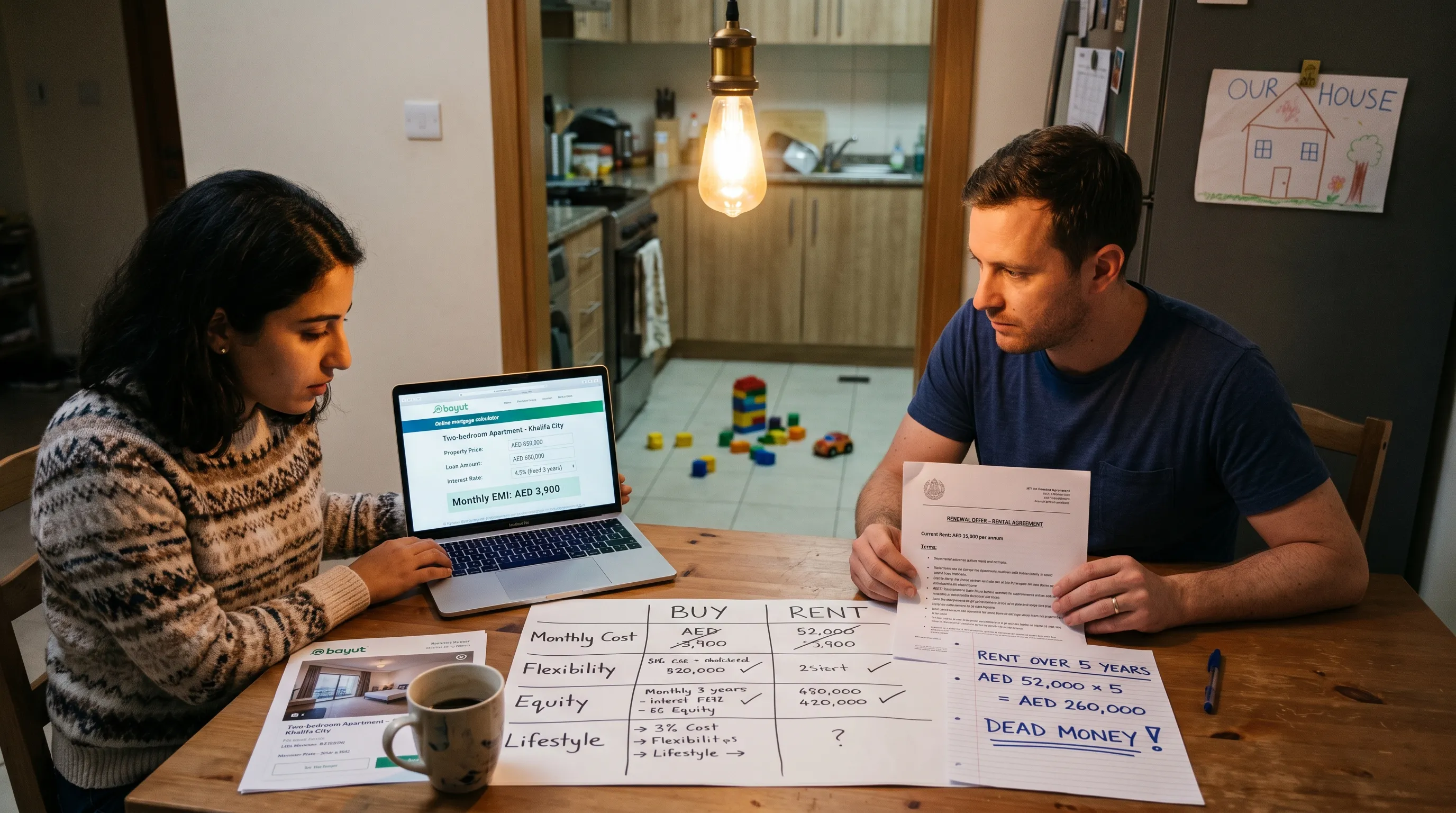
The buy vs rent calculation in Khalifa City has specific characteristics. Here's what the numbers say in 2026.
Khalifa City is where a lot of Abu Dhabi residents end up making the most consequential property decision of their time in the city. Whether to keep renting a villa for a few more years or finally buy one. The decision matters because Khalifa City has been one of the most stable corners of the Abu Dhabi residential market for over a decade, and the math on buying versus renting here has shifted meaningfully in the past two years.
Two years ago, the conversation was easy. Rent. The yields available to landlords were good enough that landlords’ asking rents made the buy-versus-rent math run against ownership for most occupiers. Today, the conversation is harder. Rents have moved up faster than purchase prices in many parts of Khalifa City. Mortgage rates, while not low, have stabilised. Foreign ownership rules in Abu Dhabi have opened up more than they were in 2018 or 2019. And the Khalifa City inventory has aged into a sweet spot where many villas are 10 to 15 years old, large, well-maintained, and selling at prices that look genuinely reasonable against the rents being asked.
We’ve handled buy-side and rent-side transactions across Khalifa City A, Khalifa City B, and the various sub-districts including Sas Al Nakhl and the newer Wahat Al Zaweya developments. The clients who come to us with the buy-or-rent question are usually long-term Abu Dhabi residents. They’ve been renting for 5 to 12 years. They’ve watched the area mature. They’ve put their kids in nearby schools. They’re now asking whether the time has come to switch from renter to owner.
This article walks through what Khalifa City actually is, what the rental market currently looks like, what the buying market looks like, the breakeven math on the buy-versus-rent question, our research on the actual cost comparison, and the honest read on which path makes sense for which kind of resident reading this piece.
A note up front. The buy-versus-rent question doesn’t have a universal answer. It depends on how long you’ll stay, your tax situation in your home country, whether you have access to a sensible mortgage rate, and how much you value the optionality that renting preserves. We’ll lay out the math and the inputs that matter. The right answer for any individual reader depends on their own situation.
What Khalifa City Is
Khalifa City sits south of central Abu Dhabi, between the airport and the eastern coastline. The area was developed in phases starting in the early 2000s, with significant build-out through the 2010s and continuing into the 2020s. Khalifa City covers a large geographic footprint and includes several distinct sub-districts.
The main components:
• Khalifa City A, the original phase, with a mix of villas, townhouses, and a smaller apartment supply. Most of the housing here is 12 to 20 years old
• Khalifa City B, the newer phase, with mostly larger villa plots and a slightly more suburban character
• Sas Al Nakhl, a mid-density villa community north of the main Khalifa City core
• Wahat Al Zaweya, a newer development of mid-rise apartments and townhouses
• Various smaller villa pockets scattered around the broader Khalifa City footprint
Most of Khalifa City is villa-led housing rather than apartment housing. That distinguishes it from central Abu Dhabi (Al Reem, Corniche apartments) and from Yas Island (mixed villa and apartment). For families wanting villa space at moderate prices, Khalifa City has been one of the most consistent options in Abu Dhabi.
The schools situation in Khalifa City is one of the area’s strongest selling points. Brighton College, Cranleigh, Bloom World Academy, Yasmina British Academy, GEMS Cambridge International School, and several other private schools operate within the area or are immediately adjacent. Many Abu Dhabi families end up in Khalifa City specifically for school access.
Healthcare access is served by Cleveland Clinic Abu Dhabi (a short drive into the central area), NMC Royal Hospital Khalifa City, Mediclinic, and various clinics within the community.
Talal Al Dhiyebi, CEO of Aldar Properties, has discussed the importance of the broader Abu Dhabi residential market’s continued maturation, with Khalifa City as one of the areas where Abu Dhabi’s middle and upper-middle class have settled in significant numbers. The community is genuinely settled in a way that few Dubai equivalents are. Khalifa City residents include senior expat professionals, Emirati families, GCC nationals, and a growing population of long-term remote workers.
The Khalifa City Rental Market
Rental prices in Khalifa City have moved meaningfully in 2024 and 2025. The general picture in 2026:
3-bedroom villas in older Khalifa City A stock: AED 120,000 to AED 160,000 a year.
4-bedroom villas in older Khalifa City A stock: AED 150,000 to AED 200,000 a year.
4-bedroom villas in newer Khalifa City B or refurbished older stock: AED 180,000 to AED 240,000 a year.
5-bedroom villas across the area: AED 200,000 to AED 280,000 a year.
Apartments in Wahat Al Zaweya and similar: 1-bedrooms from AED 55,000, 2-bedrooms from AED 75,000.
Townhouses across the area: 3-bedroom from AED 130,000, 4-bedroom from AED 170,000.
Rental growth in Khalifa City between 2022 and 2025 has averaged 30% to 50% depending on sub-district and stock condition. The newer well-maintained villas have moved fastest. The older inland villas have moved more slowly but still positively.
Voids between tenants in Khalifa City are short, typically 1 to 3 weeks for well-priced villas. Tenant retention is strong, with many tenants renewing year over year for 4 to 7 years before moving.
Service charges and maintenance costs in Khalifa City rentals vary. Most villa rentals exclude major maintenance, with the landlord responsible for structural and major systems. Tenants typically cover utilities, minor maintenance, and lawn care unless the contract specifies otherwise. The Abu Dhabi Real Estate Centre publishes guidance on tenant-landlord responsibilities that’s worth reading before signing a Khalifa City lease.
The rental market is generally well-functioning. The Abu Dhabi rent cap (5% annual increases for existing tenants where applicable, with exceptions) provides some protection against runaway rent inflation for sitting tenants. New leases are not subject to the cap, which means tenants moving between properties face current market rates.
The Khalifa City Buying Market
Sale prices in Khalifa City have moved more slowly than rents over the past three years. The current picture:
3-bedroom villas in older Khalifa City A: AED 1.8 million to AED 2.6 million.
4-bedroom villas in older Khalifa City A: AED 2.3 million to AED 3.2 million.
4-bedroom villas in newer Khalifa City B: AED 2.8 million to AED 3.8 million.
5-bedroom villas across the area: AED 3.2 million to AED 5 million.
Premium and refurbished villas across the area: prices can exceed AED 5 million for the larger plots and newer constructions.
Apartments in Wahat Al Zaweya: 1-bedrooms from AED 600,000, 2-bedrooms from AED 850,000.
The Abu Dhabi foreign ownership picture has expanded over the past several years. Various investment zones now permit foreign freehold ownership, with Khalifa City offering both freehold and long-term leasehold options depending on the specific plot. Always verify the title structure before any purchase. The Abu Dhabi Real Estate Centre’s published investment zone guidance clarifies what foreign buyers can own where.
Mortgage availability in Khalifa City is strong. Abu Dhabi banks routinely lend on Khalifa City villas, with current mortgage rates running between 4.5% and 5.5% for prime borrowers. Loan-to-value ratios go up to 80% for UAE residents and lower for non-residents.
Three-year capital appreciation in Khalifa City between 2022 and 2025 ran around 25% to 40% across the area, with newer stock and refurbished villas at the higher end. That’s slower than the citywide Abu Dhabi average for apartment-heavy areas but consistent with villa community performance across the emirate.
Breakeven Math: Buy or Rent in Khalifa City
The classic buy-versus-rent calculation requires laying out the actual cash flows under each scenario.
A representative example. A 4-bedroom villa in Khalifa City A renting at AED 180,000 a year. The same villa for sale at AED 2.8 million. The buyer has 25% deposit available, takes an 80% mortgage at 5% interest over 25 years. Service charges, insurance, and routine maintenance estimated at AED 18,000 a year.
The annual cost of buying:
Mortgage interest in year 1 at 5% on AED 2.24 million: roughly AED 112,000.
Mortgage principal in year 1: roughly AED 50,000.
Service charges and maintenance: AED 18,000.
Annual property service fees and minor costs: roughly AED 8,000.
Total annual outlay year 1: approximately AED 188,000.
The principal payment is not really a cost. It’s forced savings. So the genuine “cost” of buying in year 1 is roughly AED 138,000 (interest plus charges minus principal building equity).
The annual cost of renting:
Rent: AED 180,000.
Maintenance and minor costs (tenant share): roughly AED 5,000.
Total: AED 185,000.
On a year 1 cash flow basis, buying costs roughly AED 138,000 and renting costs roughly AED 185,000. The buyer is ahead by AED 47,000 in year 1, but the buyer also tied up roughly AED 700,000 of deposit and transaction cost capital that could have been earning interest elsewhere.
That capital cost matters. At 4% safe-yield interest, AED 700,000 generates AED 28,000 a year. Adjust for that and the year 1 advantage for buying narrows to roughly AED 19,000.
Add in the capital growth assumption. If Khalifa City villas grow at 5% per year, AED 2.8 million villa grows to AED 2.94 million by year 1. That’s AED 140,000 of capital gain. Net of transaction costs (which the buyer eventually has to recoup), this is roughly AED 100,000 to AED 120,000 of effective annual capital wealth gain.
The math, with sensible assumptions, runs strongly in favour of buying over a 5 to 10 year hold. That conclusion depends on several inputs:
1. The actual mortgage rate you can secure (lower rates strengthen the buy case)
2. The capital growth rate you assume for Khalifa City (5% is moderate, 7% would strengthen the case, 2% would weaken it)
3. The alternative use of the deposit capital (higher yields elsewhere weaken the buy case)
4. The holding period (shorter holds favour renting because transaction costs are spread over fewer years)
5. The accuracy of the maintenance and service charge estimates (under-estimating these weakens the buy case)
6. Whether you would otherwise move within the period (buying makes sense for committed long-term residents, less sense for those who might leave within 3 years)
Our Research on Real Cost Comparison
We pulled data on 45 Khalifa City buy-side transactions and matched them against equivalent rental data for the same villas (or comparable villas in the same sub-district) from 2023 and 2024. The cluster-by-cluster cost comparison, expressed as total annual cost of ownership including mortgage interest, service charges, and opportunity cost of equity, versus equivalent annual rent:
3-bedroom older Khalifa City A villas: ownership annual cost AED 145,000. Equivalent rent AED 140,000. Ownership marginally more expensive on cash flow but adds capital growth.
4-bedroom older Khalifa City A villas: ownership annual cost AED 178,000. Equivalent rent AED 180,000. Ownership marginally cheaper plus capital growth.
4-bedroom Khalifa City B newer villas: ownership annual cost AED 215,000. Equivalent rent AED 220,000. Ownership slightly cheaper plus capital growth.
5-bedroom larger Khalifa City B villas: ownership annual cost AED 265,000. Equivalent rent AED 260,000. Ownership slightly more expensive but capital growth advantage stronger.
Sas Al Nakhl villas: ownership annual cost roughly equivalent to rent, with modest capital growth advantage.
Wahat Al Zaweya apartments (2-bedroom): ownership annual cost AED 78,000. Equivalent rent AED 85,000. Ownership cheaper on cash flow and adds capital growth.
Cross-referenced against Aldar Properties research on the broader Abu Dhabi residential market, the picture is consistent. The buy-versus-rent breakeven in Khalifa City has shifted toward favouring buying for committed long-term residents over the past 18 months.
Faisal Durrani, Knight Frank’s head of Middle East research, has highlighted the relative value in Abu Dhabi residential compared to Dubai equivalents on multiple metrics. Khalifa City sits firmly in that relative value category, with sale prices that have appreciated more slowly than Dubai equivalents while delivering comparable utility and lifestyle.
For renters who have been in Khalifa City for 5 plus years and plan to stay 5 plus more, the math now favours buying for most villa types. For renters with uncertain timelines or non-resident status complicating their mortgage options, continued renting remains a reasonable choice.
Which One Makes Sense for You
The honest verdict comes down to your individual situation rather than a universal answer.
Buy makes sense if you’ve been in Abu Dhabi 5 plus years, plan to stay at least 5 more years, have access to a sensible mortgage rate, have the deposit capital available without dramatic opportunity cost elsewhere, and value the security of ownership over the flexibility of renting.
Rent makes sense if you’re new to Abu Dhabi, your timeline is uncertain, you have access to higher-yielding alternative investments for your deposit capital, you value the optionality to move neighbourhoods or leave the country quickly, or you’re a non-resident facing mortgage access friction.
A few situational factors that often tip the decision:
1. School commitments. Families with kids at nearby schools have stronger reasons to buy because moving disrupts education
2. Visa status. Long-term resident visa holders (10-year Golden Visa) have less status uncertainty than rolling 2 or 3-year visas
3. Existing portfolio diversification. If most of your wealth is already in your home country, buying in Abu Dhabi adds geographic diversification
4. Income stability. Salaried positions allow easier mortgage qualification than freelance or business-owner income
5. Currency exposure. AED-pegged income earners face less currency mismatch than those earning in volatile currencies
6. Age and life stage. Buyers in their 30s and 40s with long horizons benefit more than those near retirement looking for short-term flexibility
The most common pattern we’ve watched succeed in Khalifa City: long-term residents who rented for 5 to 8 years, knew the area well, found a villa they actually wanted to live in for the next 10 years, secured a competitive mortgage, and bought. These buyers have generally been rewarded both financially and in quality of life.
The pattern we’ve watched fail: buyers who jumped into Khalifa City purchases without spending time as renters in the area first, ended up in villas that didn’t suit their actual life, and either sold within 3 years (eating significant transaction costs) or stayed unhappy for years longer than necessary. The transaction costs alone, on both sides of a 3-year purchase and sale cycle in Khalifa City, typically run 7% to 9% of the purchase value. That’s a serious haircut that the slow-moving Khalifa City capital growth cannot offset within a 3-year hold.
For anyone weighing buy versus rent in Khalifa City, we can run the math on specific villas you’re considering. Live listings across Abu Dhabi residential areas shift weekly. Our buy property service covers both Dubai and Abu Dhabi transactions, and our rental services handle the rental side. Our agents work across both. Ready to look at specific options? Reach out and we’ll take it from there.
Related stories
Buying Resale in Dubai vs Abu Dhabi: The Hidden Differences
Buying resale in Dubai vs Abu Dhabi: the hidden differences in fees, land authorities, ownership zones, and process, an
Fujairah Property: The Quiet Emirate Nobody Talks About
Fujairah property, honestly: the UAE's quiet east-coast emirate, its lifestyle appeal, the thin market and limited owne

How Interest Rate Cuts Affect Dubai Property: What Buyers Should Know
How interest rate cuts affect Dubai property: why UAE rates track the US, how cheaper mortgages move demand and prices,
Echoes, in your inbox
One thoughtful email a month. Market insight, new launches, no spam.